

This case study is included in the report “Financing Repression” – find out more in this page.
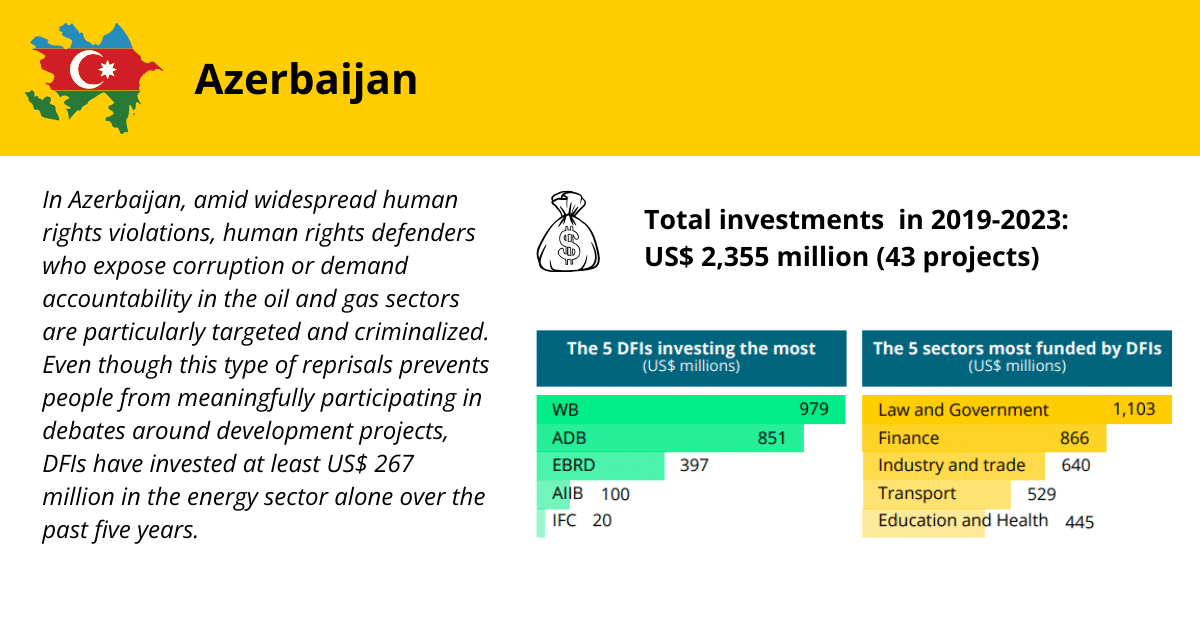
In Azerbaijan, amid widespread human rights violations, human rights defenders who expose corruption or demand accountability in the oil and gas sectors are particularly targeted and criminalized. Even though this type of reprisals prevents people from meaningfully participating in debates around development projects, DFIs have invested at least US$ 267 million in the energy sector alone over the past five years.
Gubad Ibadoghlu is a prominent Azerbaijani economist, scholar, human rights and anti-corruption defender. A former Board Member of the Extractive Industries Transparency Initiative (EITI), he has been exposing corruption in Azerbaijan’s oil and gas sector and advocating for transparency in public revenues. After living more than eight years in exile, in July 2023 Ibadoghlu returned to Azerbaijan to visit his family, but was arbitrarily detained together with his wife. In detention, both suffered ill treatment. While his wife was released hours later, Ibadoghlu was placed in pre-trial detention. The fabricated charges – that could have resulted in a prison sentence of up to 14 years – included accusations of producing, acquiring, or selling counterfeit money and distributing religious extremist materials. After nine months in pre-trial detention, during which he was deprived of critical medical care, Ibadoghlu was placed under house arrest in April 2024.

Gubad Ibadoghlu – Credit: Human Rights House
Numerous human rights organizations and international institutions have called for Ibadoghlu’s immediate release, as his criminalization is widely seen as a retaliation for his human rights work and his critical stance towards the government. Shortly before his arbitrary detention, the defender had published a critical article about the strategic partnership between the EU and Azerbaijan, which aimed to replace Russian gas with Azerbaijani gas. He argued that the EU should leverage this energy deal to demand norms and standards on transparency and accountability, instead of focusing only on securing alternative energy sources.
Ibadoghlu’s demands for greater transparency are critical: Azerbaijan ranks among the most corrupt countries in the world, standing 154th out of 180 in the Transparency International Corruption Perceptions Index.
Ibadoghlu’s arrest is part of a broader crackdown on dissenting voices in Azerbaijan. Independent activists, journalists, union leaders and political opponents are frequently harassed, detained and prosecuted on fabricated charges, and many are forced to leave the country. Before the last presidential election in February 2024, international organizations denounced severe human rights violations, including the incarceration of more than 200 political prisoners. The government also targets relatives of human rights defenders by freezing their assets as a form of collective punishment.
In response to these abuses, the Parliamentary Assembly of the Council of Europe (PACE) refused to ratify the credentials of Azerbaijan’s delegation, citing the government’s failure to uphold the rule of law and protect fundamental freedoms.
In 2017, the board of EITI (a multi-stakeholder initiative promoting accountability and transparency in the extractive sector) suspended Azerbaijan because it “did not fully meet the corrective actions related to civil society space”.

However, development banks such as the World Bank – despite supporting EITI processes – have continued investing in the country. DFIs have also remained silent on the severe barriers hindering the participation of independent civil society in COP29, which will take place in Baku in November 2024, despite supporting efforts in the climate conference.
Why DFIs should care
In Azerbaijan, DFIs have invested at least $2.3 billion over the last five years, with over $267 million directed to the energy sector alone (including, for example, to fund the Southern Gas Corridor).
As illustrated by the case of Ibadoghlu, the high risk of corruption and the repression of dissenting voices poses significant risks and obstacles to the successful implementation of development projects. This repression prevents defenders like Ibadoghlu from providing valuable insights on how to strengthen transparency and accountability, casting a chilling effect over anyone who might otherwise contribute to public discussions on the energy sector.