This blog was written by our Indonesian CRE community collaborator Fatrisia Ain, spokesperson of Buol Plasma Peasants Forum (FPPB).
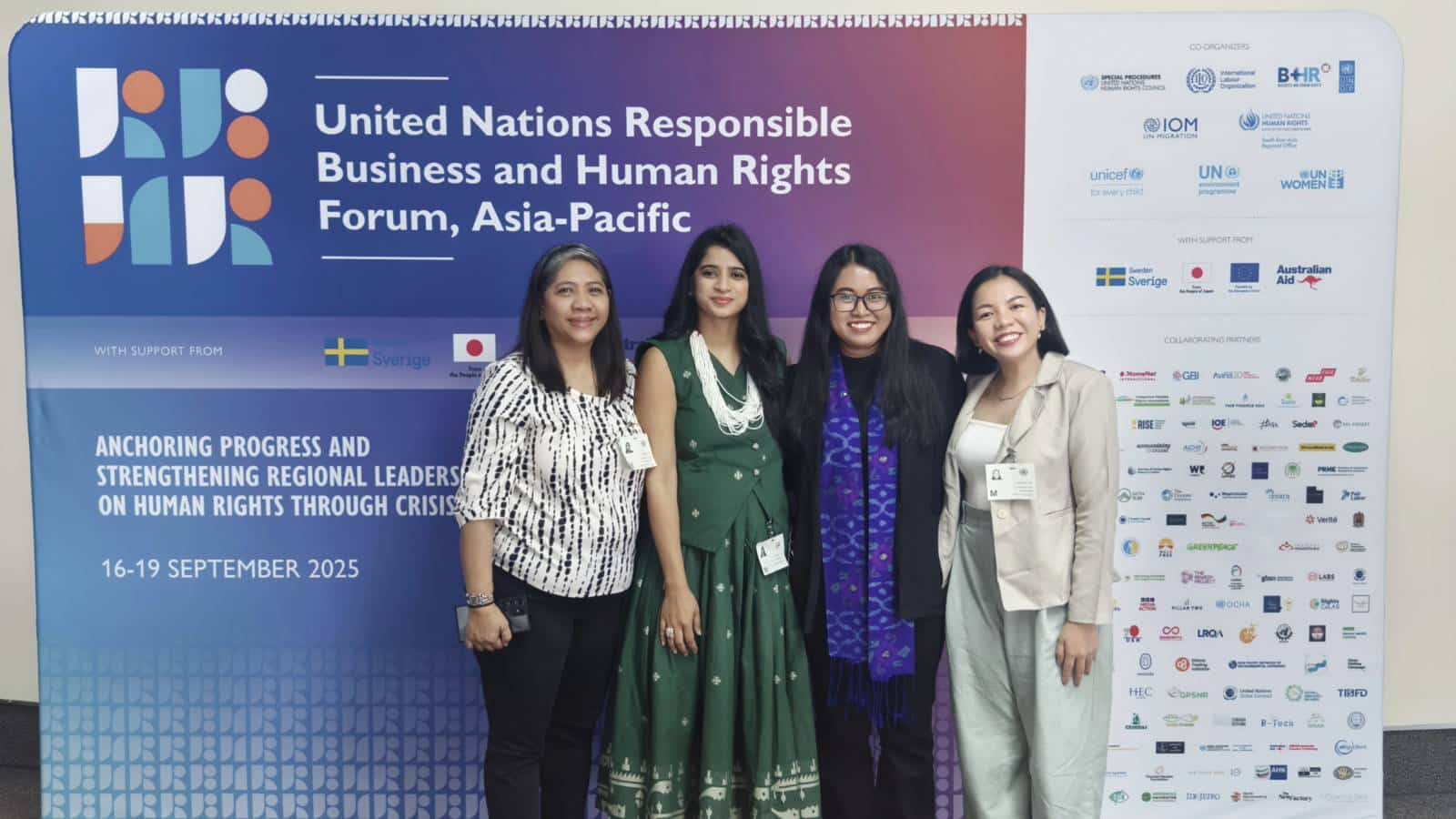
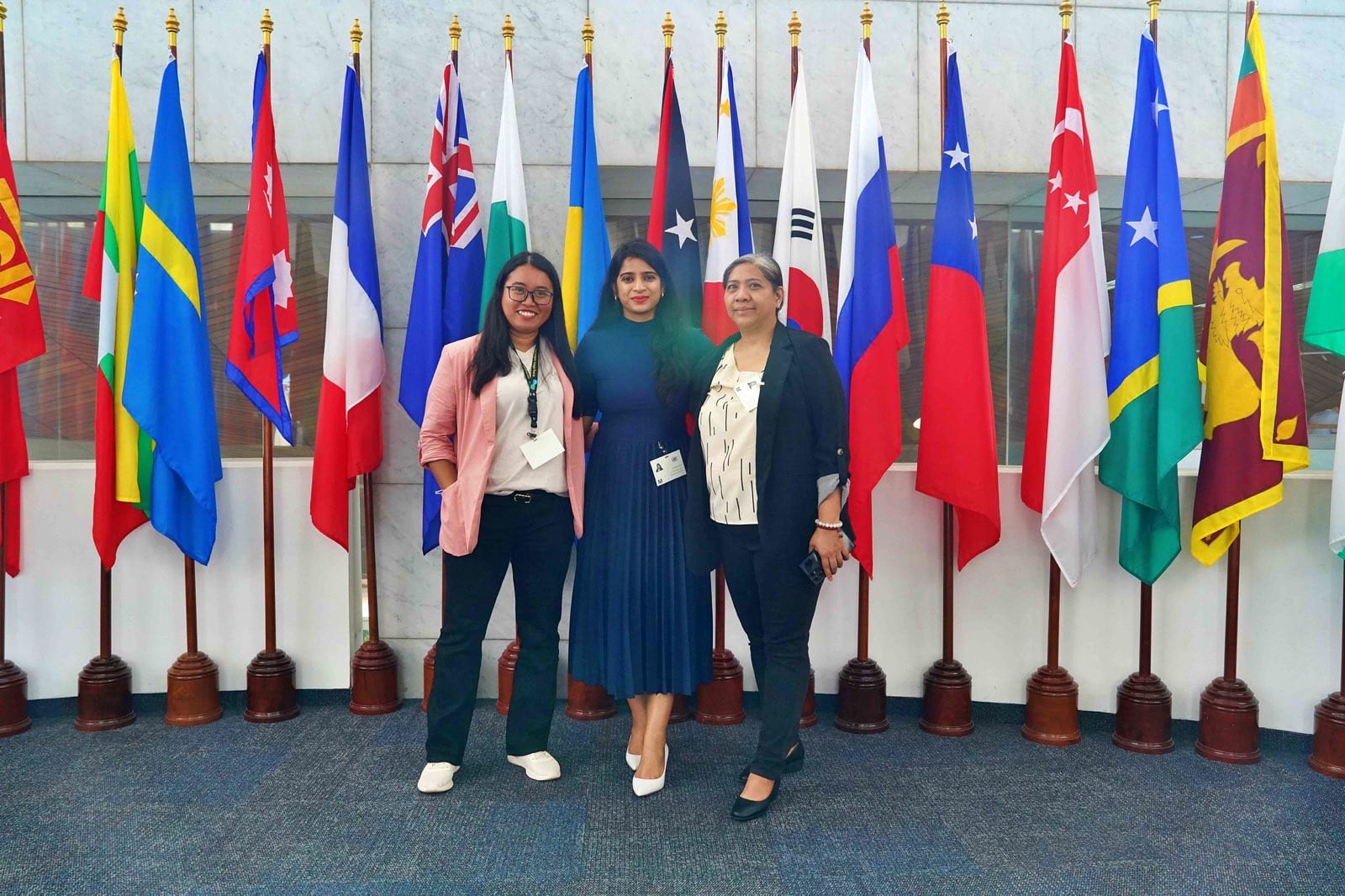
The United Nations Conference Centre (UNCC) in Bangkok was a place my community and I had only ever seen through YouTube videos—until now. This time, I was able to visit it in person to bring the voices of my community, affected by palm oil plantation expansion. Inside the grand building, I saw diplomats, ministers, researchers, and activists from across the Asia-Pacific region moving between sessions. A major theme was displayed on the screen: “Anchoring Progress and Strengthening Regional Leadership on Human Rights through Crisis.” This was the theme of the 2025 United Nations Responsible Business and Human Rights Forum (UN RBHR).
I came from a faraway place—from small villages in Buol, on the island of Sulawesi, Indonesia. I did not come carrying policy documents, but the voices of people who are rarely heard: the voices of farmers, women, youth, and plantation workers whose lives have been changed by unjust development and large-scale business operations.
Read more about Forum Petani Plasma Buol's struggle
 This year’s UN RBHR Forum brought together various parties to explore ways to strengthen respect for human rights in business practices. Coordinated by UN agencies such as ILO, IOM, OHCHR, UNDP, UN Women, UNEP, UNICEF, and the UN Working Group on Business and Human Rights, the forum focused on four major themes—policy and regulation, supply chains, protection, and sustainability.
But behind all the terminology and frameworks, I carried one simple message: No large business can call itself sustainable if rural communities continue to lose their land and their dignity.
The forum was extremely relevant for our community—to learn how frameworks for ensuring and protecting human rights in large-scale business operations are designed and evaluated, and to what extent grassroots rural communities, who are the most affected, are involved in reviewing and improving them.
When the Coalition for Human Rights in Development (CHRD) first informed me about the invitation to attend and speak at this forum, I immediately discussed it with colleagues and community leaders. We looked at each other, confused and in disbelief about what the forum would be like and what could come of it. But we were grateful—deeply grateful—for CHRD’s offer. It was an opportunity we never imagined, given how isolated our community has been from national and even provincial institutions and policies. For three generations, my family and community have suffered land dispossession. We want more people around the world to know that the palm oil–based products they use every day come from the exploitation of our lives in the rural areas where corporate plantations are built.
The responsibility of bringing the voice of our affected community was what instantly washed away my nervousness every time I was about to speak in the UN RBHR conference rooms. That voice matters—because it adds to the collective voices of other affected communities around the world. Ours is the voice of small communities impacted by the expansion of tens of thousands of hectares of palm oil plantations that “feed” the world as its most consumed vegetable oil, while we ourselves must buy the same products at high prices.
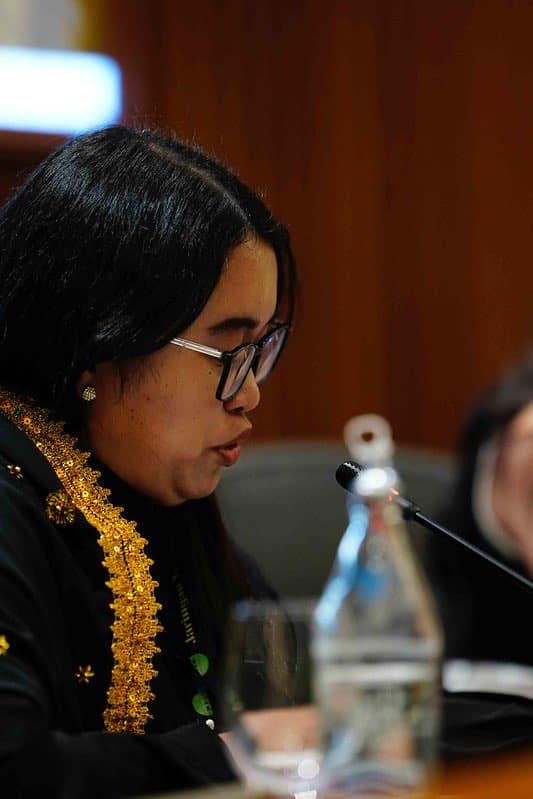
I spoke in two sessions. The first was titled “Regional Leadership in Action: National Action Plans as Pathways to Stronger Standards.” I sat alongside ministers and researchers from four countries. But I did not come with academic, corporate, or diplomatic language. I spoke with a voice born from lived experience as a young woman from an affected community.
“Indigenous peoples, women, migrant workers, and rural communities are the ones who feel the impacts of human rights violations the most. But they are rarely consulted from the beginning. And when consultations do occur, they are often formalities—brief, technical, top-down—and far from the realities of our everyday lives next to extractive corporate projects.”
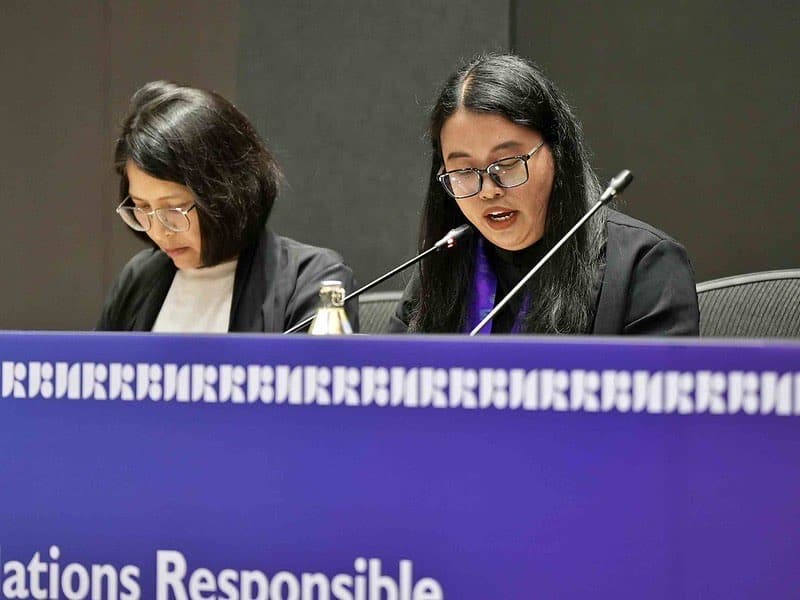 I shared what we experience in Central Sulawesi: land grabbing, environmental destruction, and worsening living conditions brought by expanding palm oil plantations and critical mineral industries such as nickel. National policies such as Presidential Regulation No. 60/2023 on the National Strategy on Business and Human Rights, or the MoU between the Central Sulawesi Provincial Government and the Ministry of Law and Human Rights (April 2025) for human-rights-based agrarian conflict resolution, have not yet offered any real protection. Every time a large business project enters our villages, no Free, Prior, and Informed Consent (FPIC) process is conducted—not even a meaningful consultation—by either corporations or the government that issues the permits.
I said clearly in the forum:
“Frameworks will only be effective if they are created with the communities most affected. Without that, all human rights mechanisms risks becoming administrative—a box-ticking—exercise without offering real protection for affected communities, a thick report while on the ground farmers are still losing lands, workers are still being exploited, and the rural are still facing violences and armed forces during their peaceful protest.”
The room fell silent. Some participants took notes, some nodded slowly. At that moment, I felt our community’s small voice truly reached a wider audience.
A few days later, I spoke again in the session “A Rights-Holder Led Approach to Corporate Accountability: Lessons from Grassroots Movements in India and Indonesia.” I spoke alongside a spokesperson for the Anti-Posco-Jindal Movement in Odisha, India. Though our stories were different, they shared the same thread: grassroots communities resisting the power of large corporations backed by governments and armed forces.
I spoke about the farmers and women in Buol who fight to protect their land, about the Buol Plasma Farmers’ Forum (FPPB) which continuously demands justice, about our community-led efforts to restore our damaged environment, and about the small victories born from collective perseverance.
“We in the rurals see forests vanish, land seized, clean water sources polluted, soil degraded, and many forced to migrate and become manual labourers. But we learned a hard truth: if we wait for the government to act, solutions rarely come. So, we choose collective struggle—small, but strong and genuine.”
From the UN RBHR Forum, I learned many things. That grassroots resilience is the truest form of accountability. That mandatory Human Rights Due Diligence regulations must be legally binding so prevention becomes a priority. That FPIC is not a slogan, but a basic right. And that solidarity across countries—between farmers in Indonesia and communities in India—can create genuine change.
Our movement’s strength does not come from big donor funding, government support, or media attention, but from our commitment to protect our future generations.
But speaking at a global forum is not without risks. I know well that being a human rights defender from a village means being prepared for surveillance, pressure, and even criminalization. In our area, corporate crimes we report are often met with counter-lawsuits using SLAPP, violence, and intimidation. But we also know that silence is surrender—and deepens injustice.
Aside from the official sessions, I used my time in Bangkok for bilateral meetings with leaders of OHCHR, the UN Working Group on BHR, and several UN Special Rapporteurs. I delivered strong criticism: that international human rights mechanisms remain difficult for rural communities to access; that corporate “sustainability” certifications often do not match the reality on the ground; and that armed forces are still used to pressure communities in the name of national strategic projects and national vital objects.
I also emphasized that without firm sanctions against corporations and foreign investors who violate human rights, all accountability principles amount to nothing more than slogans. The UN must intervene more strongly, because even with existing safeguards, remedies for victims on the ground remain extremely difficult.
Through this experience, I learned that local and global struggles are not separate.
What we experience in Buol—agrarian conflicts, environmental exploitation, and power imbalances—is also felt by communities in India, Thailand, and many countries across Asia and the Pacific.
The climate crisis, energy transition, and international trade all connect to one simple question:
Who bears the real cost?
And the answer is always the same—the people at the bottom.
That is why solidarity matters. Support from regional and international networks helps us know we are not alone. From a small village on the island of Sulawesi, our voices now echo onto the global stage.
Attending this forum was a deeply personal and political experience for me. I came to Bangkok as a representative of a rural community, but I returned home with the conviction that our struggle in Buol is part of a global fight for social and environmental justice. True justice always grows from the ground up.
Returning from the forum, I brought this spirit back to my community: strengthening grassroots human rights education, expanding inter-regional solidarity, and ensuring that the voices of rural people are no longer pushed aside.
From Buol to Bangkok, from the village to the world stage—this journey is not about campaigning for a single issue, but about bringing the faces and voices of ordinary people into spaces usually reserved for elites.
My deepest gratitude goes to the RBHR Forum organizers who managed to hold this major event despite a worsening global political situation, and especially to the CHRD team for opening this path for our community.