“We used to live in heaven, but since the company came to our lands we have been living in hell,” says Delima Silalahi, a Batak Toba Indigenous woman leader from North Sumatra, (Indonesia) and executive director of Kelompok Studi dan Pengembangan Prakarsa Masyarakat (KSPPM).
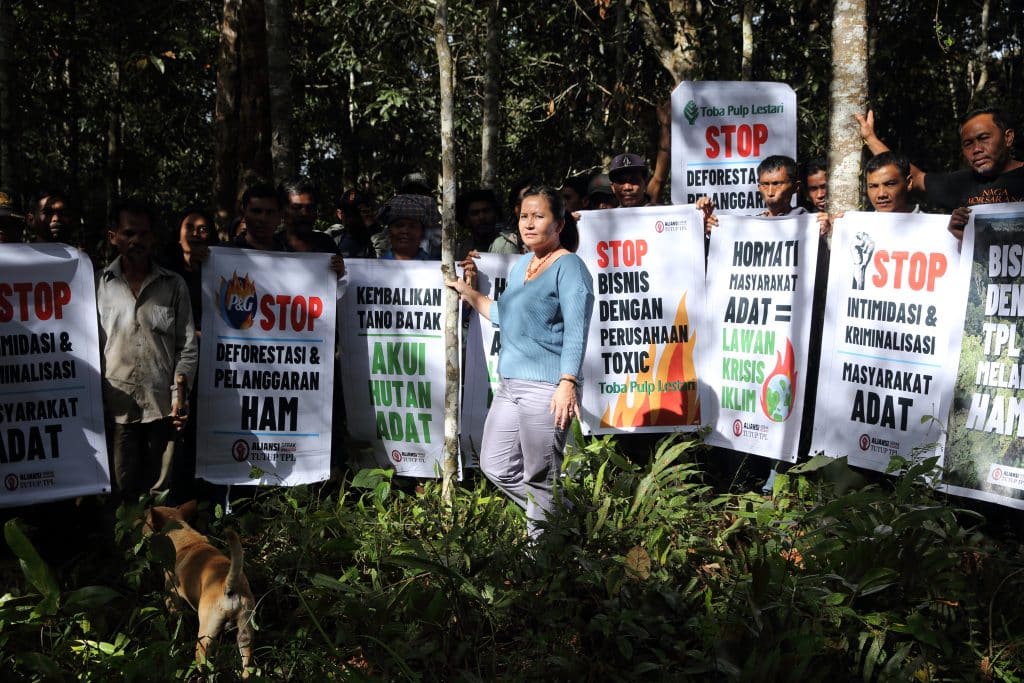
Delima Silalahi during a community protest (Photo: Edward Tigor for the Goldman Environmental Prize)
In the late 1980s, the Indonesian pulp and paper company Toba Pulp Lestari (TPL) started its operations in North Sumatra. According to the international organization Rainforest Action Network, TPL destroyed over 17,000 hectares of natural forest, including the precious Benzoin incense trees, which are crucial for the local economy. Eucalyptus plantations developed by the company led to environmental degradation and impoverished the soil. And the social impacts have been catastrophic: TPL operations have displaced more than 13,000 Indigenous People and jeopardized their livelihoods, disproportionately impacting women and the youth.
Who is behind Toba Pulp Lestari (TPL)?
In principle, Indonesian law protects Indigenous People’s customary land rights. However, the government granted concessions to TPL without their free, prior and informed consent (FPIC). For decades, local Indigenous communities have been struggling to get their land back. Since 2018 – thanks to the powerful advocacy efforts of Delima and other human rights defenders – 11 Indigenous communities have succeeded in gaining customary forest recognition and over 7,000 hectares of land were spared from destruction.
“Recognition of customary land is a key remedy”, says Delima. “In the areas marked as customary forests by the government, Indigenous communities have been able to reforest them with the native benzoin trees”. However, this has been a partial victory: 25 other Indigenous communities are still fighting for the recognition of their customary land and seeking justice for the harm they have suffered.
The right to remedy
The right to remedy is enshrined in international and regional human rights instruments. In particular, Pillar III of the UN Guiding Principles on Business and Human Rights specifies that “as part of their duty to protect against business-related human rights abuse, States must take appropriate steps to ensure, through judicial, administrative, legislative or other appropriate means, that when such abuses occur within their territory and/or jurisdiction those affected have access to effective remedy”.
However, Indigenous communities and defenders say that access to remedy is extremely limited and that existing mechanisms are insufficient. In the rare case where the right to remedy is recognized, it often comes too late, as legal processes (or complaint processes through development banks’ mechanisms) are extremely lengthy and complex.
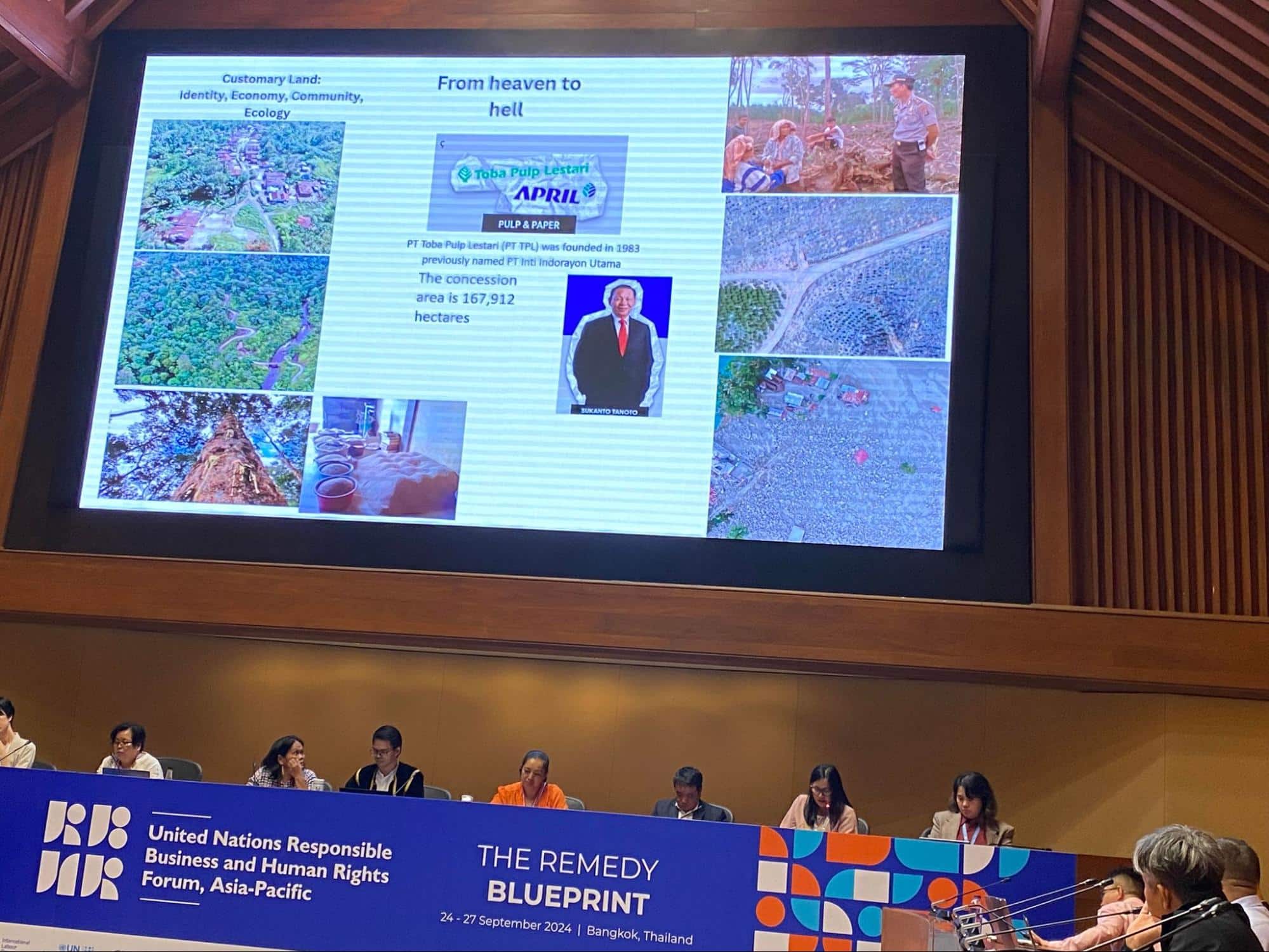
UN Responsible Business and Human Rights Forum (Asia-Pacific), in September 2024
In September 2024, Delima – together with several other Indigenous human rights defenders from Nepal, Philippines and Malaysia – joined a session at the UN Responsible Business and Human Rights Forum in Bangkok, co-hosted by the Community Resource Exchange and several other partners: Asia Indigenous Peoples Pact Foundation (AIPP), Zero Tolerance Initiative (ZTI), Right Energy Partnership (REP), Asia Indigenous People’s Network on Extractive Industries and Energy (APNEE), and Indigenous Peoples Rights International (IPRI). The session, titled “Remedying the Harm: Indigenous Peoples’ Perspectives on Access to Remedies and Justice”, was an opportunity to share perspectives on the current challenges faced by Indigenous Peoples and how effective remedy could look like.
According to the panelists, justice for Indigenous Peoples means recognizing their identity and territory, their right to self-determination, their role as custodians of ancestral domains that are being preserved for the future generations, and their unique traditional knowledge that allows them to “benefit from what nature offers without destroying it”. It means to prioritize their needs rather than the interests of economic elites, to consider them as active subjects rather than objects, and to recognize their traditional justice system as an instrument for dispute resolution.
Apart from the theme of access to remedy, the panelists also focused on the importance of preventing harm before it’s too late. A key issue is that, way too often, projects are being imposed with a top-down approach, without involving Indigenous Peoples in the decision-making processes.
“Free, Prior and Informed Consent is often misunderstood as just a consultation, but what Indigenous people and communities need is to be involved in the decision-making process from the day one to the end of the project”, says Frederic Wilson, Regional Program Officer, Asia Indigenous Peoples Pact (AIPP).
A dangerous environment for human rights defenders
The violation of the Indigenous People’s right to free, prior and informed consent, the absence of a democratic environment, the militarisation of territories where there are development projects, and the criminalisation of Indigenous leaders are some of the key factors that have contributed to restrict the spaces for meaningful participation and dialogue.
“For protecting our land we are labeled as anti-development”, says Delima. “Communities and human rights defenders face false accusations and we are often criminalized, and as a result many are traumatized and silenced”.
As a woman defender, Delima herself has faced many challenges. When together with her team at KSPPM she started mobilizing local communities, she traveled across the different villages to facilitate participatory mapping of the forests, she involved local women to ensure their voices were heard, and organized protests against the paper and pulp company responsible for the destruction of their territories. For doing so, she faced threats and stigmatization.
Across Asia, Indigenous communities and human rights defenders face widespread threats, attacks, and killings for protecting their land and the environment. According to the latest report by Global Witness, in 2023 a total of 25 environmental and land rights defenders were killed in Asia (17 in the Philippines, 5 in India and 3 in Indonesia). Judicial harassment is one of the most common violations: according to Forum Asia, there have been 1,033 incidents between 2021 and 2022.
Most reprisals occur in the context of development projects connected to the global supply chain, in sectors such as agriculture, extractive industries, energy, conservation and tourism. And with the global rush towards the energy transition, Indigenous communities are now facing increased risks of violations.
Indigenous Peoples’ key demands
In the face of these growing violations, Indigenous communities across Asia are advocating for a legally binding human rights system in Asia, that could provide a platform to raise complaints and seek justice. In order to do so, they also need to have the conditions to be able to safely raise concerns and there must be guarantees of non-repetition. This is why they are calling for the suspension or withdrawal of investments in cases of reprisals or harmful impacts on their territories, waters, and resources.
Avoiding and remedying harm is key, but it’s only half of the battle. Across Asia, Indigenous communities are articulating clear and urgent demands around solutions that are shaped and led by Indigenous peoples themselves. For instance, many Indigenous groups are calling for flexible financial and technical support that can empower Indigenous-led climate and energy initiatives. Indigenous communities have preserved their territories and natural resources for generations: they know what’s best for them and for our planet. It’s time to recognize their knowledge, listen to their wisdom, and support them in their struggles for justice and for community-led development.