

International financial institutions have designated billions of dollars to respond to the COVID-19 pandemic. But what has been the impact of the projects and activities they funded? And did these funds really reach those who really needed them most?
Since the beginning of the pandemic, Coalition’s members and our allies have monitored how development banks have mobilized resources around COVID-19, what have been the shortcomings of their response, and the risks faced by human rights defenders raising concerns around the human rights impacts of the pandemic response.
In this page, you can find more around our collective work on these issues.
Missing Receipts
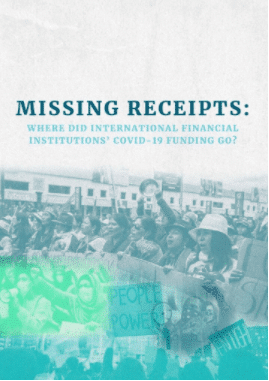 The report “Missing Receipts“, published in January 2022 by members and partners of the Coalition for Human Rights in Development, analyzes the COVID-19 response supported by International Financial Institutions (IFIs). It also identifies concrete recommendations for existing interventions, as well as critical questions for the ongoing pandemic response, the recovery and any future global crisis financing.
“Missing receipts” draws on findings of several case studies and briefing papers produced by Coalition’s members and partners, which are compiled and hosted on this interactive web portal.
PRESS FREEDOM AND COVID-19
Around the world, journalists, bloggers, medical workers, human rights defenders and all those who are raising concerns for the inadequate response to the Covid-19 pandemic are under attack. In an attempt to silence their dissenting voices, they are being accused of spreading false information, smeared, threatened, arrested, and physically attacked.
Development banks have earmarked over US$100 billion for Covid-19-related projects around the world. These banks have committed to respect and implement their social and environmental safeguards and to engage with all stakeholders, including journalists and civil society. However, they are failing to take actions to protect those who are criticizing the emergency response, denouncing corruption scandals, and raising questions around transparency and accountability.
Development banks have played a crucial role in funding and shaping the responses to the pandemic, providing more than 150 billions of dollars. However, they have failed in taking concrete actions to ensure that – in the context of the COVID-19 response they were supporting – people could freely and safely express their opinions and raise their concerns. When cases of retaliations occurred, they stayed silent.
The report “Unhealthy silence: Development banks’ inaction on retaliation during COVID-19 ”, published on July 27, 2021 by the Coalition for Human Rights in Development, ARTICLE 19 and IFEX, presents eight emblematic case studies of reprisals and statistical analysis of 335 cases of people attacked for speaking up around COVID-19 responses. The report also shows how development banks have failed to uphold their own commitments and presents a set of recommendations to address reprisals.


In May 2020, the Coalition published a statement urging development finance institutions to ensure that the funding and support they provide for the Covid-19 response, and during the economic recovery period, upholds human rights and leads to economic justice for those who are most vulnerable.
We see that Covid-19 and the ensuing economic lockdowns are having unequal impacts, hurting already vulnerable communities the most and exacerbating issues around inequality, violence, militarisation, and surveillance. DFIs have committed to contribute billions of dollars as part of the global response to the Covid-19 pandemic. While we recognize that the pandemic necessitates an urgent response, members and community partners of our coalition have concerns about the implications of DFI support and how this money will be spent.
A significant amount of DFI support is going toward governments and other clients with poor human rights records. There are gaps in transparency and accountability. And in many cases the money will go to corporations and banks and may never reach those who are the most vulnerable. At the same time, the focus on combating the spread of Covid-19 has created additional risks and challenges for those standing up for their rights or speaking out against development activities that are harming them and their communities. Thus, Covid-19 is both a test and an opportunity for DFIs to align their policies and practices with laws, policies and standards on human rights and responsible business conduct.
DFIs’ response to Covid-19 should support equitable and universal access to healthcare, food, water and other essential services. This includes avoiding projects that harm the environment, displace people, increase surveillance and militarisation risks, or threaten sustainable livelihoods and food security.
Recognizing that there are real challenges to meaningful consultation and participation due to the pandemic, especially in communities that are worst hit by the crisis, DFIs should take additional steps to support communities’ access to the information, power and resources they need to determine their own development paths. This means DFIs should take steps to plan for the changed environment around reprisals and restricted freedoms, and ensure that their Covid-19 response supports, and does not hamper, communities’ ability to hold DFIs, governments, and other actors accountable, now and into the future.
Download here the full statement in English, French and Spanish.
Download here the press release in English, French and Spanish.