

When communities confront harmful development projects that displace them, pollute their land or threaten their livelihoods, they often struggle to secure remedy and protect their rights. These projects tend to involve a complex web of actors, including public authorities, development finance institutions (DFIs), transnational corporations (TNCs), contractors and investors. Each actor controls part of the project. And when harm occurs, responsibility is often shifted from one to another, leaving communities without solutions.
This is why, at the upcoming African Business and Human Rights Forum (ABHRF) in October 2026, our members and partners will be calling for stronger tools to prevent corporate abuse and secure remedy, including through a legally binding UN Treaty on business and human rights.
What is the African Business and Human Rights Forum?
The fifth ABHRF will take place in Dakar, Senegal, from 29 September to 1 October 2026, bringing together governments, businesses, civil society, trade unions, affected communities and human rights institutions.
This year’s theme is “Realizing the Right to a Clean, Healthy and Sustainable Environment through Responsible Business Conduct.” The programme will address human rights and environmental due diligence, access to water and land, just transition and climate justice, and access to remedy. The Forum will be hybrid, with simultaneous interpretation in English and French, and registration is open.
Although grounded in the UN Guiding Principles on Business and Human Rights (UNGPs), the Forum has also become a space to highlight the limits of voluntary standards and coordinate around the UN Binding Treaty. After the inaugural Forum in 2022, African civil society organisations called for meaningful government participation in the Treaty negotiations, stronger legal frameworks, protection from retaliation, access to remedy, and the primacy of human rights over trade and investment agreements.
The Forum and UN negotiations are separate but politically connected, as the ABHRF allows African organisations to compare experiences, develop common demands and engage the representatives who then negotiate at the UN, giving affected communities an opportunity to influence debates often dominated by governments, corporations and legal experts.
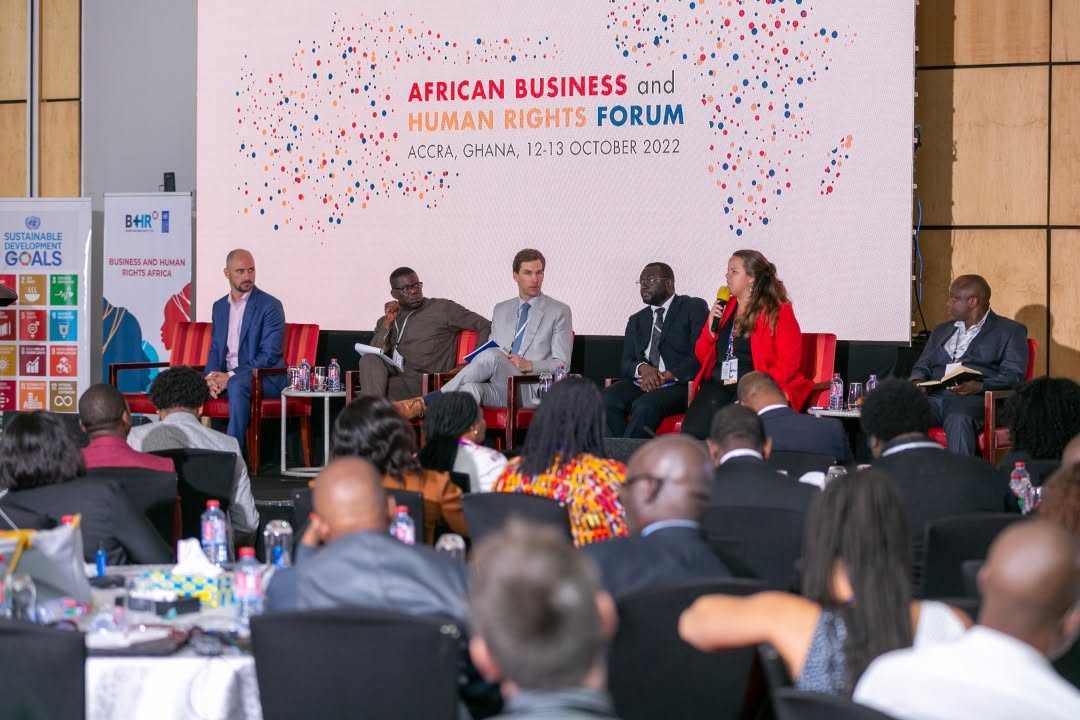
Africa’s role in the UN Treaty process
African states have played a central role in the UN Treaty process from the beginning. In 2014, South Africa and Ecuador led the UN Human Rights Council resolution establishing the intergovernmental working group responsible for negotiating the Treaty.
The African Group at the UN, representing 54 states, has since been among the process’ strongest collective defenders. States including South Africa, Namibia and Egypt have resisted attempts to weaken its mandate and supported progressive provisions on affected people’s rights, access to information and remedy, legal liability, jurisdiction, cross-border cooperation and the duties of states where companies operate and are headquartered.
This leadership reflects the continent’s experience. Africa’s resources and labour are integrated into global systems of investment and production. A company may be headquartered in one country, registered in another, and operate through subsidiaries and contractors elsewhere. Profits and commodities cross borders easily, while communities seeking justice encounter barriers at every stage.
Why a UN Binding Treaty?
Currently, there is no comprehensive, legally binding international instrument governing corporations’ human rights responsibilities. Human rights treaties primarily impose obligations on states, DFIs have their own safeguards and policies, while corporate conduct is governed through an uneven combination of national laws, voluntary standards and company policies.
The UNGPs establish that states must protect human rights, businesses should respect them, and affected people should have access to remedy. However, they create no legally enforceable corporate obligations. Failure to follow them is not, by itself, a legal violation, although the same conduct may violate national law or a state’s existing human rights obligations.
This creates a deep imbalance: corporations and investors are protected through binding contracts, investment treaties and arbitration, while harmed communities frequently depend on voluntary standards, company grievance procedures or inadequate national legal systems.
The proposed UN Treaty aims to prevent corporate abuse, improve remedy and clarify states’ obligations across borders. It could address cases where companies use subsidiaries, joint ventures and contractors while communities must pursue different parts of the same case through separate legal systems.
Negotiations have continued for more than a decade, with the 12th session taking place in Geneva from 12 to 16 October 2026. Progress has been slowed by disagreement and resistance from several powerful capitalist and extractivist economies, and the Treaty’s scope, legal liability, jurisdiction, access to information and the duties of home and host states remain contested.
What does this have to do with DFI accountability?
Although it remains unclear to what extent the proposed Treaty could apply to DFIs, it could strengthen their accountability in several ways. First, it could impose clearer duties on States in relation to the institutions they own, regulate or govern. Secondly, the Treaty could apply to companies, investors, contractors, commercial lenders and other businesses within a DFI-financed project. At a time when the efficacy and independence of DFI’s own accountability mechanisms is coming under increasing scrutiny (see for example the recent crisis at the World Bank), a binding Treaty would give communities alternative routes to seek remedy and protect their rights.
Additionally, the current draft expressly includes financial institutions, investment funds and state-owned enterprises within its definition of business activities. This means that bilateral and national development banks, commercial banks and other financial institutions that are financing projects with transnational impacts across their supply chain could fall within its scope, if the States that own them or where they are registered ratifies the Treaty.
However, the Treaty would not automatically bind multilateral DFIs such as the World Bank, the African Development Bank (AfDB) or the New Development Bank (NDB), even if their shareholders might ratify the Treaty. These institutions have separate international legal personalities, governance structures and, in some jurisdictions, privileges and immunities. Since DFIs are owned by States, they should act as duty bearers within the international human rights system. Yet, at the moment, the larger DFIs do not accept that the international human rights legal system applies to them.
How corporate and financial accountability overlap
The stories of our members and community partners across Africa show us the wide gap between their needs and the current accountability system.
In Cameroon, several DFIs and other investors (including the AfDB, the European Investment Bank and the World Bank Group) funded the Nachtigal hydropower project, a controversial dam that led to loss of livelihoods for fishers and sand miners on the Sanaga River, deforestation, and other harmful impacts. Communities concerned about inadequate consultation, lost livelihoods, compensation and resettlement submitted complaints to the IFC/MIGA’s Compliance Advisor Ombudsman, the World Bank’s Inspection Panel, and the AfDB’s Independent Recourse Mechanism. The three mechanisms coordinated a single dispute-resolution process, resulting in an agreement in May 2024. Yet the agreement remains confidential and under monitoring, and each mechanism could examine only its own institution’s conduct. None could establish enforceable responsibility across the project company, shareholders, financiers and contractors.
The Lesotho Highlands Water Project presents a similar problem. Phase II, including the Polihali Dam and transfer tunnel, is governed by Lesotho and South Africa and financed through the AfDB and NDB, a R5.5 billion loan from the Development Bank of South Africa, commercial banks and public funds. Communities experience one project, but accountability is divided between two governments, a binational authority, several financiers and contractors. The available mechanisms cover only particular institutions, while the NDB has no comparable independent mechanism for affected communities. No single forum can address responsibility or cumulative harm across the whole project.
The situation is even worse in projects where DFIs are not involved. Communities affected by gold mining operations in Mwenga Territory, South Kivu (Democratic Republic of Congo), for example, are reporting displacement, uncompensated land loss, destruction of homes and cultural sites, river pollution, livelihood losses and reprisals against those who resist. The mining operations involve Chinese-capitalised companies working through mining cooperatives and holders of existing rights (such as ORC, Full Trag and Yellow Water Resources). However, without clear information about ownership and finance, communities struggle to identify who can be held responsible and where claims can be brought.
These cases reveal different versions of the same gap. DFI mechanisms can examine only the institutions that created them; several mechanisms may cover fragments of one project; and sometimes no DFI mechanism exists. A strong Treaty could connect responsibility across financiers, shareholders, project companies and contractors, improve corporate disclosure and create routes to legal remedy beyond voluntary institutional processes.
What will we do in Dakar?
The Coalition for Human Rights in Development will attend the AFBHR Forum with several African members, along with our Community Resource Exchange partners from the Democratic Republic of Congo, Cameroon and Lesotho. We will also join regional networks working on corporate accountability, economic justice and tax justice, including the African Coalition for Corporate Accountability, Economic Justice Network and Tax Justice Network Africa, among others.
We will connect community experience with wider African advocacy, examine how corporate structures and project financing interact, and contribute to shared priorities ahead of the next UN negotiating session.
Members and partners can follow the Forum online and register, share cases and advocacy priorities with us, engage through regional networks and monitor their governments’ positions in the Treaty negotiations. Community evidence is essential to debates about access to remedy, corporate structures, reprisals, environmental harm, gendered impacts and responsibility across global supply chains.
The Treaty process can appear distant and highly legalistic. Yet it will shape whether communities can obtain information, identify who is responsible, bring claims across borders and secure remedy. Our work on DFIs has taught us that finance provides one route into accountability. Communities need every available route. The ABHRF and the Binding Treaty process offer an opportunity to confront public finance, corporate power and state responsibility together.
Calendar of events
Tuesday 29 September 2026
- 11:30-12:50 (Hotel Azalai) – CSO Caucus: From Compliance to Reciprocity: Advancing Binding Human Rights and Environmental Due Diligence (mHREDD) Laws in Africa for Climate Justice and Sustainable Development.
Organized by: African Coalition for Corporate Accountability (ACCA); Coalition for Human Rights in Development (CHRD) and Kimberley Process Civil Society Coalition (KPCSC)
- 15:40 – 17:00 (Hotel Azalai) – ABHRF Session: Strengthening Corporate Accountability in the Just Transition: Women’s Leadership, Inclusive Participation, and Remedy Across Indigenous Territories
Organized by: Business and Human Rights Centre, Indigenous Peoples’ Rights International, Pastoralists Indigenous Non-Governmental Organizations Forum (PINGOs Forum), IMPACT Kenya
Wednesday 30 September
- 10:30-11:50 (Hotel Azalai) – ABHFR Session: Upfront company-community agreements as a just alternative to development-forced displacement
Organized by: Inclusive Development International (IDI), OXFAM
Thursday 1 October
- 8:00 – 9:00 (Hotel Azalai) – Who Bears the Burden? Critical Minerals, Energy Access, and the Right to a Clean and Healthy Environment Across Africa
Organized by: DanChurchAid (DCA), Economic Justice Network (EJN) of the Fellowship of Christian Councils in Southern Africa (FOCCISA), SynDev, Centre for Economic and Social Rights (CESR), Tax Justice Network Africa, Stop the Bleeding Campaign (STBC).
- 13:00-14:30 (Hotel Azalai) – ABHRF Session: Energy, Extraction, Harm: How Communities Are Building Accountability?
Organized by: African Coalition for Corporate Accountability, Coalition for Human Rights in Development, Accountability Counsel, Seinoli Legal Centre.