

The #RethinkRekoDiq campaign is coordinated by a group of local and international civil society organizations and individual activists. These include: Human Rights Council of Balochistan, MiningWatch Canada, Recourse, FORUM-ASIA, International Accountability Project and the Defenders in Development campaign. If you want to join the social media campaign, check out this package!
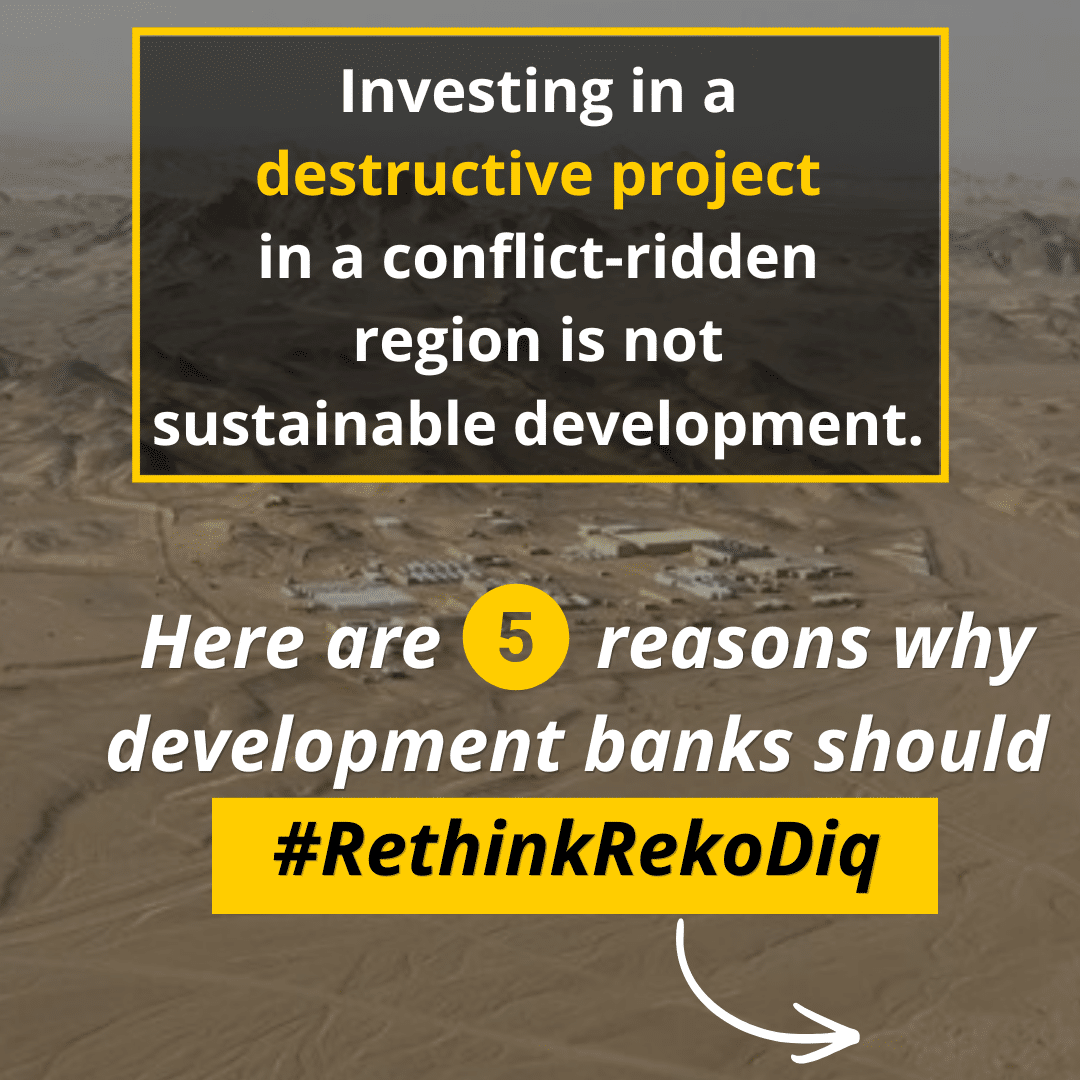
Some of the world’s biggest public development banks — including the International Finance Corporation (IFC) and the Asian Development Bank (ADB) — are backing a destructive copper and gold mining project in Chagai district, Balochistan, a conflict-ridden region in Pakistan.
As copper is a key material for renewable energy technology, the mine is being promoted as a project that will drive the clean energy transition. However, the project is all but sustainable.
Located in an intensely militarised region, where civic space is extremely closed and where reprisals against civil society actors are systematic, the Reko Diq mine risks exacerbating social tensions, attacks against peaceful activists, water scarcity, and severe environmental and social harm.



Useful links
Who is funding Reko Diq?
 The Reko Diq mining project is owned and developed by Reko Diq Mining Company (RDMC), a joint venture owned by the Canadian corporation Barrick Mining (50%), the Pakistan’s federal government (25%), and the Balochistan provincial government (25%).
In 2011, Tethyan Copper Company Pty Limited (TCC) – a joint venture including Barrick Mining Corporation and the Islamic Republic of Pakistan – opened an international arbitration court case, which had slapped a penalty of $11 billion on Pakistan for blocking the planned Reko Diq project and suspending the contracts of the company and its partners. The case was withdrawn in 2022, when a court allowed Barrick to resume the project.
A long list of development finance institutions and export credit agencies have lined up to support the project:
> International Finance Corporation (IFC): In June 2025, the IFC approved a $300 million loan and a subordinated loan of up to $400 million from IFC as the implementing entity of two International Development Association (IDA) financing lines.
> Asian Development Bank (ADB): In August 2025, the ADB approved a $410 million package ($300 million loan to RDMC + $110 million partial credit guarantee to cover the equity component of the Government of Balochistan).
> U.S. Export-Import Bank: in December 2025, it approved a $1.25 billion loan.
According to a RDMC press release and other media, other lenders who have shown interest in the project include:
No space for dissent
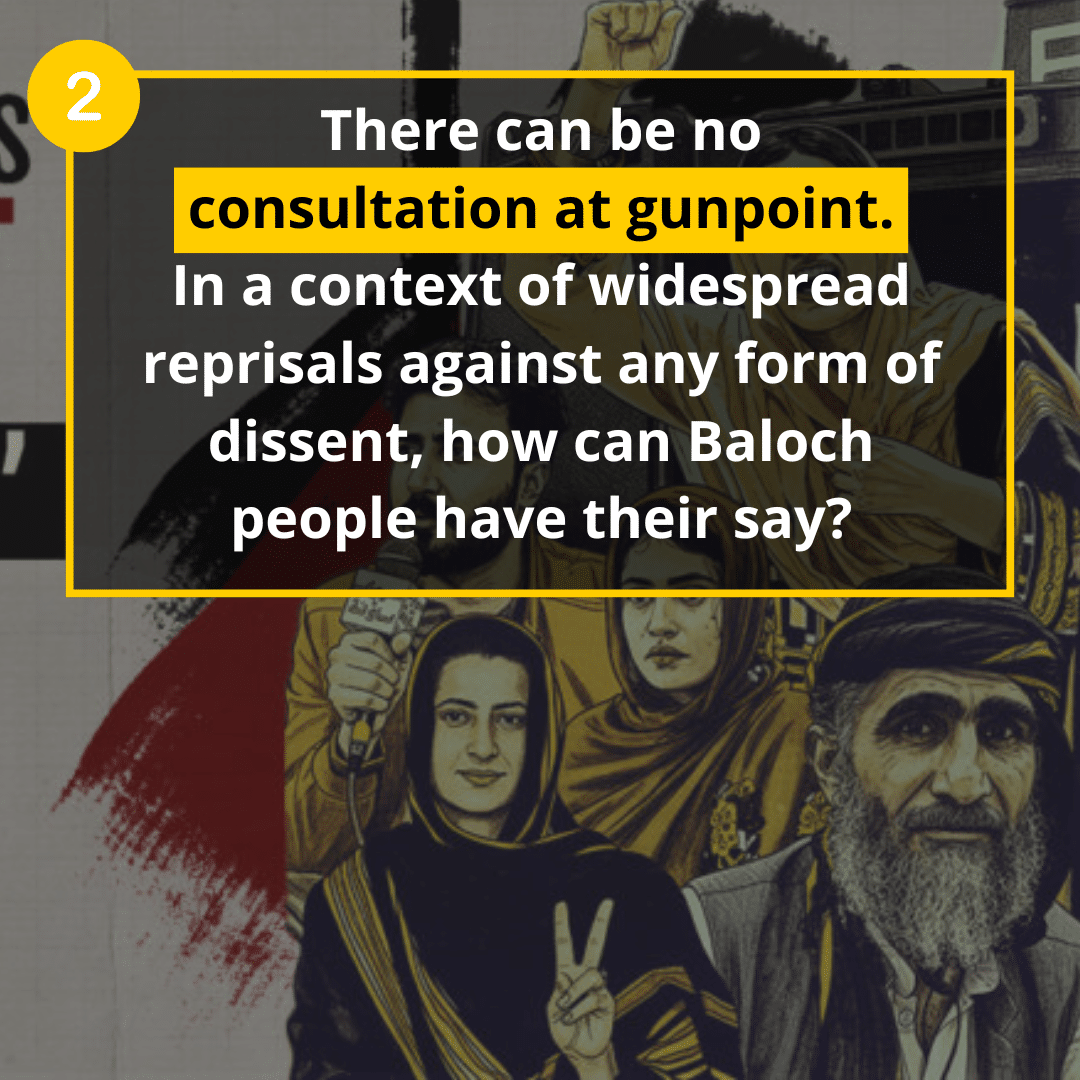
Indigenous Baloch peoples have long asserted their right for self-determination and control over their natural resources. Rather than listening to their legitimate demands and respect their rights, the Pakistani government has responded with heavy political suppression, routine arrests, enforced disappearances and killings.
On 22 June 2026, an Anti-Terrorism Court in Quetta, Pakistan convicted human rights defenders Mahrang Baloch and Sibghatullah Shahji – leaders of the Baloch Yakjehti Committee (BYC) – on charges of “terrorism, sedition, and murder” in connection to a protest organized by the BYC in 2024. BYC is a grassroots movement that has campaigned against enforced disappearances, extrajudicial killings, and ongoing human rights violations in Balochistan. BYC has also been raising concerns around the large-scale development and resource extraction projects in the region, which is often undertaken without the meaningful consultation and consent of the community or adequate environmental and social impact assessments.
In April 2025 alone, the Human Rights Council of Balochistan reported the enforced disappearance of 168 people and the extrajudicial killing of 67 people. This has also been accompanied by a broader crackdown against human rights defenders in the region. UN human rights experts have classified the situation of enforced disappearances as a “serious human rights violation and an international crime”.
Those who have raised concerns about the Reko Diq project previously, such as the Human Rights Council of Balochistan, have seen their members detained, in what UN experts classify as reprisals by state forces.
 Local workers at the site have also faced labour violations. In one documented incident on 20 August 2023, it was reported that four Baloch Indigenous workers were fired by military-owned security guards hired by Barrick without explanation and forced to leave the Reko Diq camp. These young men were left to walk on foot for hours in 39°C heat, posing serious risks to their health and safety.
In such a context, it is virtually impossible for local communities to safely raise opposition to Reko Diq and participate in meaningful consultations, given the pervasive atmosphere of fear and repression across Balochistan.
Furthermore, reports regarding Barrick’s operations in other contexts raise concern about whether this is a company that can be trusted to handle such a sensitive project with the required care. Barrick’s operations have been linked to cases of human rights abuses. At the North Mara Gold Mine in Tanzania, violence by police and private mine security allegedly led to several assaults and deaths, while at the Porgera Gold Mine in Papua New Guinea, security forces employed or contracted by the mine have been accused of abuse and sexual violence. These incidents, among others, raise serious questions about the ability of the company to treat the Reko Diq project with the sensitivity and thoughtfulness it deserves.
Conflict and militarization
 The security situation in Balochistan has deteriorated significantly in recent years, with an increase in large-scale violent incidents affecting transportation networks, public infrastructure, and urban centres across the province. These incidents have resulted in the loss of life, injuries to civilians, and significant disruption to daily life for communities in the region.
At the same time, intensified security operations have also raised serious human rights concerns, with documented patterns and escalating instances of enforced disappearances, arbitrary detention, extrajudicial killings, and other abuses affecting local residents and human rights defenders. Together, these dynamics have contributed to a highly volatile environment that poses risks not only to infrastructure and economic activity but also to the safety, rights, and livelihoods of individuals and communities living in Balochistan.
Last April 2, 2026, Barrick Mining Corporation disclosed that they are slowing down activity and reviewing security risks around the Reko Diq project in Balochistan, Pakistan until mid-2027.
Latest incidents
Recent incidents illustrate the severity of the security challenges.
- In November 2024, a suicide bombing at a railway station in Quetta killed at least two dozen people and injured many more, marking one of the deadliest attacks in the city in recent years.
- In March 2025, armed attackers halted a passenger train after damaging railway tracks and opened fire on the train, leading to a hostage situation and a major military operation. The incident resulted in at least 31 deaths, including soldiers, railway staff and civilians. Soon after, a suicide car bombing struck a convoy transporting security personnel, killing at least seven people and injuring others.
- In May 2025, an explosive attack targeting a school bus killed at least 10 people, including several children, and injured more than 50 others.
- On 31 January 2026, a series of large-scale coordinated attacks across multiple districts, including Quetta and Gwadar, resulted in the deaths of more than 30 people, including civilians and security personnel, and triggered extensive security operations across the province.
Militarization of the project area
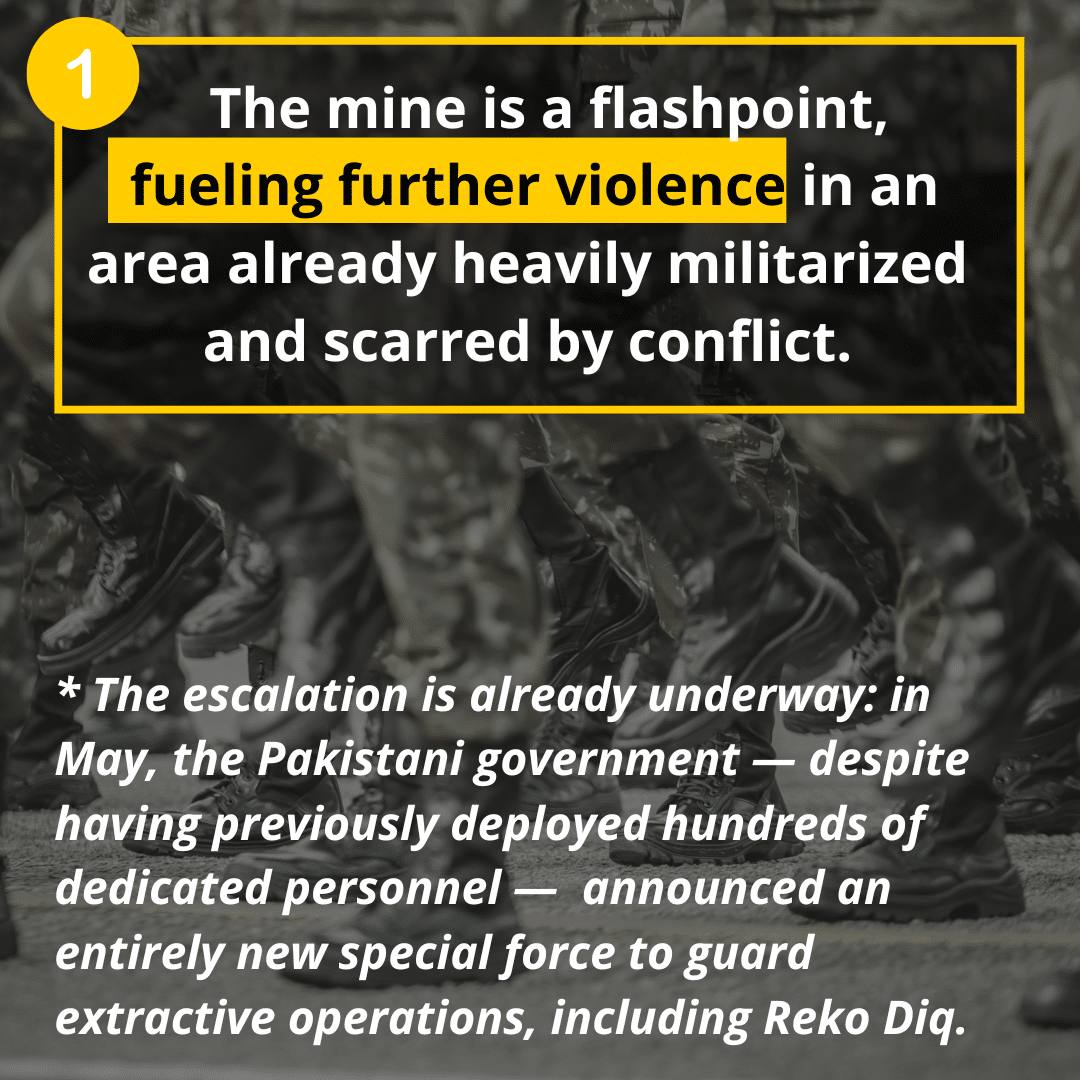
 The Reko Diq project area has been heavily militarized, with both public and private security forces guarding the site. According to the Security Services Framework Agreement, the government has deployed the Frontier Corps Balochistan and Levies (which has been recently merged with the Balochistan Police), while the Reko Diq Mining Company (RDMC) has employed the private services of Askari Guards Limited, which has ties to the Pakistan military.
The RDMC has taken on the responsibility of training and ensuring that security forces adhere to international human rights and security standards, including conducting due diligence when deploying members of the armed forces. However, there are serious concerns about the poor human rights track record of the security forces deployed at the mine.
In February 2025, Barrick Mining reviewed the project’s security arrangements. This entailed allocating a significant amount of money — a total of Rs 1.79 billion (approximately USD 6.4 million) – for the deployment of security around the project site. The government says these funds would support the establishment of a dedicated Frontier Corps to guard borders with Iran and Afghanistan, as well as strengthening its intelligence network in the name of security.
The proposed security arrangement reportedly “aims to safeguard” mineral extraction and investments, thereby further militarizing the region, particularly Chagai, the host district of the Reko Diq project. With the amount of influence and control of the security forces over the project, the local Baloch have raised concerns regarding the militarization of their land. This has already contributed to intensified conflict and unrest, as Baloch movements continue to challenge the control over their territories and resources.
The presence of military and security forces has also contributed to a climate of fear, given the role that the Levies, Police and Frontier Corps have played in arresting, disappearing, and killing Baloch people in order to suppress dissent. Information around attacks, arrests and disappearances against the Baloch people, as well as the location of detention facilities, is rarely disclosed.
Specific security incidents related to the Reko Diq mine
Baloch activists, such as Sabiha Baloch, have warned that it was only a matter of time before armed Baloch insurgents would organise an attack against the project, considering the uptick in violence in the region and the fact that the project was moving forward amidst the opposition of the Baloch community.
- On 30 November 2025, as reported by The Diplomat among others, a suicide bombing coupled with an armed attack targeted a compound housing foreign staff and engineers working for the Saindak and Reko Diq projects in the city of Nokkundi. The Balochistan Liberation Front claimed responsibility for the attack.
- As reported by local media, on two separate occasions over the weekend of 23 November 2025, Pakistani security forces abducted and forcibly disappeared two Reko Diq employees. Both were taken from the company’s vehicles.
The project developer, the Reko Diq Mining Company, informed the ADB that one of the employees was eventually released while the other was put on trial, but that the disappearances were “unrelated to the project and were carried out by a wing of law enforcement outside the project’s Security Framework Agreement.” However, there is no information on where the detained employee is being held, what charges he is facing, and under what conditions the other employee was held. This is extremely concerning, given the well-documented and systematic abuses by Pakistani security forces targeting ethnic Baloch, including arbitrary detention, torture, forced disappearances, and extrajudicial executions. Local and international CSOs are concerned about the detained employee’s conditions and whether his right to a fair trial is being respected.
For Reko Diq Mining Company in particular, questions arise about what it is doing to ensure the safety of Indigenous Baloch employees, and whether they can work without fearing being arbitrarily targeted by the authorities. As one local news report pointed out, the Security Services Framework Agreement between Reko Diq and the Pakistan government entrusted the Balochistan Frontier Corps with “apprehending illegal immigrants and countering terrorist activities, including securing the Reko Diq project.” Local and international human rights organizations reported the Frontier Corps was responsible for most of the abductions in Balochistan, including 56 cases out of 107 enforced disappearances reported by the Human Rights Council of Balochistan in January this year. This clearly indicates a risk for collusion of Reko Diq security with other Pakistani security services targeting the Baloch people.
- On 13 March 2026, Balochistan Liberation Front (BLF) fighters temporarily detained personnel of a “mineral exploration company” at the Wadh area of Chagai, damaged their vehicle and seized their weapon. While the personnel were released safely, BLF has warned that such instances will continue unless mineral exploration and extraction of natural resources in Balochistan is ceased immediately. As mentioned in BLF’s official press release about the incident, if companies do not stop such activities, “they will be responsible for the consequences.”
Violations of the rights of the Baloch
as Indigenous Peoples
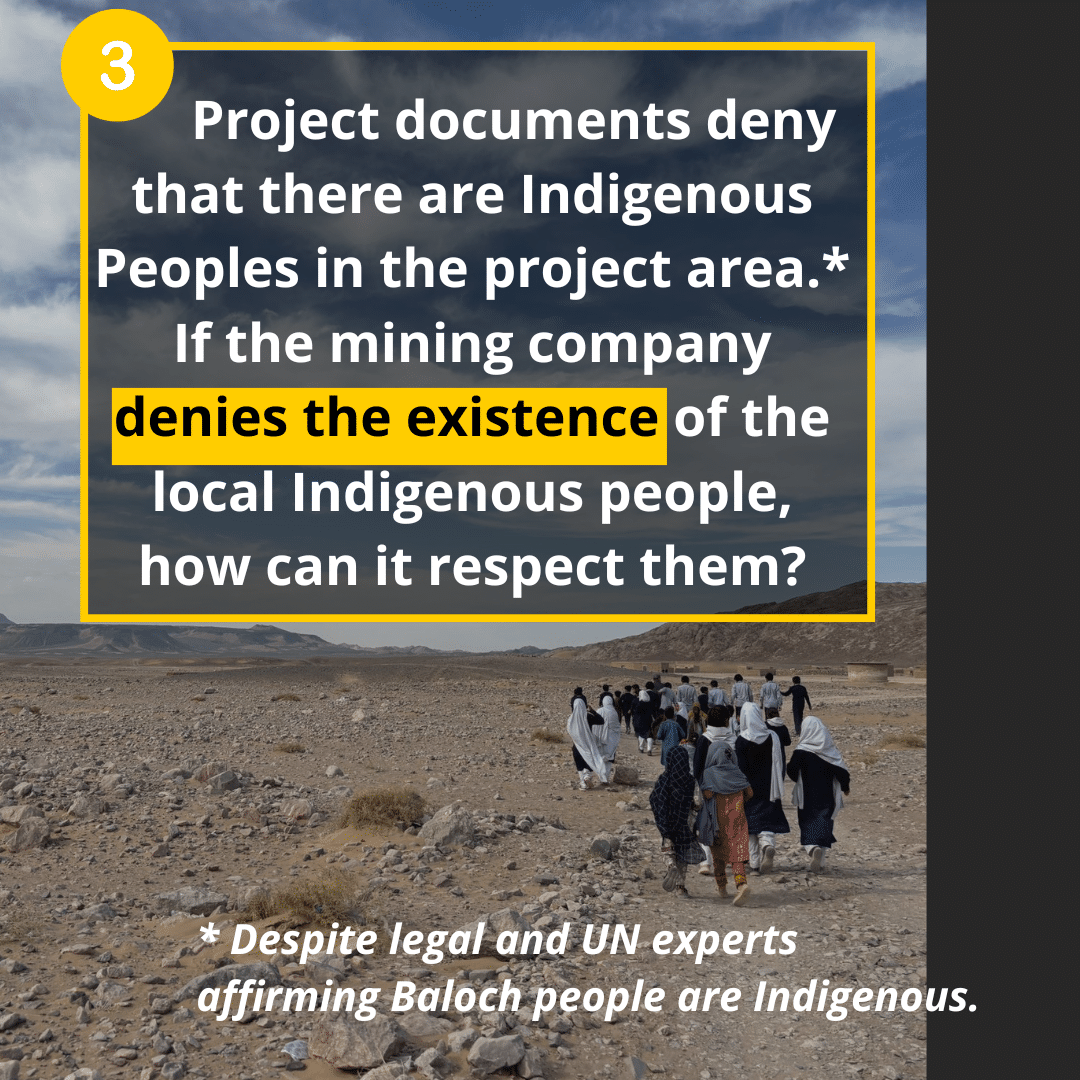
 The Baloch are an Indigenous group living in a region which spans parts of Pakistan, Iran, and Afghanistan. They possess a distinct language and cultural identity, self-identify as Indigenous, have strong ancestral and territorial ties to the region, and maintain their separate and distinct customary institutions. This has been recognised by the Baloch communities themselves, is recognised in case law, and is widely affirmed in international scholarship. UN Special Rapporteurs have also asserted that the Baloch people are Indigenous, based on the Indigenous and Tribal Peoples Convention and the UN Declaration on the Rights of Indigenous Peoples.
However, the Pakistani government, RDMC and the financiers have ignored the presence of the Indigenous Baloch population in the project’s Environmental and Social Impact Assessment (ESIA), which classifies the Baloch people as an “ethnic minority”.
In the context of the Reko Diq mine, the failure to recognize the Baloch as Indigenous Peoples draws into question the adequacy and legitimacy of the project’s impact assessments and consultation processes, particularly with respect to international safeguard standards for Indigenous Peoples on Free, Prior and Informed Consent (FPIC), stakeholder engagement, land rights and cultural heritage.
Promises vs reality: environmental harm under the banner of the just energy transition
 The Reko Diq mine is being framed as a critical project for global clean energy supply chains. The global demand for copper, a key mineral for both renewable energy technologies and military equipment, is rising. Behind Reko Diq, there are high interests at stake: the US is backing the project to secure critical mineral supply chains away from China.
But in a region already facing water stress and ecological fragility, such a large-scale mining project risks deepening water scarcity, pollution, and loss of livelihoods (as highlighted also by Pakistan’s Supreme Court).
Such a large-scale, industrial copper extraction project will likely lead to:
> increased water scarcity or pollution: in an already arid region, the mine’s substantial water use risks depleting or contaminating scarce groundwater sources, undermining crop irrigation and drinking water for animals and people;
> harmful impacts on human and animal’s health (e.g.: increased risk of respiratory illnesses, neurological disorders and other chronic diseases in humans, and poisoning, reduced fertility, stunted growth and increased mortality in animals);
> pollution (the IFC Disclosure page acknowledges that the project will emit significant particulate matter and there are also concerns about outstanding harms from previous attempts to develop the site, including cyanide poisoning);
> loss of livelihoods, particularly for those dependent on pastoralism and small-scale agriculture. The project will require significant land acquisition, which will restrict access to grazing lands and seasonal migration routes critical for livestock herders. Dust emissions can also damage pasture vegetation, reduce crop yields, and contaminate fodder with heavy metals, which in turn can harm animal health and reduce market value for livestock products. These changes will force herders and farmers to alter their way of life, fundamentally impacting their livelihoods, forcing many to find alternatives or migrate.
> increased greenhouse gas emissions and climate change impacts: according to the project documents, Reko Diq will generate “approximately 850,000 tons of carbon dioxide equivalent», because of the direct emissions from the combustion of heavy fuel oil and diesel fuel to power the mine. This will increase Pakistan’s national greenhouse gas emissions and contribute to further exacerbating the country’s vulnerability to climate change.
Recommendations to development banks
The heavy militarization of the project area, the documented pattern of human rights violations in the region, the limited possibility for independent monitoring, and unresolved concerns regarding Indigenous Peoples’ rights raise serious questions about whether the project can be implemented in a manner consistent with international human rights standards and the environmental and social safeguard commitments of its financiers.
In light of these concerns, we urge the development banks involved in, or considering, financing the Reko Diq project – including International Finance Corporation (IFC), the Asian Development Bank (ADB), the United States Export-Import Bank (US EXIM), Export Development Canada (EDC), Germany’s Untied Loan Guarantees (UFK), Sweden’s Export kreditnämnden (EKN) and Japan Bank for International Cooperation (JBIC) – to take the following steps to ensure compliance with their environmental, social, and human rights commitments:
– Suspend disbursement of funds and reconsider financing to the project until key human rights and environmental concerns are independently assessed and addressed: Financiers should ensure that independent and credible environmental and human rights impact assessments are conducted to determine whether the project can proceed without exacerbating harm to local communities and Indigenous peoples.
– Ensure full transparency regarding project financing and safeguard implementation: Financiers should publicly disclose relevant project documentation, including loan agreements, environmental and social monitoring reports, their own due diligence process and agreements governing cooperation with security forces, in order to allow for meaningful public scrutiny and accountability.
– Clarify how the project’s human rights management plan and security arrangements have been adapted to the current security environment in Balochistan: In particular, financiers should provide information on the safeguards and oversight mechanisms in place to ensure that security forces deployed to protect the project operate in accordance with international human rights standards.
– Ensure that project safeguards fully recognize and address the rights of the Baloch people as Indigenous Peoples: Project assessments and safeguard frameworks should be aligned with international standards relating to Indigenous Peoples, including requirements for meaningful consultation and participation in decisions affecting their lands, territories, and resources.
– Provide full transparency regarding the ongoing review and the security arrangements around the project: Financiers should disclose the number and mandate of security personnel deployed in connection with the project, the vetting and oversight mechanisms used to ensure that these personnel have not been implicated in human rights violations, and any financial or logistical support provided by the project to public security forces.
– Establish independent monitoring mechanisms to assess the human rights and environmental impacts of the project: such mechanisms should allow for regular reporting, meaningful engagement with affected communities, and the participation of independent civil society organizations and human rights experts.