

In June 2026, the Coalition for Human Rights in Development conducted in-person research with members and partners in Uganda working on the impacts of the East African Crude Oil Pipeline (EACOP), and how communities are responding. Please note that names marked with an asterisk are pseudonyms used to protect participants’ identities.
This series starts with a blog written by our Research and Learning Facilitator Charlize Tomaselli, with an overview of EACOP and its impacts. In the next blogs, we will feature the collaborative network of community organisations and NGOs responding to them, and the livelihood projects through which communities are rebuilding food security, income and collective power.
Martha* first heard about the proposed oil refinery as a rumour. Her husband attended the meetings, but women were excluded and their husbands did not tell them what had been discussed. Then officials arrived and told her that the land on which she and her neighbours lived belonged to the government. Farming stopped. The school and market closed. Some families left; others remained behind.
Martha’s family eventually received a new house and agricultural land in the resettlement village. The new property looked like compensation, but it could not sustain the life they had built before. The land was less productive, and the family lost the crops and fruit trees from which Martha had earned money. Less than a year after the move, her husband died. She was left supporting her family from a poorer farm, in a house connected to the grid but without enough income to use the electricity regularly.
Martha responded by organising with other displaced women. Together, they began rebuilding small parts of the food, income and mutual support that resettlement had taken apart.
In western Uganda, an oil industry is being built across farmland, fishing grounds, villages and one of the country’s most important protected landscapes. Wells are being drilled around Lake Albert. Roads, pipelines and processing facilities now cut through areas where most families have long depended on farming, fishing, livestock and the resources they share with neighbours and relatives. A 1,443-kilometre heated pipeline will carry the crude from Hoima, across the border into Tanzania, and onwards to the port of Tanga.
Uganda’s emerging oil corridor includes the Tilenga oilfields, operated by TotalEnergies; the Kingfisher development, operated by the China National Offshore Oil Corporation (CNOOC); a network of well pads, feeder pipelines and central processing facilities; the proposed Hoima refinery; and the East African Crude Oil Pipeline (EACOP).
The projects are promoted as the foundation of Uganda’s economic transformation. Oil revenue, the government argues, will finance infrastructure, create jobs and help move the country from a predominantly agrarian economy towards industrialisation. The pipeline has the capacity to carry up to 246,000 barrels of crude each day to the international market. Up to 60,000 barrels could eventually be processed at the proposed refinery in Hoima. Those ambitions have real force in a country where public services remain underfunded and many people still lack reliable electricity, clean cooking, decent roads and secure employment.
Yet the oil corridor is principally an extraction and export system. The refinery has not reached a final investment decision and will not be operating when oil production begins. During the early years, almost all commercially produced crude is therefore expected to leave Uganda.
For communities in Hoima and Buliisa, the promised national future has arrived first as a demand for land that they are expected to supply without compensation. Long before the first barrel travels through EACOP, oil development has already altered who controls land, what families can produce and what the next generation will inherit. Any honest assessment of Uganda’s oil future must begin there.

Source: Petroleum Authority of Uganda
One oil corridor, many corporate and financial actors
Tilenga is operated by TotalEnergies, while CNOOC operates Kingfisher on the south-eastern shore of Lake Albert. EACOP Ltd is owned by TotalEnergies (62%), Uganda’s state-owned Uganda National Oil Company (15%), the Tanzania Petroleum Development Corporation (15%) and CNOOC (8%). The corridor depends upon much more than the companies drilling the wells. Governments provide licences, land and political backing. Contractors build roads, camps and processing infrastructure. Banks, insurers and export credit agencies make projects of this size possible by supplying loans, guarantees and protection against risk.
That financial architecture has become highly contested. Ugandan organisations, affected communities and the international Stop EACOP campaign have taken evidence of land loss, inadequate compensation, environmental damage and restrictions on civic space directly to prospective financiers. By February 2026, 43 banks and 30 insurers had publicly ruled out support for EACOP. The project nevertheless secured a first tranche of external finance in March 2025 from a group including Afreximbank, Standard Bank, Stanbic Bank Uganda, KCB Bank Uganda and the Islamic Corporation for the Development of the Private Sector.
The controversy over finance is important because it makes responsibility harder to contain within the project site. The oil corridor is being constructed in Uganda and Tanzania, but decisions that determine whether it can proceed are made in corporate headquarters and financial institutions far beyond the communities carrying its costs.
A forced choice after the decision was made
When land was acquired for oil infrastructure in Hoima, affected families were channelled into one of two routes: physical resettlement or cash compensation. The company itself describes the process as providing monetary compensation and/or compensation in kind. Households displaced for processing and related infrastructure were concentrated in a resettlement village. Along the pipeline route, cash payments were more common.
On paper, this appeared to offer a choice. Physical resettlement promised a replacement house, agricultural land and access to services. Cash compensation appeared to give families greater control over where they moved and what they rebuilt.
In practice, both options eroded communities resources, savings and security. They had no say in where they had to go, how much their land and assets were worth or what the replacements on offer looked like. Like many development projects, the only choice was how to absorb the loss, not whether the loss should occur.
Elias*, a farmer from Hoima, was displaced twice by Uganda’s oil developments. His original farm was acquired for the proposed refinery. He used the meagre compensation to relocate and purchase new land, only to learn that this property would soon also be affected, this time by pipeline infrastructure.
Once the new land had been assessed, Elias was told not to plant perennial crops or make other improvements. Anything added after the assessment could be treated as an attempt to inflate the value of his assets. He therefore had to wait for compensation without being able to use the land fully. The payment took more than three years to arrive.
During that time, Elias had little income from farming but still had to cover the costs of the initial relocation and his family’s daily needs. He borrowed to survive. By the time the compensation arrived, much of it was already owed to creditors, leaving him with too little to rebuild his livelihood again.
Elias had previously farmed approximately six hectares. His second farm was reduced to two hectares. After paying his debts and trying to buy land in an area where oil development had driven up prices, he could afford only one acre (0,404 hectares). When he challenged the valuations, they were told that their customary ownership gave them no power to negotiate. “The price is set by the government,” he recalled.
The valuation of productive trees showed how little the payment reflected what the land had provided. Residents explained that a mature jackfruit tree could generate around 50,000 Ugandan shillings (12 USD) each year through fruit sales, yet whole trees were valued at only 10,000 shillings (2.5 USD). For context, at the time of writing, a meal in a restaurant cost around 30,000 shillings. Compensation recorded the tree as a single asset. It did not account for the income it would have produced year after year.
For the group who were resettled, the project replaced some of the most visible assets. Families received new houses, connected to water and electricity grids. But a homestead is more than a structure. Before displacement, several generations could live on the same land in separate buildings. Families kept livestock, planted near their homes and accommodated relatives as circumstances changed. Farming, childcare and domestic work took place within one connected space.
The resettlement village compressed these arrangements into standardised houses on much smaller, closely packed urban plots. Agricultural land was separated long distances from the home. Families described poorer soils, no access to irrigation, more travel between fields and houses and the resulting weaker harvests. Relatives and neighbours were placed in a new spatial arrangement forcing people used to living in a rural environment into a tightly packed urban one. A larger, more ‘modern’ house made life considerably smaller.
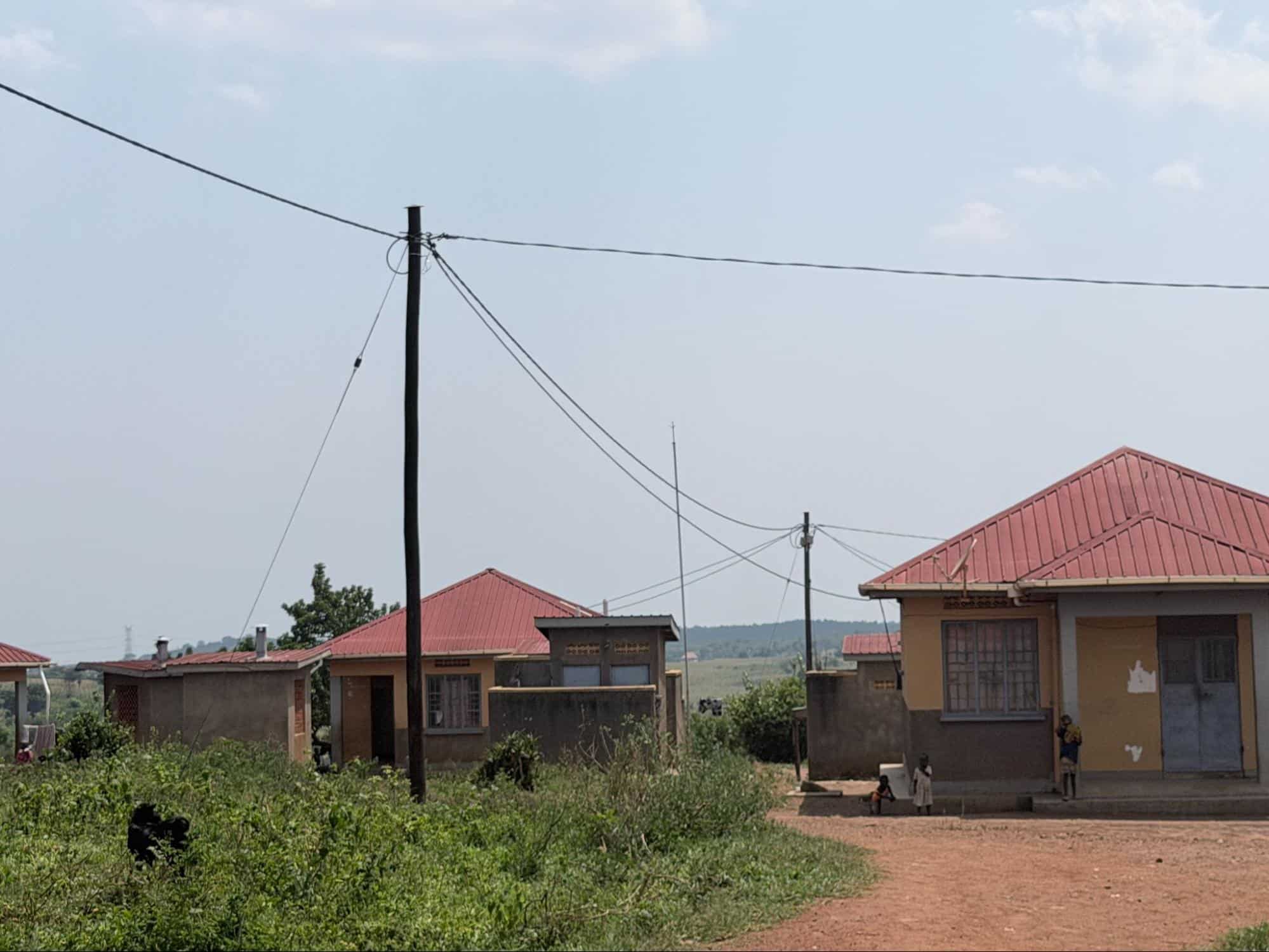 Kyakaboda Resettlement Camp. Credit: Charlize Tomaselli
The impacts travel through the household
Across both routes, the central economic change was the same. Families retained less capacity to produce what they needed and became more dependent on cash at precisely the moment their means of earning it had weakened. Food once harvested at home became a daily expense. Families with too little land had to rent additional fields. Water and firewood became harder to obtain. Livestock could no longer be kept at the same scale. School fees became more difficult to meet, and interrupted education narrowed young people’s access to the skilled jobs promised by the oil economy.
These impacts were not evenly shared. Research on EACOP’s gendered impacts has shown how women’s limited formal ownership of land can exclude them from compensation and decision-making even when they depend upon that land for food and income. A payment to one male titleholder could extinguish the practical rights of a wife, children and relatives. Women then absorbed the consequences through the work of finding food, collecting water and fuel, caring for children and holding households together with fewer resources.
For Aggi*, who lived near the pipeline, this exclusion happened within her own family. Before the refinery acquisition, she cultivated several plots on her father’s land without paying rent. When the property was acquired, the compensation was paid directly to her father. The daughters who had depended on the land received nothing. Patriarchal systems mean that money is not shared with women. She now has to rent a third of an acre to continue farming and sometimes cannot afford to do so.
Whenever she sees another community being affected, she said, it reminds her of what her own family lost. Government officials had promised that the development would bring benefits. Her daily experience was different: less land, less security and an ongoing struggle to produce food. She kept returning to one question: “Why did they lie to us at the start?”
Communities are reconnecting
what the projects divide

Ugandan human rights defender Aryampa Brighton with his colleagues from Youth for Green Communities (YGC) during a awareness raising activity with communities affected by the EACOP pipeline. Credit: YGC
The oil corridor is administered as separate projects, each with its own documents, contractors, grievance procedures and lists of affected people. Project documents, for example, divide affected households across 17 separate Resettlement Action Plans for EACOP alone. Communities have responded by rebuilding the connections this system obscures.
Local organisations including the Oil Refinery Residents Association (ORRA), EACOP Host Communities, Youth for Green Communities (YGC), the Buliisa Initiative for Rural Development Organisation (BIRUDO), Witness Radio, the Africa Institute for Energy Governance and the Centre for Environmental Research and Agriculture Innovations work directly with affected households. Together, these groups are mobilizing through community organising, rights education, documentation, media work, petitions, litigation, protest and advocacy aimed at governments, companies and financiers. This work has taken place amid documented arrests, surveillance, intimidation and restrictions on oil-sector activism.
As we will explore in the next blog of this series, communities are also building practical responses to the loss of land and income. Women’s savings groups provide loans for school fees, healthcare and emergencies. Collective farms, seedling nurseries, beekeeping, poultry, livestock, fishponds and fruit production replace some food and income. Clean-cooking, biogas and solar initiatives respond to the contradiction of communities hosting an enormous energy project while struggling to obtain affordable energy for daily life. These projects do more than generate small amounts of income. They rebuild relationships disrupted by displacement and create spaces where people can compare experiences that were previously treated as individual grievances. They help families survive and make continued organising possible.