

About the project
In the late 1980s, the Indonesian pulp and paper company Toba Pulp Lestari (TPL) started its operations in North Sumatra. According to the international organization Rainforest Action Network, TPL destroyed over 17,000 hectares of natural forest, including the precious Benzoin incense trees, which are crucial for the local economy. Eucalyptus plantations developed by the company led to environmental degradation and impoverished the soil. And the social impacts have been catastrophic: TPL operations have displaced more than 13,000 Indigenous People and jeopardized their livelihoods, disproportionately impacting women and the youth.
As documented by Rainforest Action Network, TPL is owned by Singapore-based Pinnacle Company Limited but controlled by the Tanoto family of the Royal Golden Eagle group, a company that operates numerous shadow companies that are driving deforestation across Indonesia. The supply chain involves corporations such as Procter & Gamble, Mondelēz, Colgate-Palmolive, Unilever, Kao, PepsiCo, Nestlé and Nissin Foods and banks like Mitsubishi UFJ Financial Group (MUFG).
In principle, Indonesian law protects Indigenous People’s customary land rights. However, the government granted concessions to TPL without their free, prior and informed consent (FPIC).
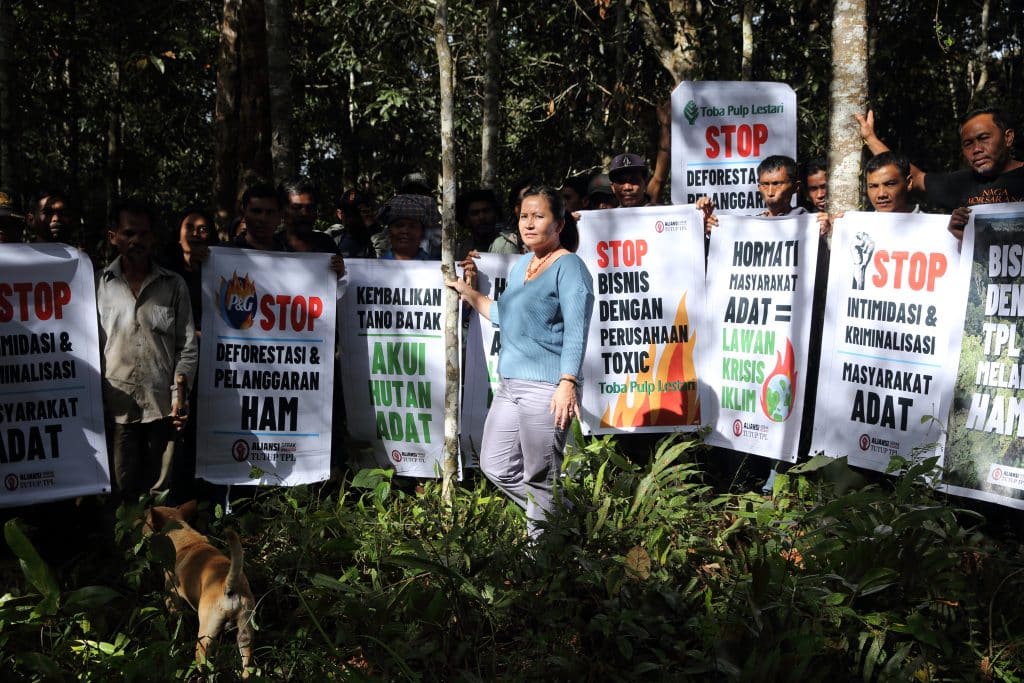 Delima Silalahi during a community protest (Photo: Edward Tigor for the Goldman Environmental Prize)
About the community-led struggle
Thanks to the powerful advocacy efforts of Delima and other human rights defenders, 11 Indigenous communities so far have succeeded in gaining customary forest recognition and over 7,000 hectares of land have been spared from destruction.
“Recognition of customary land is a key remedy”, says Delima. “In the areas marked as customary forests by the government, Indigenous communities have been able to reforest them with the native benzoin trees. However, this has been a partial victory: 25 other Indigenous communities are still fighting for the recognition of their customary land and seeking justice for the harm they have suffered. »
In 2013, a landmark constitutional court ruling confirmed that customary forests are not state forests, opening a key opportunity for Indigenous communities to reclaim legal stewardship of their traditional forest territories. After this ruling, Delima and her team at KSPPM began organising to claim their traditional forests and protect them from the ruthless exploitation of companies such as Toba Pulp Lestari.
Travelling from village to village, Delima started mobilizing communities, educating them about their right, and promoting gender education to ensure that also women would be included in decision-making processes and their voices could be heard. KSPPM also facilitated participatory mapping of the forests, supporting each community to document their customary territories. They also organized protests and held advocacy meetings, including a meeting between community members and the Minister of Environment and Forestry
In February 2022, thanks to these collective efforts, the Indonesian government finally granted six Tano Batak communities legal stewardship of 17,824 acres of their customary forests. Since then, these communities started reforesting the area with native species (such as benzoin trees). This restoration of the original ecosystem is boosting the forests’ tree cover, natural climate resilience and biodiversity.
Behind this successful struggle there have also been many challenges. When together with her team at KSPPM she started mobilizing local communities, she traveled across the different villages to facilitate participatory mapping of the forests, she involved local women to ensure their voices were heard, and organized protests against the paper and pulp company responsible for the destruction of their territories. For doing so, she faced threats and stigmatization.
“For protecting our land we are labeled as anti-development”, says Delima. “Communities and human rights defenders face false accusations and we are often criminalized, and as a result many are traumatized and silenced”.
Further resources
- Can there be a fair remedy for the harm inflicted on Indigenous Peoples?
- On the company Toba Pulp Lestari and the actors behind it
- Activists call out ‘one of the worst actors in pulp and paper’
- Toba Pulp Lestari: In depth on one of the worst actors in pulp and paper
- Indigenous peoples in Indonesia
- 2023 Goldman environmental prize winner Delima Silalahi
- Defending in Numbers 2021-2022