



On May 2-5, the Asian Development Bank held its 57th Annual Meeting in Tbilisi, Georgia. With the theme “Bridge to the Future”, the bank aimed to tackle solutions to the world’s pressing problems of food security, climate change, poverty, and widening inequalities. These discussions were taking place just meters away from the Parliament, where tens of hundreds of Georgian people were gathering to protest against the “foreign influence” bill and to denounce a crackdown on their civil liberties and freedoms.
ADB, heed our calls!
Given this background, one resounding call from civil society was the need for the bank to adequately respond to the continuous worsening and shrinking of civic space, and the threat it poses to development. Despite the loud calls from inside and outside the halls of the Annual Meeting, the bank kept repeating it is “monitoring” the situation, but cannot comment on it as it is a “political matter”.
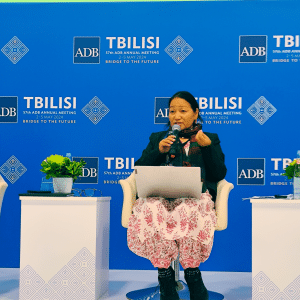
Adv Indira (INWOLAG, Nepal) at the ADB Annual Meetings, May 2024. Credit: NGO Forum on ADB
The ADB is falling short of its commitments. It is actively choosing to overlook how repressive laws in their client countries will negatively impact their operations and undermine their commitment to meaningful stakeholder engagement. Kyrgyz civil society had already raised this point in the past months, as their government passed a similar foreign representatives law in April. The ADB, along with other multilateral development banks, need to acknowledge that promoting human rights and providing an enabling environment will avoid risks and create more effective projects, a case also made by the bank’s former General Counsel Christopher Stephens.
When civic space is limited and freedoms are threatened, the bank’s operations are endangered and risk resulting in further harm to the communities and environment. The upcoming Environmental and Social Framework (ESF), that serves as an update to the Safeguards Policy, cannot be properly implemented if impacted communities will not be able to safely speak out. The NGO Forum on ADB has repeatedly called on the bank to adopt the highest standards in its safeguards to protect people and the planet. And in an action during the Annual Meetings, the Forum took the stage to reject the dismantling of the bank’s safeguards.
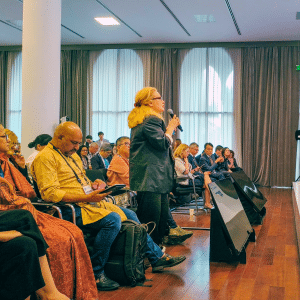
Manana Kochladze (Green Alternative/Bankwatch, Georgia) at the ADB Annual Meetings, May 2024. Credit: NGO Forum on ADB
Likewise, the ADB’s Accountability Mechanism – which is currently under review – will fail its mandate if there is a climate of fear that pervades communities and civil society. The closing of civic space will allow for more cases of reprisals against those who bravely speak out and will have reverberating impacts on development outcomes of projects. This contributes to the failure of the bank to be responsible for its actions and to learn from its mistakes, as impacted communities shoulder the burden with no remedy in place.
Given that the ADB is ushering in a new phase of its operations, with the evolution roadmap and its new ways of working, the bank is at a crossroads. It can take the business as usual approach, which can put frontline communities further at risk. Alternatively, the bank could take a solid stance against the shrinking civic space in the region, adopt stronger safeguards, build a robust accountability mechanism, and pursue projects that uphold rights, protect the environment and put people at the center, advancing the development that communities want.
ADB, this is the development we want!
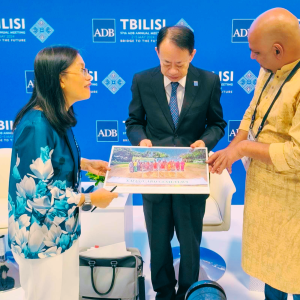
Hasan Mehedi (CLEAN, Bangladesh) at the ADB Annual Meetings, May 2024. Credit: NGO Forum on ADB
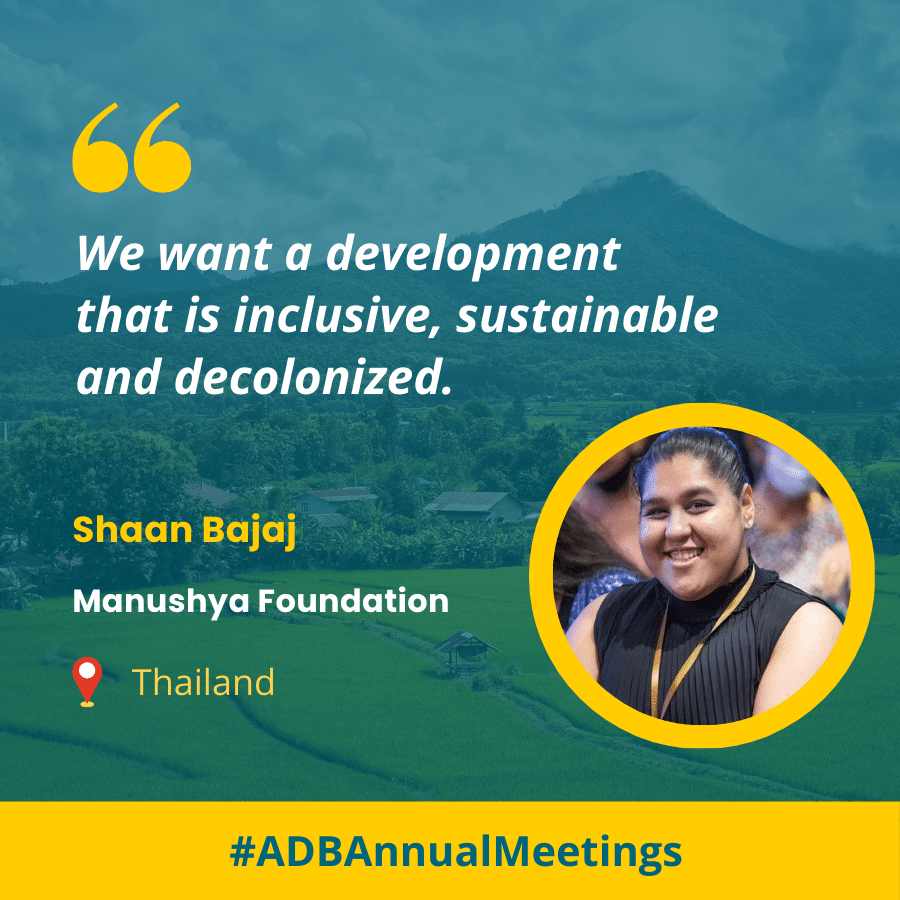
Peoples in the Asia-Pacific continue to call for a development that is “inclusive, sustainable and decolonized,” as encapsulated by Shaan Bajaj of Manushya Foundation.
Civil society organizations in Georgia, who are facing threats to their freedoms, envision a development that “does not label CSOs and independent media as foreign influencers, but instead values their work in forwarding the rights of disadvantaged groups, farmers, small landowners, workers, and women, and ensures their meaningful participation in development activities,” as Manana Kochladze of CEE Bankwatch says.
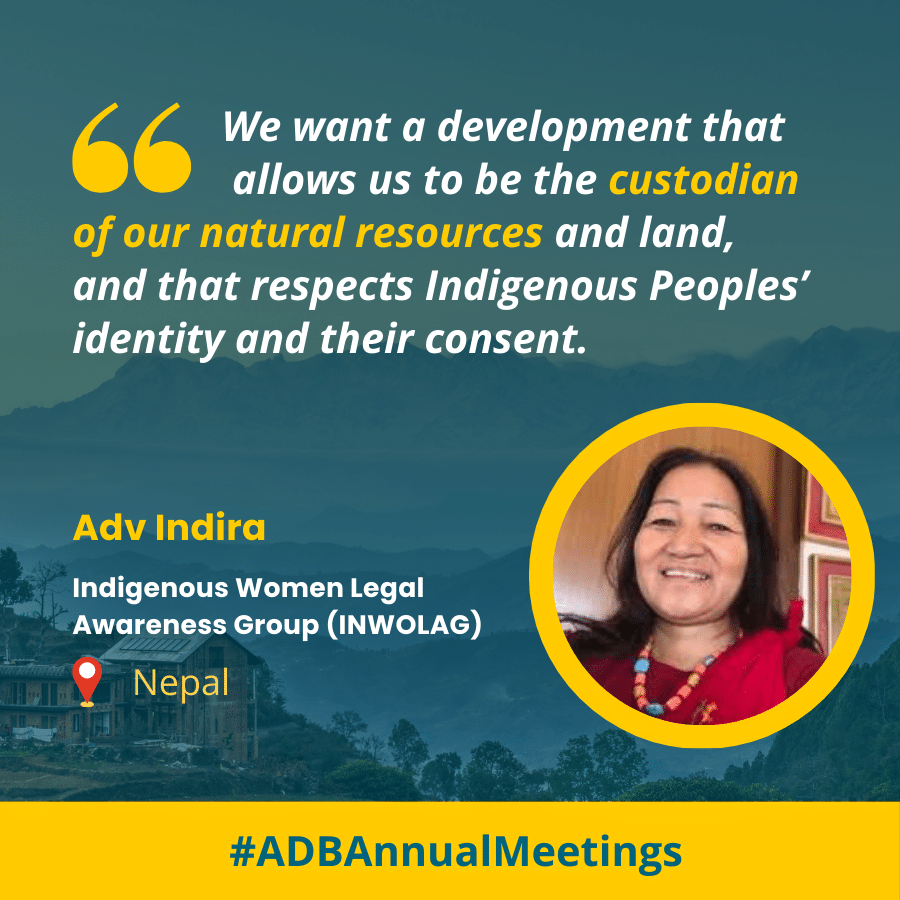
The Indigenous communities protesting the Tanahu Hydropower Project are demanding for a development that “allows us to be the custodian of our natural resources and land, respecting Indigenous Peoples’ identity and consent,” as described by Adv. Indira of the Indigenous Women Legal Awareness Group.
Given the long history of the ADB in supporting fossil fuel dependence in the region, civil society demands from the bank a development that is “not reliant on fossil fuels and ensures meaningful participation from civil society and affected communities, towards a just energy transition for all,” Andri Prasetiyo of Senik Centre Asia says.
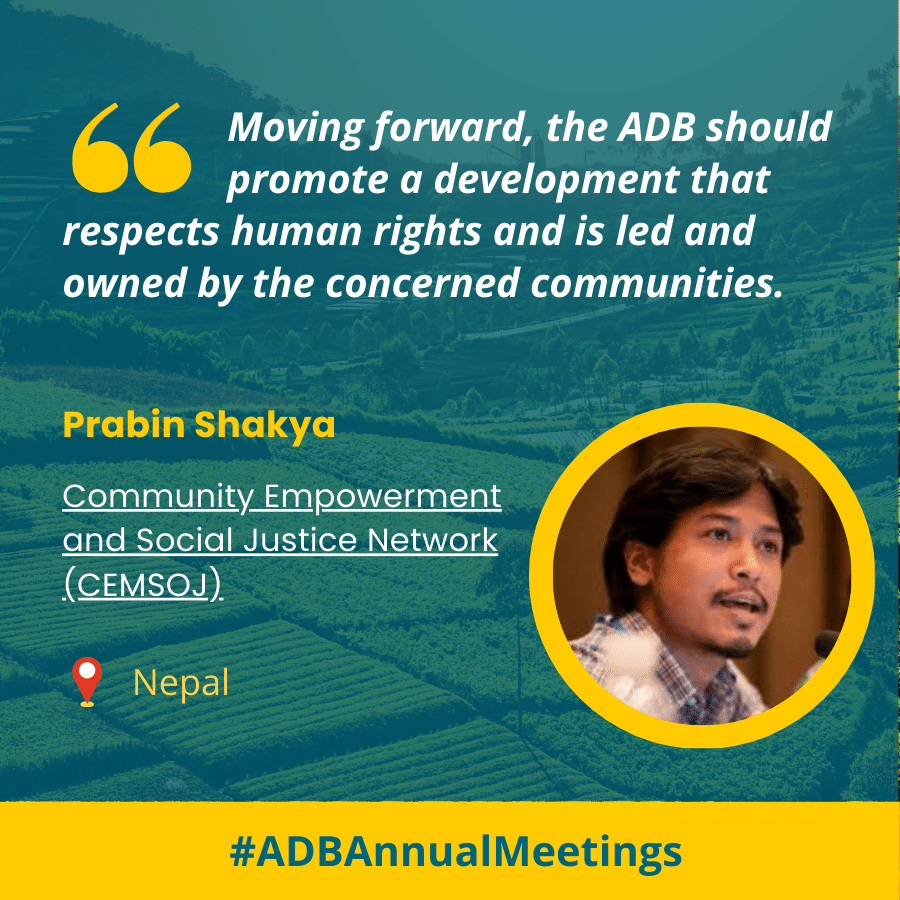
For communities impacted by harmful development projects and business activities, Jaybee Garganera of Alyansa Tigil Mina demands a development that “promotes justice and accountability for the protection of people and the planet.” Moving forward, the ADB should promote a development that “respects human rights and is led and owned by the concerned communities” as strongly put by Prabindra Shakya of the Community Empowerment and Social Justice Network.
These critical voices and perspectives from communities serve as an important pillar in building the bridge to the future. Without this crucial foundation, the agenda of a prosperous, inclusive, resilient, and sustainable Asia-Pacific will fall through the cracks.
This blog was written by Tala Batangan, Asia Regional Coordinator at the Coalition for Human Rights in Development. The video was produced by Shruti Nambiar.
Want to share this blog on social media? Download these cards and share the messages of community & CSOs activists from across Asia!



Reading list and important resources from the ADB Annual Meeting!
- Georgia: Civil society groups urge financial institutions to express concerns on “foreign influence” bill
- Joint letter to development banks re: Kyrgyzstan “foreign representative” law
- Defenders in Development Campaign: Recommendations on reprisals for the updated ADB Safeguards
- NGO Forum on ADB: Ripple Effect: Unveiling ADB’s Ecological & Human Rights Violations through Watercolor Narratives
- NGO Forum on ADB: Collective Civil Society Statement on ESF Draft: Calling for an Overhaul and immediate redrafting
- Inclusive Development International, Recourse, Trend Asia Indonesia, NGO Forum on ADB: Smog and Mirrors: How “Sustainable” Finance from the Asian Development Bank is Fueling Indonesia’s Coal Expansion
- Recourse, Senik Centre Asia, Indus Consortium, Trend Asia: The Technical Assistance Paradox: How World Bank and ADB advisory services are ‘assisting’ dependency on fossil gas
- Urgewald, NGO Forum on ADB: Polluters Getting Paid: The ADB’s Energy Transition Mechanism
- Reality of Aid-Asia Pacific: End Austerity in Asia Pacific Campaign
- Oxfam in Asia: Unaccountable Adaptation: The Asian Development Bank’s overstated claims on climate adaptation finance