

Meeting with IDB Annual President during the IDB Group Annual Meeting, March 2024.
Representatives of around 30 environmental and human rights organizations and affected communities from Latin America, that are part of the IDB Working Group, participated in the Annual Meetings of the Boards of Governors of the Inter-American Development Bank (IDB) and IDB Invest, which took place between March 6 and 10 in Punta Cana, Dominican Republic.
The participation of civil society in the IDB Group’s 2024 Annual Meetings was described by its president, Ilan Goldfajn, as a historic moment for the Bank. « It’s hard to believe, but the last time the IDB invited civil society to play a central role in our annual meeting was in 2013, » he said, reaffirming his administration’s commitment to improve the relationship with stakeholders and especially with civil society organizations.
In his opening remarks at the session titled « Development from a Stakeholder and Civil Society Perspective, » which kicked off the 2024 Annual Meetings, IDB President Ilan Goldfajn thanked civil society for attending and stressed the importance of organizations becoming key partners of the IDB Group. « One of the changes we are making at the IDB is to revitalize the relationship with civil society. We want to make a big change in the way we work together, » he said.
Goldfajn emphasized that, « Our strategy for working with you is focused on what matters: operations, projects and country programming. You are a key partner in keeping us informed in everything we do, keeping us disciplined and focused. We are here because we need you. We need to listen to you and make sure we learn from your feedback. As I mentioned, we want to revitalize our relationship, and we are doing so with a new approach. »
Goldfajn said that one of the main changes being promoted by his administration is to improve the relationship between the bank and civil society and work together to achieve common goals more effectively. In this context, Goldfajn announced the update of the Civil Society framework strategy, which aims to broaden the range of civil society representatives that interact with the bank, and the participation of civil society in IDB country strategies.
Carolina Juaneda, representative of the Bank Information Center (BIC) in Latin America, highlighted the efforts of the Bank’s current management to strengthen the links between the IDB Group and civil society and, in particular, President Goldfajn’s announcement of a new Bank strategy to engage with civil society. She also said that « civil society participation in country strategies » is welcome.
Regarding the recapitalization of IDB Invest, Juaneda noted:
« Greater risk requires stronger commitments to ensure effective compliance with social and environmental safeguards, something that IDB Invest lacks today. »
She noted that the evaluation conducted by the Bank’s own Office of Evaluation and Oversight (OVE) confirmed many of the issues that civil society has been pointing out for some time. One of these is the recommendation to strengthen the additionality and effectiveness of IDB Invest, as well as the need to redefine the approach to strategically select operations and clients.
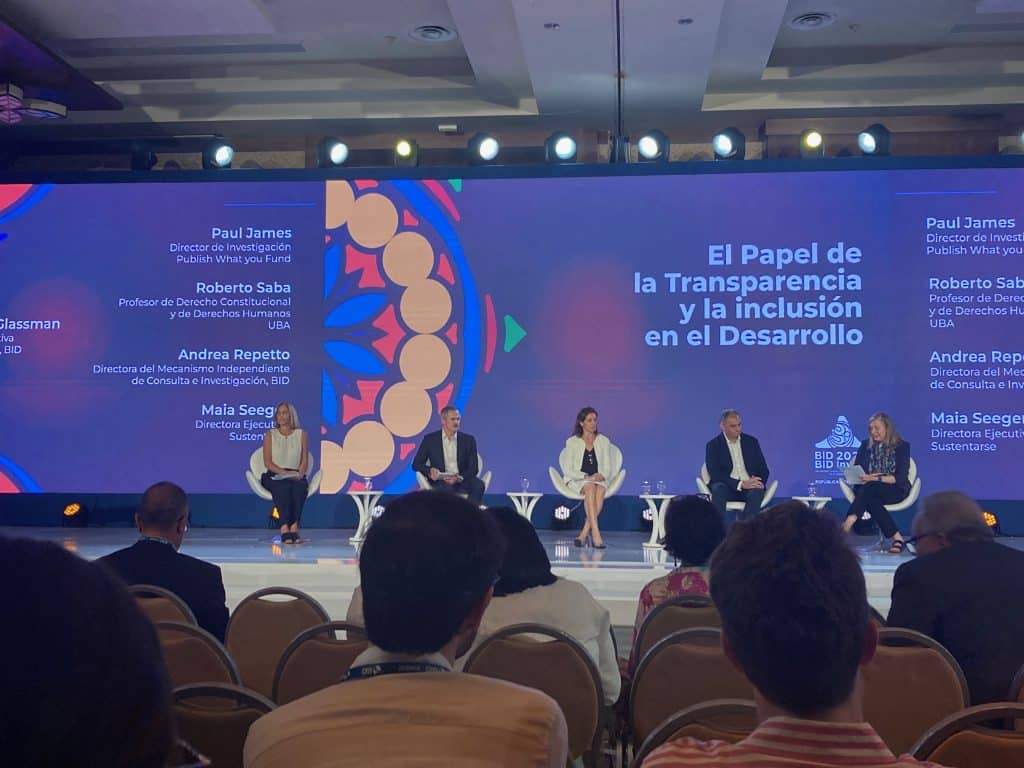
Maia Seeger, Director of Sustentarse, on behalf of the IDB Working Group also participated in the panel « The Role of Transparency and Inclusion in Development ». In her intervention (in this video, at 2:08), she pointed out that transparency, especially access to information, is key, as it constitutes a fundamental right that allows the exercise of other rights, such as the right of communities to participate in decisions that affect them. In this regard, she pointed out that there are challenges in the implementation of the IDB’s Access to Information Policy and accountability. She also cited a study conducted by Accountability Counsel, which analyzed more than 230 complaints filed with the MICI between 2010 and 2023, establishing that in 31% of the cases such complaints originated from a lack of transparency and participation. Seeger called on the bank to ensure greater transparency and involve civil society and communities in decision-making processes and the definition of priorities, not only for specific projects, but also in institutional strategies and plans.
During the 2024 Annual Meetings, representatives of the IDB Working Group held several bilateral meetings with senior Bank officials, including a protocol meeting with President Ilan Goldfajn. These meetings allowed them to strengthen dialogue with key managers and teams, present practical recommendations to more effectively implement environmental and social commitments, and address the Bank’s challenges.
The working group presented its priorities to the Bank, calling on the IDB Group to strengthen:
- the principles of good governance, including transparency, access to information and accountability;
- the meaningful participation of stakeholders and impacted communities in the framework of the projects it finances;
- the implementation of the IDB Environmental and Social Policy Framework and the IDB Invest Sustainability Policy; and
- the prevention of retaliation against environmental and human rights defenders.
Attention was also drawn to the negative impacts of some IDB-financed projects.
In evaluating civil society participation in the 2024 Annual Meetings, Javier Dávalos, coordinator of AIDA’s Climate Program, said:
« The participation of civil society in the IDB’s Annual Meetings has been a milestone in advancing the Bank’s compliance with its climate, social and environmental commitments in the region. The various voices present have brought a clear message about the need to have a clear policy of responsible exit of projects that have caused impacts on territories and communities, and thus reinforce the leading role that the IDB Group can play in financing the just energy transition in Latin America ».
In turn, Suhayla Bazbaz, director of the Mexican organization Cohesión Comunitaria e Innovación Social, CCIS, said:
« The IDB Group’s dialogue with affected communities and civil society organizations – including those of us who are critical and independent – should not depend on the discretion or goodwill of the staff. It must be part of the institutional culture. He added that, « this requires institutional channels and processes, and strong teams, that are aligned with the IDB Group’s commitment and responsibility to respect human rights and good governance principles as central to its activities and operations. »
It should be noted that the IDB Group’s Annual Meetings bring together the IDB and IDB Invest Boards of Governors, composed of finance ministers, economy ministers and central bank presidents from the 48 member countries, who are responsible for the governance of the bank. During the event, the challenges and opportunities for the development of Latin America and the Caribbean are discussed and the Bank’s strategies and programs are defined.
About the IDB Working Group
The IDB Working Group, also known as the IDB Working Group, is a network of Latin American and international civil society organizations that monitors and advocates with the IDB Group to promote better governance, greater institutional transparency, and more robust and effective environmental and social safeguards and respect for human rights in the projects it finances.
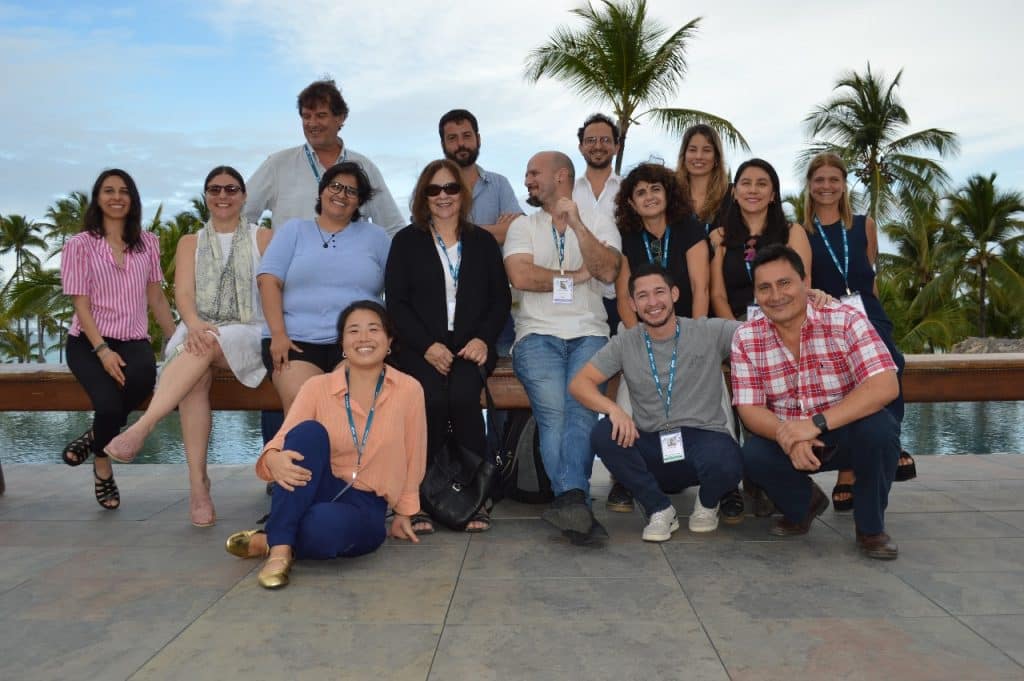
The IDB Working Group organizations that attended the IDB 2024 Annual Meetings were the following:
- Accountability Counsel (Internacional)
- Articulación Salvadoreña para la Incidencia en las IFIs (El Salvador)
- Asociación Ambiente y Sociedad (Colombia)
- Asociación Interamericana para la Defensa del Ambiente, AIDA (Regional)
- Bank Information Center, BIC (Internacional)
- Centro de Estudios Heñói (Paraguay)
- Coalición para los Derechos Humanos en el Desarrollo (Internacional)
- Cohesión Comunitaria e Innovación Social, CCIS (México)
- Conectas Direitos Humanos (Brasil)
- Derecho, Ambiente y Recursos Naturales, DAR (Perú)
- Ecologia e Ação, ECOA (Brasil)
- Fundación CAUCE, Cultura Ambiental – Causa Ecologista (Argentina)
- Fundación Tierra (Bolivia)
- GT Infraestructura (Brazil)
- Instituto Maíra (Brasil)
- International Rivers (International)
- Red de Comunidades Afectadas por IFIs en América Latina (Regional)
- Red Latinoamericana por la Justicia Económica y Social, LATINDADD (Regional)
- Observatorio Ambiental Ciudadano – Veeduría Ciudadana (Colombia)
- Plataforma Internacional contra la Impunidad (Guatemala)
- Sociedad y Discapacidad, Sodis (Perú)
- Sustentarse (Chile)