

Following COP30 in Belém, the need to open and sustain spaces for dialogue has grown stronger, in order to continue collectively building a critical understanding of so-called “green solutions” and to make visible their real impacts on territories and communities. The debates and commitments promoted at the COP once again showed that, although many of these projects are presented under the framework of a just energy transition, in practice they continue to reproduce extractivist logics that generate dispossession, socio-environmental harm, and a deepening of inequalities. These include mining for the production of so-called “critical minerals,” large-scale green hydrogen projects, and hydroelectric infrastructure which, far from responding to local needs, channel the energy produced toward export and the expansion of highly polluting industrial sectors.
At the same time, communities continue to put forward their own responses to the climate crisis, even in contexts of growing pressure and shrinking civic space. Through the defense of their territories, they advance proposals rooted in their lived realities, knowledge, and struggles, placing sovereignty, autonomy, and self-determined development models at the center. These alternatives not only challenge the dominant narratives of the green transition, but also the power structures and economic interests that sustain them. Recognizing, strengthening, and amplifying these proposals remains an indispensable condition for moving toward a truly just and people-centered energy transition.
Drawing on the lessons and limitations exposed at COP30, the Coalition reaffirms its commitment to articulating regional work across Latin America, Africa, and Asia, with the aim of aligning strategies, sharing learning, and strengthening joint advocacy around common demands:
- Reject false solutions that deepen extractivism and its impacts on territories.
- Support community-led actions and alternatives, grounded in their own visions of development and climate justice.
- Guarantee the protection of human rights and the rights of nature, including the protection of human rights defenders and affected communities.
- Demand a fair, transparent, and coherent allocation of climate finance that prioritizes local initiatives over corporate interests.
COP Testimonies
Panel event on the role of financial institutions
in the Amazon
At a time when the Amazon occupies a central place in global debates on the climate emergency, the IDB Working Group organized the panel “Logistics Corridors, Socio-Environmental Rights, and the Role of Financial Institutions in the Amazon.” The discussion was part of the parallel programming of COP30 in Belém, at the Inter-American Development Bank’s (IDB) “Amazonía Siempre” station at the Goeldi Museum, and brought together representatives from civil society organizations, Indigenous and territorial leaders, researchers, IDB representatives, and international experts.
The panel was moderated by Marco Vermaasen of the Bank Information Center (BIC) and featured contributions from Brent Millikan of the Working Group on Infrastructure and Socio-Environmental Justice; Fany Kuiru of the Coordinator of Indigenous Organizations of the Amazon Basin (COICA); Iremar Ferreira of Instituto Madeira Vivo; Sandra Valenzuela of the World Wide Fund for Nature (WWF Colombia); and Renata Vargas from the IDB’s Conexión Sur program.
Financing has been one of the fundamental pillars enabling the advancement of large-scale infrastructure projects in the Amazon. For this reason, when selecting which projects to finance, multilateral banks and development institutions play a decisive role in shaping the development model that takes hold in the region and, consequently, the socio-environmental impacts that result.

Blogs around our COP engagement
As we approached the COP, we launched a series of blogs reflecting on climate justice in development and the importance of centering community-led solutions.

The Planet is Burning and Communities Worldwide Are Calling for Justice
In this first blog of the series, Claudia (CRE-LAC Coordinator) highlights community resistance to extractivist models and the importance of amplifying their voices in the face of the dominant corporate discourse at the COP. She underscores the need to halt the “green” commodification of nature and to move toward approaches that place the care of territories at the center.
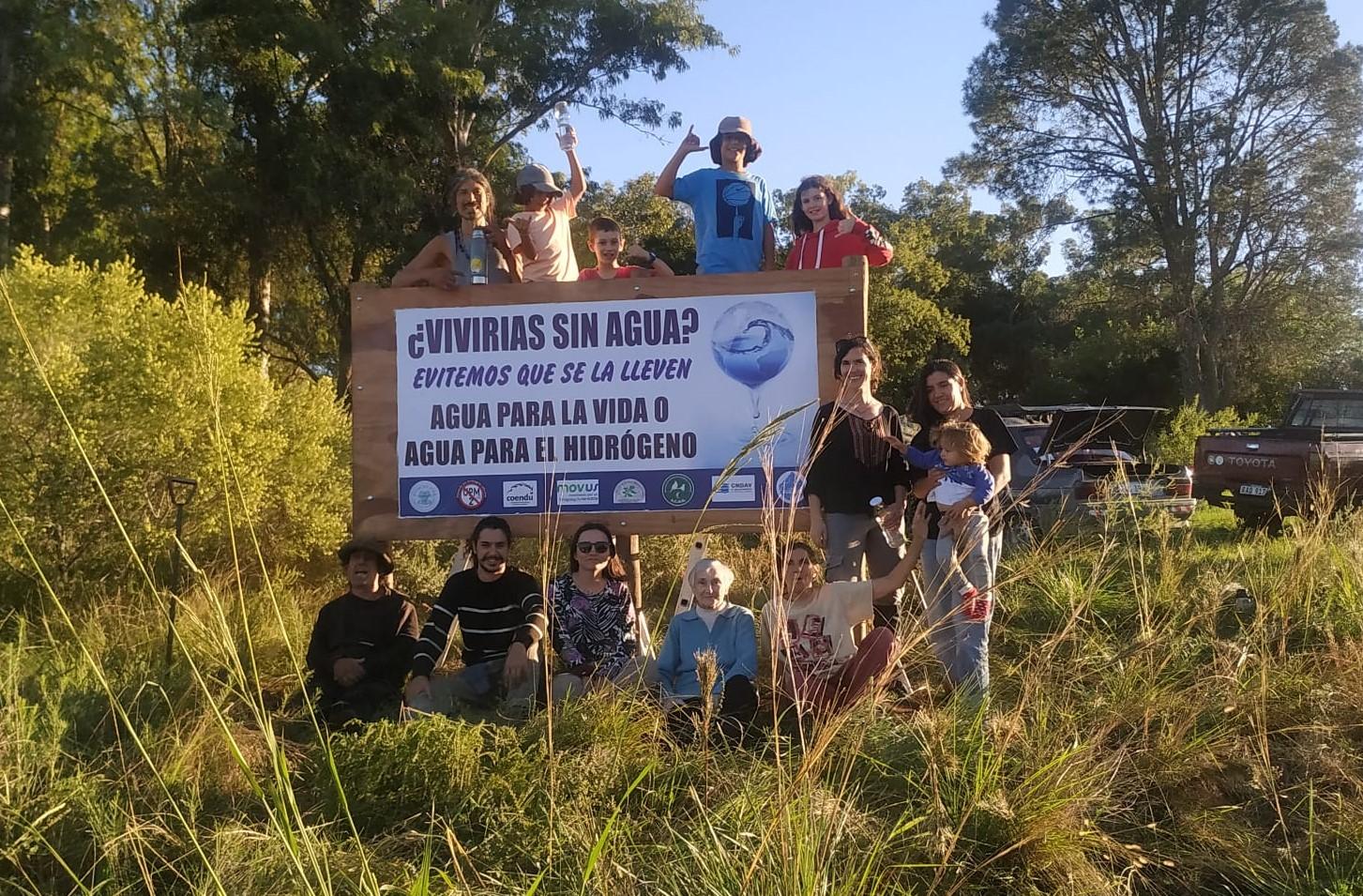
The Dark Side of Green Hydrogen: Community Resistance
From Chile to Uruguay, green hydrogen is being promoted as a “magic wand” capable of solving the energy crisis, the post-fossil transition, and regional economic growth. It has become one of the most heavily promoted technologies in recent years, attracting governments, development banks, and industries in spaces such as the COP. But who will really benefit from this model—and who will once again be sacrificed?
Mesoamerican Caravan for
Climate and Life
The Caravan is a political and territorial process driven by peoples, communities, and organizations from Mesoamerica to make resistance visible, articulate struggles, build people’s power, and defend life in the face of the climate crisis, extractivism, and human rights violations that threaten their territories and communities.
During the days when the Mesoamerican Caravan was in Guatemala City, a range of activities took place focused on exchange and coordination among organizations from Mexico and Guatemala, within the framework of the caravan’s four thematic axes: megaprojects and militarization, the commodification of natural goods, forced migration, and the global water crisis.
In this first stage, the caravan was made up primarily of collectives from Mexico and Guatemala. From October 6 to November 12, it will travel through the territories known as Guatemala, El Salvador, Honduras, Costa Rica, Panama, Colombia, and will conclude in Belém do Pará.
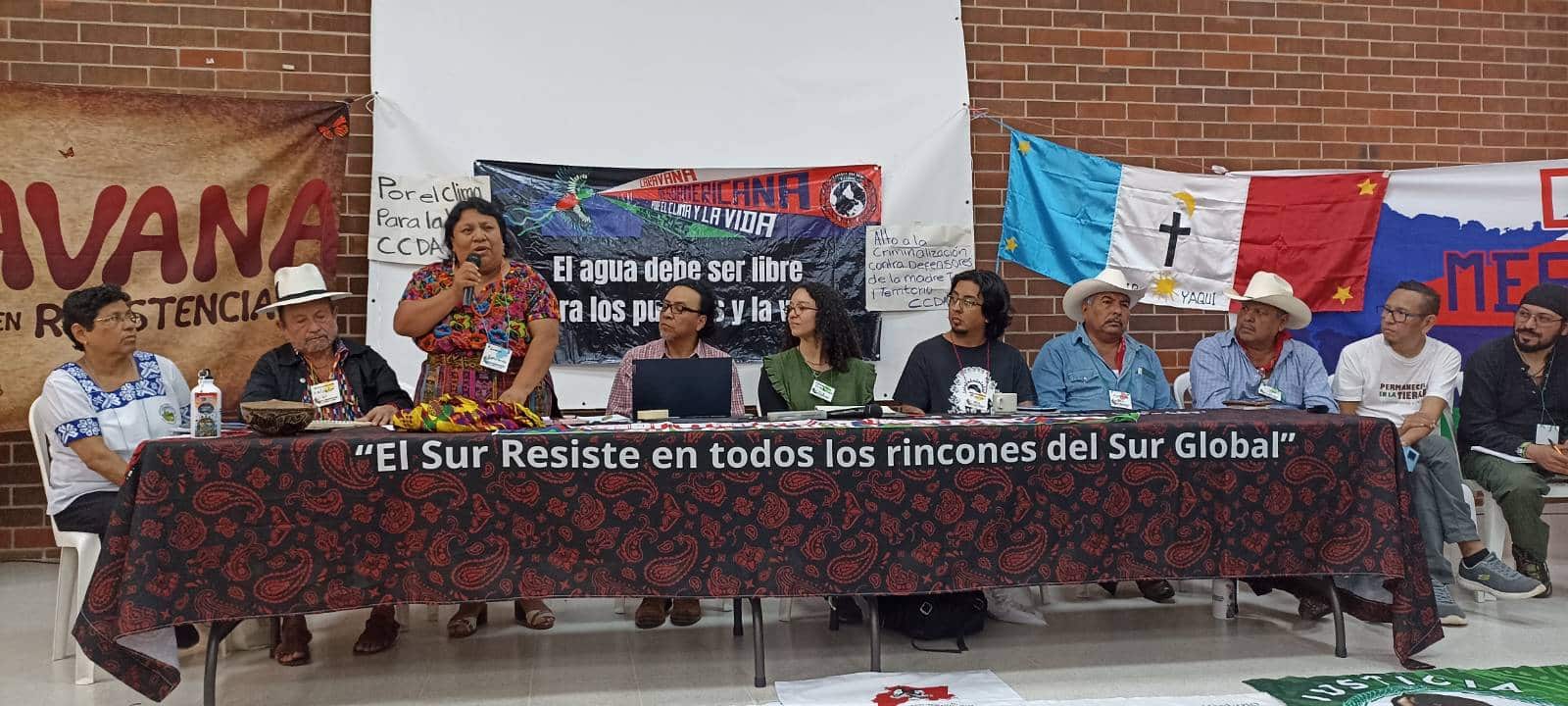
The first day began with an opening ceremony to set directions, aimed at guiding collective work, dialogue, and exchange. This was followed by dialogue roundtables on each thematic axis, where organizations shared experiences, reflections, and common challenges. At the end of the roundtables, a plenary session was held to present collective agreements and conclusions.
In the afternoon, a film-and-dialogue activity took place, featuring the screening of documentaries produced by participating communities that showcase their struggles and organizing processes. Among them, the documentary by women water defenders from Lake Atitlán stood out, whose story generated strong emotion among participants.
Carmen Reina, from the Feminist Collective and a member of the Alianza Política Sector de Mujeres, speaks about the enormous burden faced by women in communities in her region as they resist development projects that affect their territories and ways of life.
Vicky Samol from the Tzu ununya San Pedro la Laguna Collective speaks about her community’s struggle to protect Lake Atitlán against foreign donors financing the construction of a megacollector that threatens their ways of life.
Discussions in the Run Up to the COP
Just Energy Transition? | October 16, 2025
The climate crisis is a systemic crisis that must be addressed in a structural way. The foundation of transitions in each context must be equity, energy sufficiency, respect for human rights, ecosystems, and planetary boundaries.
The solutions that green capitalism proposes for decarbonization, in many cases, do not replace emissions. Instead, they reproduce the extractivist system they claim to combat, generating negative impacts on communities rather than solving the problems faced by those communities and their territories. For this reason, we refer to them as false solutions.
Green hydrogen is another example of a false solution, as it entails resource extraction to expand production for export to Northern powers, without consideration of local social problems, without the principle of certainty or the precautionary principle regarding potential risks to water or ecosystems, and in most cases without guaranteeing the right of access to information and community participation. Moreover, it is being developed within a speculative market that increases debt, without clear oversight and accountability mechanisms.
“For us, green hydrogen demonstrated in Chile the spirit of a real solution for the Global North at the cost of making invisible what happens in the Global South, dispossessing territories and preventing them from developing. Magallanes depends 99% on gas and fossil fuels for heating. We live in an extreme region where heating is vital, and there is not a single proposal addressing this reality.”
Loreto Vasquez Salvador, Fundación ACUE
The role of development financiers is being monitored by actors such as the IDB Working Group; however, it still lacks ambition in climate action, shows weak alignment with the Paris Agreement, presents shortcomings in the implementation of safeguards to address socio-environmental risks, and lacks a strategy to protect human rights defenders and affected communities.
“The IDB Group’s approach to energy transition is focused on facilitating investments, with a clear emphasis on investments for companies. It is assumed—completely uncritically—that the private sector is a good ally to solve the problems facing the planet, without questioning corporate responsibility for the climate crisis and human rights violations. There is a lack of clarity and coherence between climate goals and the energy portfolio. On the one hand, there is talk of climate and biodiversity, and on the other, the energy portfolio moves in a different direction. A central concern for us in the IDB Working Group is that Latin America is openly conceived as a sacrifice zone—not said explicitly, but implied when they state that we have the minerals needed for the global transition.”
Suhayla Bazbaz, Cohesión Comunitaria e Innovación Social AC (CCIS)
The main topics discussed were:
1. False solutions and corporate capture
Lithium mining and rare earth mineral extraction, for example—both increasingly intensified in the LAC region—are generating a new extractive wave that places the full burden of climate change on peoples of the Global South. Under a green discourse, the extraction of natural goods is deepened and colonial dynamics are reproduced, leading to water contamination, the destruction of wetlands, and the total loss of ecosystems.
- The mapping work on false solutions in Latin America and the Caribbean was presented, developed by organizations such as DCJ, Viento Sur, and the Climate Justice Platform.
- It was emphasized that not all technological or “green” solutions are positive if they reproduce the same extractivist system, displace communities, or fail to genuinely reduce emissions.
- The map was shared as a tool to make cases visible, strengthen arguments, and coordinate resistance
.
“In the case of mitigation projects, [development projects] do not solve the problems of communities and territories themselves. For example, if we talk about reservoirs or desalination plants oriented toward large-scale mining, these are clearly facilities that will serve those operations and reproduce the extractivist system, rather than providing water to a coastal or inland community that has been left without natural water sources.”
2. Opportunity for mobilization in the People’s Summit and COP30
-
The importance of using Belém as a moment for the re-mobilization of movements was highlighted, following recent COPs with limited impact in Sharm el-Sheikh (Egypt), Dubai (United Arab Emirates), and Baku (Azerbaijan).
-
It was proposed that the summit should be understood not as an isolated event, but as the beginning of a sustained movement.
-
The People’s Summit will be decisive in shaping a social agenda within the climate agenda—grounded in already diagnosed problems—and in catalyzing collective pressure from global civil society in a neoliberal context.
3. From diagnosis to strategy: What now?
-
There is already strong collective analysis of the impacts of green hydrogen, transition mining, wind energy, water, deforestation, and related issues.
-
The urgent challenge is how to move toward proposals, strategies for action, and a shared narrative, rather than continuing only to denounce problems.
-
The need for a collective voice and a coordinated global pressure plan was raised.
4. Connecting social and climate agendas
-
The importance of incorporating feminism, territorial justice, anti-racist struggles, and the defense of communities at the heart of the climate agenda was emphasized.
-
It was underscored that there is no just transition without strong, articulated social movements.
-
We speak of transitions in the plural because they take place within the diversity of each country’s context.
-
If the energy transition is based on the sacrifice of our territories, it is not a transition—it is accumulation.