

By Loreto Vasquez Salvador | Spokesperson of Asamblea Ciudadana Ultima Esperanza (Magallanes)
In this op-ed, originally published by Resumen on 10 March 2025, Loreto questions the role of public development banks have been playing, in a context of “”silent entry into Chile, where they are “are a presence that enslaves the country with debt, burdening precarious and vulnerable populations”.
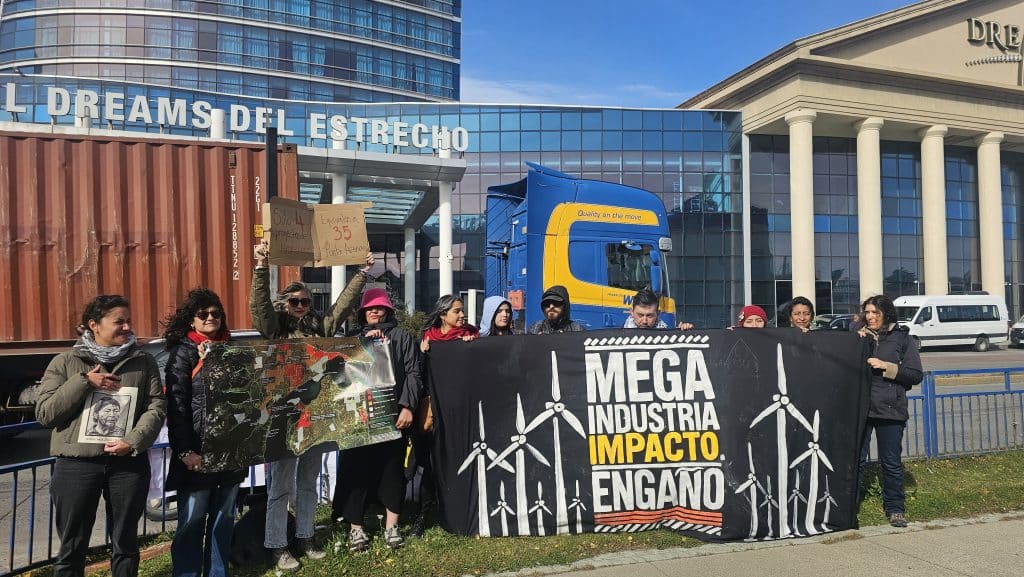
Protest in Magallanes, Chile, during the IDB Annual Meeting in March 2025. Credit: Cerro Sombrero-Punta Arenas
One thing is certain about purchasing power: in most cases, it is based on the creation of debt. Debt is ultimately a prison: it doesn’t have walls, but it keeps us under strict control. It creates a vicious cycle, where investments equate to indebtedness.
The Inter-American Development Bank (IDB) will hold its annual meeting in Santiago at the end of March, including, for the first time, a meeting in Magallanes between its president and investors. This decision is no coincidence: the meetings will take place at the epicenter of massive investments aimed at decarbonizing the economies of the Global North, with green hydrogen projects and associated infrastructure (ports, desalination plants, roads, power lines, wind farms, etc.) built in the Global South. These inherently destructive initiatives are financed by the IDB and other Multilateral Development Banks, such as the World Bank and the Development Bank of Latin America and the Caribbean (CAF).
Despite the fact that the meeting in Magallanes will take place in the territory directly affected by these investments, the participation of civil society so far has not been considered. Engaging impacted communities should be a basic principle, especially when these projects threaten their livelihoods, ecosystems, and ancestral heritage.
Public development banks have various private and public shareholders. The public shareholders are states, mainly “developed” countries from the Global North. They provide both resources and technical expertise. The positions of power are mostly held by men—white, bourgeois, and “successful.” If they are not white, they are often replicas of the colonial model of masculinity imposed on the entire Global South, which includes not only the geographical South but also India, Africa, Asia, and Latin America. The presence of women is still insufficient to claim true gender parity, let alone to demonstrate a genuine commitment to gender equity that extends beyond protocols buried in databases. Moreover, the mere presence of women does not equate to a challenge against the oppressive model of extractivism that disproportionately affects women and local communities.
Development banks’ strategies are aligned with the rhetoric of the “just energy transition”, as banks present themselves as the financiers that will allow them to enable such transition. It is crucial to highlight that these investments are primarily directed at developing countries—a significant detail that reflects the colonial structure of the financing system and its intervention that affects local communities, their knowledge, traditions, and identities.

Finance in Common Summit planey. Credit: Bibbi Abruzzini / Forus.
In 2025, the Finance in Common summit – branded as “the Summit of Solutions” – took place in Cape Town, South Africa. It was a gathering of – in their own words – rational men, bankers who claim to have the solution to address climate change and investors who will make the so-called “just energy transition” possible.
I joined the Summit on behalf of Asamblea Ciudadana Ultima Esperanza (ACUE), alongside other civil society delegates from Africa, Southeast Asia and Brazil. This space was not granted because the banks believe in the importance of civil society and communities in decision-making. Rather, it was the result of pressure from civil society organizations, who have been demanding participation and challenging colonial decision-making structures. In essence, it was a space of resistance, not genuine dialogue.
Over three days, a strict hierarchy prevented us from voicing our opinions or asking questions in any panel where bank representatives or executives were present. The event’s structure made it clear that the presence of civil society—like the banks’ complaint mechanisms and gender equality protocols—was merely symbolic, a box to be checked, rather than an avenue for meaningful exchange and recognition.
In the sessions, speakers shared despicable statements such as: “We have to be careful with the radical approach to human rights, equity, and the environment”; “The problem in Africa is that there are too many communities”; “We are rational and cold men—investing in development is not only a political issue but also an economic one”; and “If there is less development in the South, there is less growth in the North, which means more migration” (obviously, presenting migration as something negative).
In summary, the remarks we gathered over three days, as one of our colleagues put it, confirmed that the development model disregards human rights. People and communities are denied a voice and are not—and will not be—considered in investment plans that dictate their living spaces. Gender equality is viewed as a radical and negative concept that must be managed because it supposedly threatens investment. In reality, what is called “development” is extractivism—a colonial model designed to sustain the lifestyles and welfare of the Global North. Investors, disconnected from local realities, build roads through villages, transform them into industrial camps, and construct power plants that offer no community access. They believe gender equity in Africa, for instance, means providing women with modern cookers, all while they continue to experience violence and suffer the worst effects of climate change. Without addressing gender-based violence and adopting an ecofeminist approach, a just energy transition is impossible.
 When we took action during the final plenary session, raising the word “justice” and chanting “We are not for sale! We demand justice!”, one participant cynically asked, “What is for sale?”
This summit did not discuss climate justice, reparations, the right to free, prior, and informed consent, or the right to reject investments. It did not address the democratic crises in African countries embroiled in civil wars, while still attracting investment under the same exploitative terms. It did not speak of socio-ecological transformation or question the prevailing development model.
The so-called “just energy transition” promoted in these spaces excludes communities, upholds hierarchical decision-making, lacks reparations, fails to provide energy access, does not challenge the production and consumption model, disregards Indigenous knowledge, refuses to invest in small-scale, community-driven energy models, ignores human rights and adaptation measures, and does not alter the colonial framework of decision-making—let alone the concept of decarbonization.
Public development banks may seem invisible in our country because they operate quietly through the state, but make no mistake: they are financing green hydrogen projects in Chile. They have their eyes on the critical minerals that fuel the so-called “energy transition”—a transition without socio-ecological transformation. They are a presence that enslaves nations with debt, the burden of which is ultimately shouldered by the most precarious and vulnerable populations.
In the Global South, we need to connect with each other. We have to learn from our own experiences and listen to our voices. Chile, in its ambition to be the “jaguar of South America,” tells itself the story that we are better off, that we are not dispossessed, and that dignity exists. The truth is, dispossession is real. If there is one thing the experiences of other Global South nations have shown us, it is the awareness that we, too, are the South—that we are colonized, that we are prisoners of an exploitative and extractive colonial system. There are no “jaguars” of the Global South in the eyes of the North—only potential dividends and investment opportunities. There are not even recognized people here, only numbers on a financial ledger. This is why we demand that civil society be granted real participation, and not continue to be erased.