

A truly just energy transition requires recognizing communities as key decision-makers — with women and Indigenous Peoples at the forefront — and placing their knowledge and priorities at the center of global energy policies. Check out this position paper, prepared by the members and partners of the Coalition for Human Rights in Development, to read our key demands.

Introduction
Across the world, we are confronting the dramatic consequences of industrial-era climate change (from extreme droughts to floods and heatwaves), which are displacing communities, destroying their livelihoods, and threatening ecosystems. Despite the Paris Agreement commitments – where countries vowed to reduce emissions to limit global warming – we are rapidly heading towards the 2° temperature increase, which will lead to even more catastrophic impacts.
To mitigate and avoid the worst effects of climate change, world leaders and policymakers have called for profound structural transformations and a “just energy transition”. Countries and institutions across the globe are now scaling up renewable and low-carbon energy solutions, while phasing out fossil fuels.
But behind the slogans about “green growth” and “sustainability”, the current approach to the just energy transition is marred with contradictions, as it has been used as a smokescreen to keep pursuing a neoliberal and extractivist approach. Public development banks (PDBs) are promoting large-scale projects and false solutions – such as green hydrogen, geothermal or nuclear plants – which are neither green nor sustainable, as they violate human rights and contribute to environmental degradation.
The Global South sits at a critical position within this transition. Despite being the least responsible for the climate crisis, Global South communities are being disproportionately impacted both by the impacts of climate change, but also by the rush towards renewable energy. Additionally, many countries – especially across Africa – are still grappling with the challenge to balance the need to ensure energy access (for underserved communities, industrialization and economic transformation), with the international pressure to phase out fossil fuels.
So-called “critical” minerals used in renewable technologies and large-scale renewable energy projects – mainly driven by the growing demand in the Global North – are creating new sacrifice zones in resource-rich countries. The current approach to the “just” energy transition is reproducing long-standing patterns of dispossession, rights violations, and environmental harm, as projects are being imposed without the consent of local communities and ignoring the impacts on their land, food systems, water, energy access, and cultural survival. This perpetuates a model of “energy colonialism”, that imposes projects only to benefit economic elites (and in many cases, large corporations in the Global North) at the expense of local communities in the Global South.
Critical mining and renewable energy projects are also fuelling conflict and reprisals. As civic space continues to shrink around the world, communities and human rights defenders who are resisting these projects or rising concerns are facing threats and attacks. This, in turn, generates a climate of fear, limiting opportunities for safe and meaningful consultations.
International law and standards recognize that people everywhere have a fundamental right to a clean, healthy and sustainable environment, nutritious food, clean water, education and housing, all rights which are inextricably linked to the right to land. International law specifically recognizes the right of Indigenous Peoples to Free, Prior and Informed Consent, and requires States to protect their lands from encroachment. Additionally, international law and regional instruments (such as the Escazú agreement in LAC) also recognize the right to access to information and participation. Yet, development projects imposed in the name of the just energy transition or green growth are increasingly violating these fundamental rights.

Community-led small-scale hydroelectric energy project in Nepal. Credit: CEMSOJ
The role of PDBs in energy transition
PDBs are positioning themselves – through their climate commitments and support for the energy transition – as critical actors in the energy transition, particularly in the Global South.
Between January 2022 and June 2025, PDBs have invested a total of USD 245.5 billion for energy projects across the globe, largely in the form of loans and coursing through the private sector. The highest percentage of investments went into the solar energy sector (30%), followed by transmission lines (24%) and wind power (22%). However, research shows that PDBs are still pouring money into fossil fuels, often through financial intermediaries. Additionally, PDBs have been largely supporting false solutions in the form of large-scale renewable energy projects, technofixes, extractivist activities and market-based approaches.
A global call to a community-led approach to JET
It is against this backdrop that in the past few years the Coalition for Human Rights in Development has been engaging its members and partners in discussions around the just energy transition and the role of PDBs, to denounce false solutions and contradictions while also developing demands on how a truly just transition – that centers the voices and demands of affected communities – should look like.
This paper presents a set of collective demands that emerged in a series of parallel processes, both at the regional and cross-regional level:
- Regional strategy-setting processes in Asia, Africa and LAC, as well the global strategy-setting process which culminated in the Members Gathering, where JET and extractivism emerged as a key priority;
- Workshop ahead of the Finance in Common Summit in South Africa, where 35 community members and CSOs representatives (mostly from Africa, but with four participants from Asia and LAC) identified key demands for a community-led solution to the just energy transition;
- Thematic work on climate justice and thematic alliance on JET in Latin America;
- Strategy sessions with members and partners in Asia on critical minerals, hydropower and other large-scale renewable energy projects.
Our demands to PDBs
To support a community-led energy transition, that respects the rights and meets the needs of communities in the Global South, PDBs should:
1. Recognize communities as central and leading actors in the energy transition
The rights of communities most affected by climate change – who already struggle to secure water, food, shelter, livelihoods, and cultural survival – must be at the center of the transition. PDBs must shift their paradigm: from viewing communities as passive “beneficiaries,” obstacles, or casualties of development, to recognizing them as full stakeholders and protagonists of the energy transition. Embedding this recognition into policy and practice means treating local communities and Indigenous Peoples not as victims to be hastily compensated or displaced, but as co-creators and co-monitors of just energy solutions that put people and planet first.
How to do it:
- Shift from loans to grants: Replace debt-based financing with grant-based support that allows communities to lead their own transitions.
- Decentralized energy solutions: Focus on small-scale, context-specific projects that directly meet local needs, rather than large-scale, export-oriented energy projects.
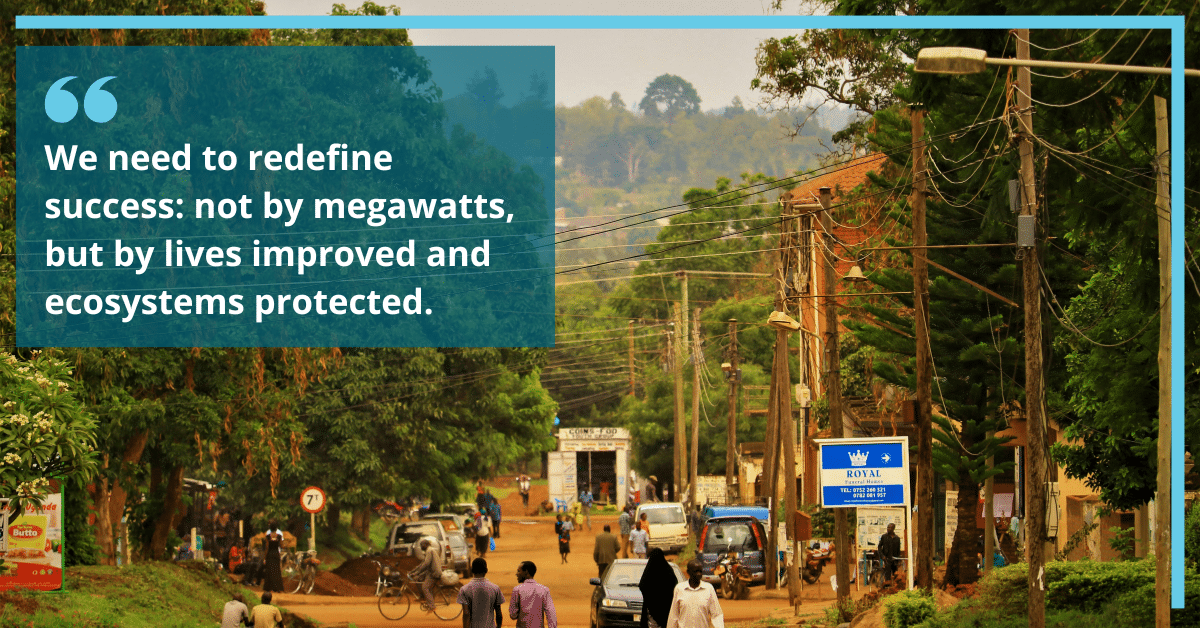
- Redefine success: PDBs must measure real community benefits – energy access, livelihoods, equity, ecosystem health and cultural integrity – rather than financial disbursement or megawatt output alone.

2. Prioritize funding for decentralized, small-scale and community-led energy solutions
Across the Global South, local communities are advancing grassroots solutions to mitigate the impacts of climate change and generate energy through small-scale projects. Such projects, designed through participatory, inclusive and feminist approaches, can effectively meet the needs of local communities and prevent harm.
How to do it:
- Free, Prior, and Informed Consent (FPIC) for Indigenous Peoples and Right to Say No: Communities must have the right to approve, shape or reject projects, and to withdraw consent at any time if violations occur. For Indigenous Peoples, their right to FPIC should be respected and upheld.
- Decision-making power: Communities must be active participants in all decisions on land use, resource governance and energy projects, from the planning to the implementation phase.
- Safe and meaningful stakeholder engagement: Banks should take into consideration civic space restrictions in project contexts and identify, mitigate and address any risk of retaliation, without delegating such responsibility to their clients.
- Diversity and inclusion: Ensure the active participation of all sectors of society, by recognizing the voices of women, LGBTQIA+ groups, people with disability and marginalized populations, respecting their role in shaping local understandings of a just energy transition.

3. Design accountability, monitoring and rights protection, informed by community needs and priorities
An energy transition can only be just if it accounts for and remedy its potential negative impacts, particularly on rural, local, and Indigenous communities. To do so, it is key to enable communities to participate in the project design and assessment phases, to implement strong safeguards, and to ensure remedy and justice when rights are violated.
How to do it:
- Stronger environmental and social safeguards: In line with international human rights standards, in their policies and practices PDBs should conduct human rights due diligence to prevent harm (including human rights violations and harmful impacts on land, water, forests, biodiversity, cultural heritage, etc.), uphold human rights, and protect the environment. They should strengthen their safeguards and their implementation at all stages of their operations.
- Community-centered assessment and monitoring: To understand local realities and better assess impacts, PDBs should rely on independent assessments that center community voices and create direct platforms for dialogue, rather than relying solely on government or corporate reporting. Project assessment, design and monitoring should be based on participatory, community-led methodologies.
- Transparency and access to information: Development banks should ensure transparency, providing accessible and timely information about projects (including impact assessment documents) and requiring their clients to uphold access to information standards, in line with international law.
- Accessible, gender-responsive accountability mechanisms: Establish transparent, gender-responsive and culturally appropriate accountability mechanisms that can provide adequate, enforceable, effective and timely provision of remedy for any human rights or environmental harm.
Key elements of a community-led just energy transition in the Global South
Human rights and self-determination of communities at its core
- Any project, policy or framework for energy transition, including the extraction of transition minerals, complies with international human rights standards and norms.
- Communities exercise their right to participate in development processes in a safe and meaningful manner. Communities have the agency to make decisions regarding the use of their land and resources. All sectors of society, especially women, actively participate in all project stages and strengthen women’s legal recognition of land rights.
- Communities have the right to say no to energy transition projects that are not aligned with their development priorities. For Indigenous Peoples, FPIC is carried out and respected.
Protection of land, livelihoods and food security
- Communities are not subjected to live in “sacrifice zones” in order to contribute to the energy transition.
- No large-scale displacement of communities takes place without consent and adequate compensation. Customary land rights are respected and protected, including for communities without formal land titles (e.g. Indigenous Peoples, pastoralists, peasants, other traditional communities and urban poor).
- Land governance is aligned with local cultural protocols, recognizing ancestral lands, sacred areas and cultural heritage sites.
- If land rights are violated, communities receive remedies and reparations for the harm they experience. This also includes environmental reparations when projects cause harm.
- Climate finance is democratized to support primary livelihood activities and prevent harm to local food systems, prioritizing direct funding of decentralized community-based organizations or community-led solutions.
- Secure food sources through policy coherence across sectors affecting agriculture, fisheries, and primary livelihoods.
- Respect for community-led and Indigenous-led environmental stewardship, including for water, forests, and biodiversity.
People-powered and gender just energy transition
- Decentralized and small-scale energy projects that deliver to local needs are prioritized. Energy solutions are responsive to local contexts and needs, accounting for unpaid care work, food production roles, and food security concerns in project design. This can be supported through direct financing windows or assistance through technology transfer and capacity development.
- Community and Indigenous knowledge systems shape energy transition policies. Community-defined indicators of success are used, rather than financial outputs.
- Communities and CSOs are involved in monitoring project implementation. Pathways for accountability from governments, multilateral institutions and companies are available for communities.
Conclusion and call to action
These collective demands offer a roadmap toward an energy transition that leaves no one behind and that is rooted in local realities, a feminist and intersectional perspective, global solidarity, and justice.
A technological shift alone is not enough to make the energy transition just: a truly just energy transition requires centering communities in development finance decisions. We need a transformative paradigm shift that puts people and the planet first in both policy and practice.
To break away from the exploitative patterns of the fossil-fuel model of development, all actors involved in shaping and financing the transition (States, international and multilateral bodies, PDBs, private actors, etc.) must prioritize bottom-up, community-led solutions that uphold human rights, safeguard ecosystems, and ensure equitable energy access.

