


Across Africa, mining-affected communities are leading powerful struggles, advocating for their rights, and imagining alternative development pathways. They are facing displacement, pollution and human rights violations, but they refuse to be just passive victims. Their visions redefine what justice could mean, not as compensation after the fact, but as participation and sovereignty from the start.
During the 2026 Alternative Mining Indaba (Cape Town, 9-11 February) we are hosting a multimedia exhibition – together with our partners – collecting poems, songs, videos and photos bringing the voices and aspirations of mining-affected communities in Guinea, Madagascar, South Africa, Tanzania, Zambia and Zimbabwe. These stories illuminate how resistance and hope can coexist in the same landscapes of extraction; and how genuine justice in the energy transition depends on listening to, learning from, and standing with those on the frontlines.
The exhibition will be hosted at the Central Methodist Church (Greenmarket Square, Cape Town) on 9-11 February. In this page, you can read a short profile of the communities who participated in this collective exhibition, read their poems, and listen to their voices.
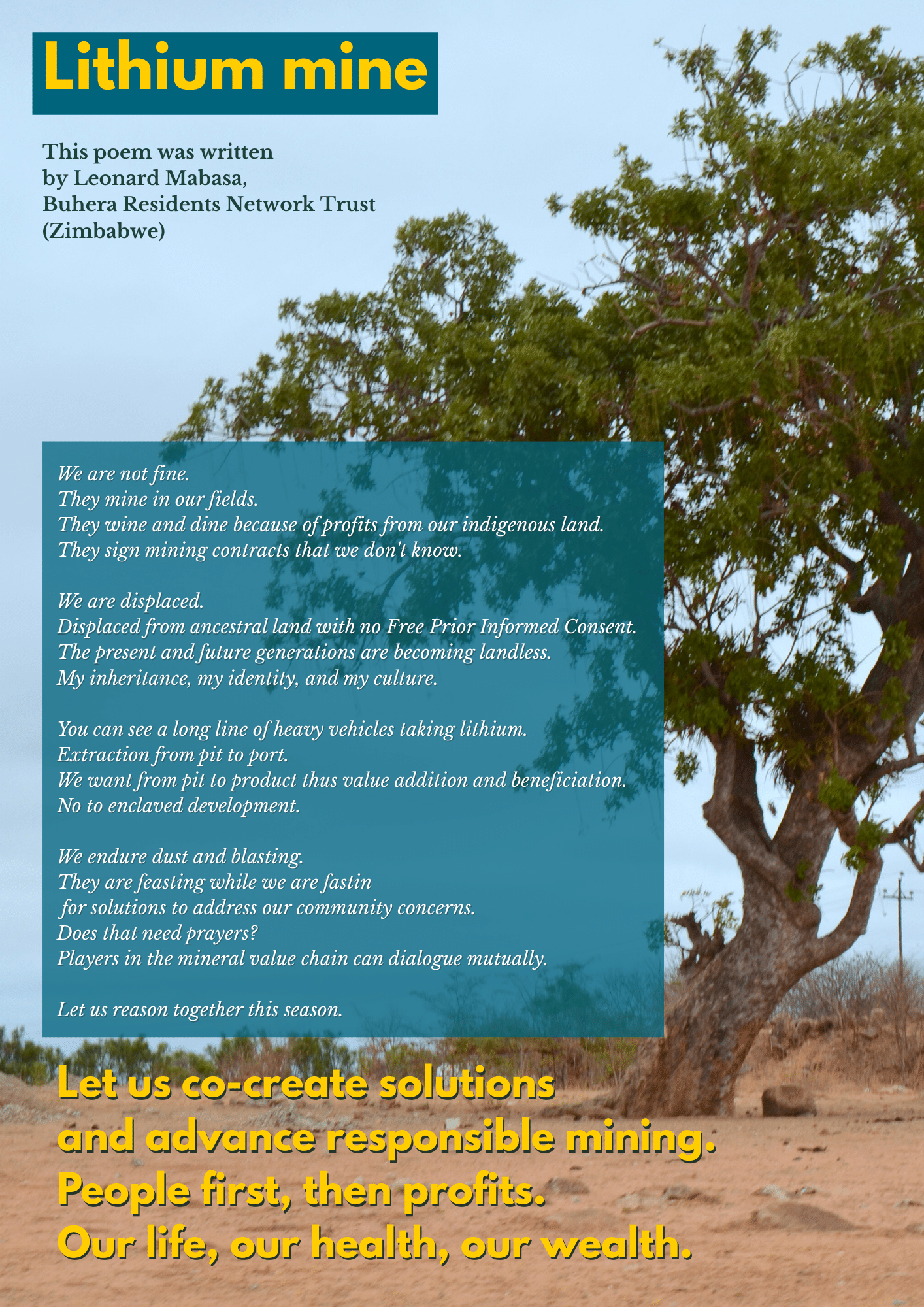
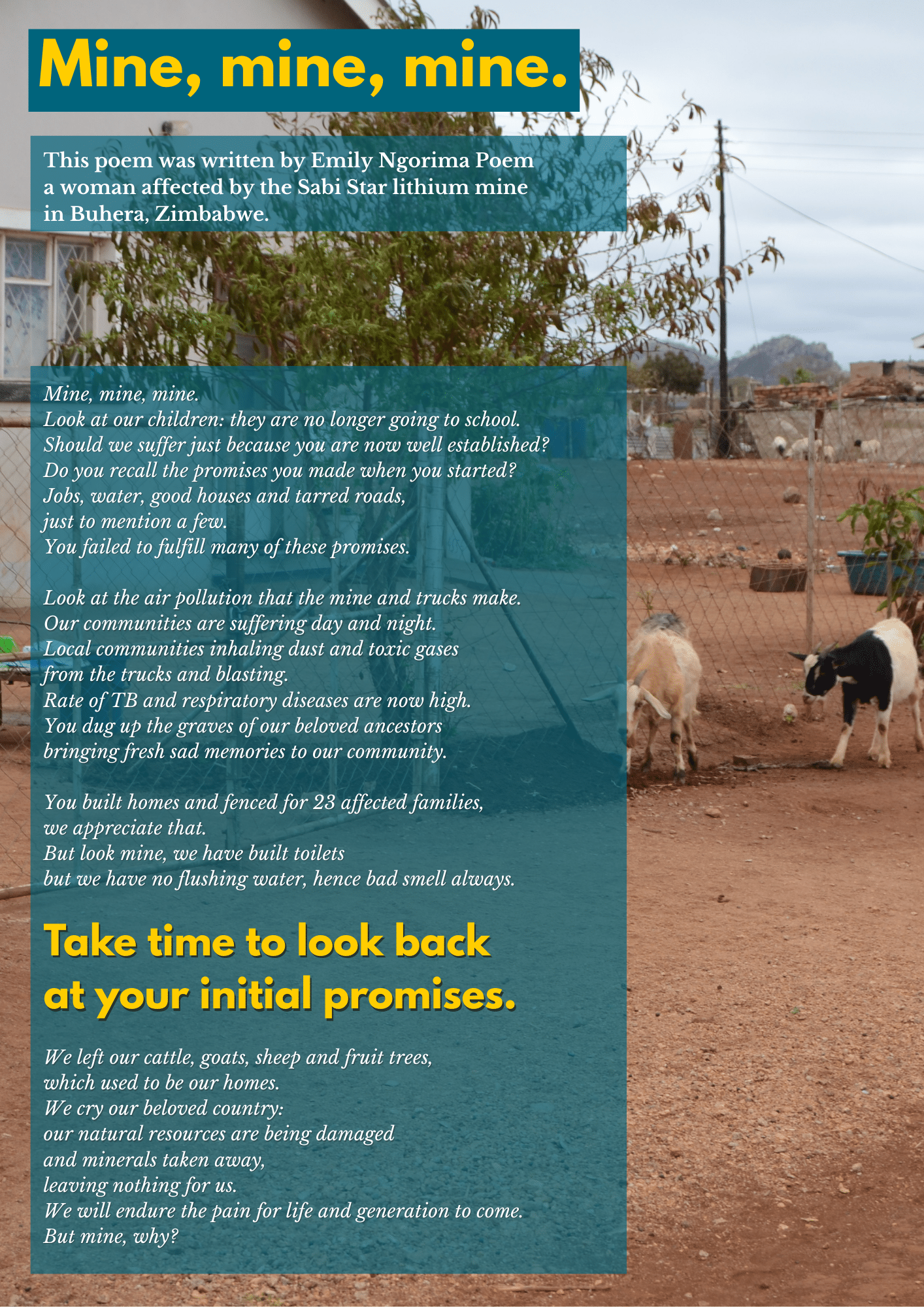
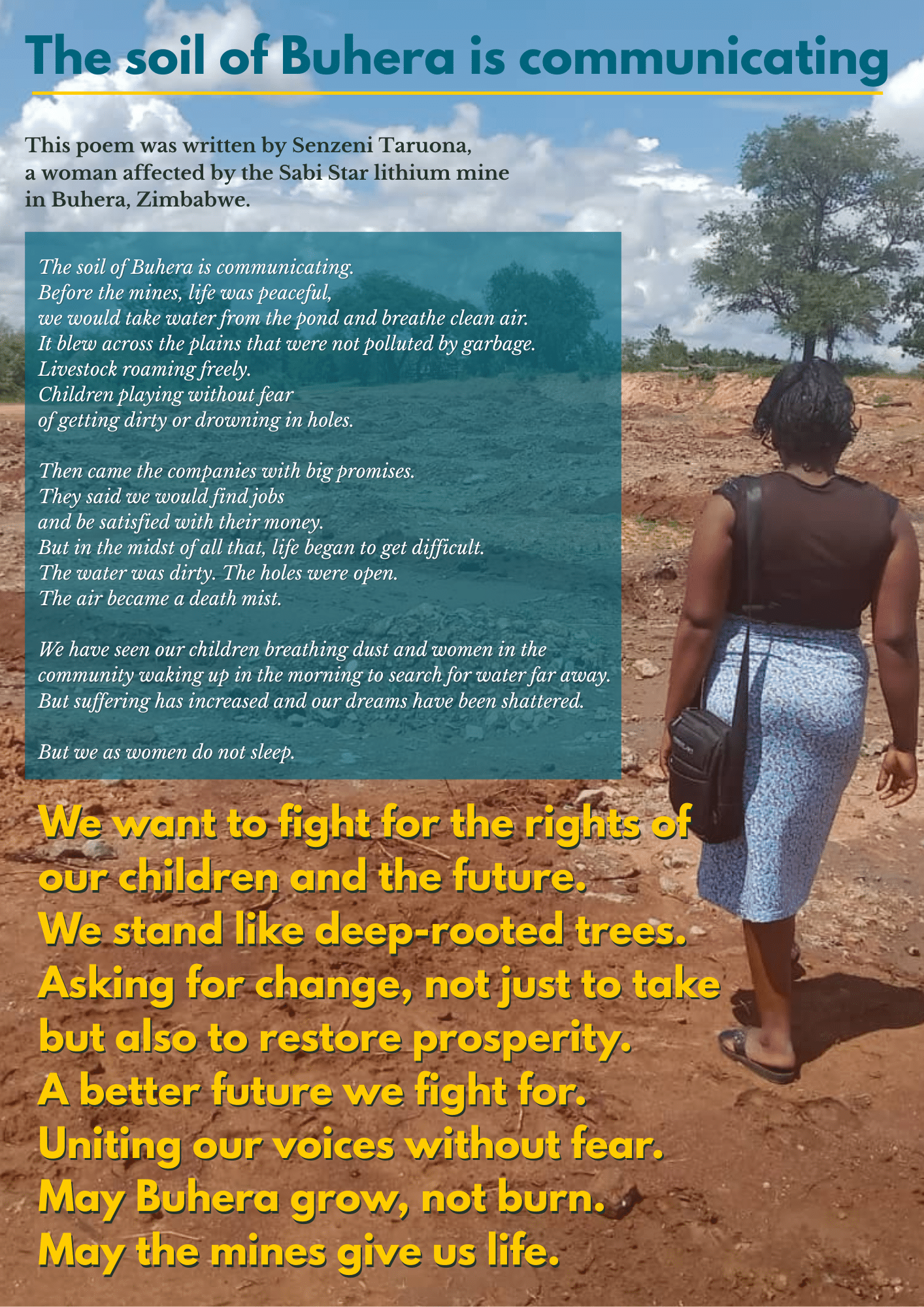
Buhera (Zimbabwe)
In Buhera district, in eastern Zimbabwe, the land has historically sustained livelihoods and anchored cultural life. Subsistence farming provided food security, grazing land supported cattle and goats, and ancestral graves tied communities to their history and spiritual identity. This balance has been disrupted by the arrival of the Sabi Star lithium mine, operated by the Chinese-backed Max Mind Investments, which has begun to reshape both the physical landscape and the social fabric of the area. Local communities report inadequate consultation and growing fears of land loss and environmental degradation, while enduring the trauma of cultural dislocation.
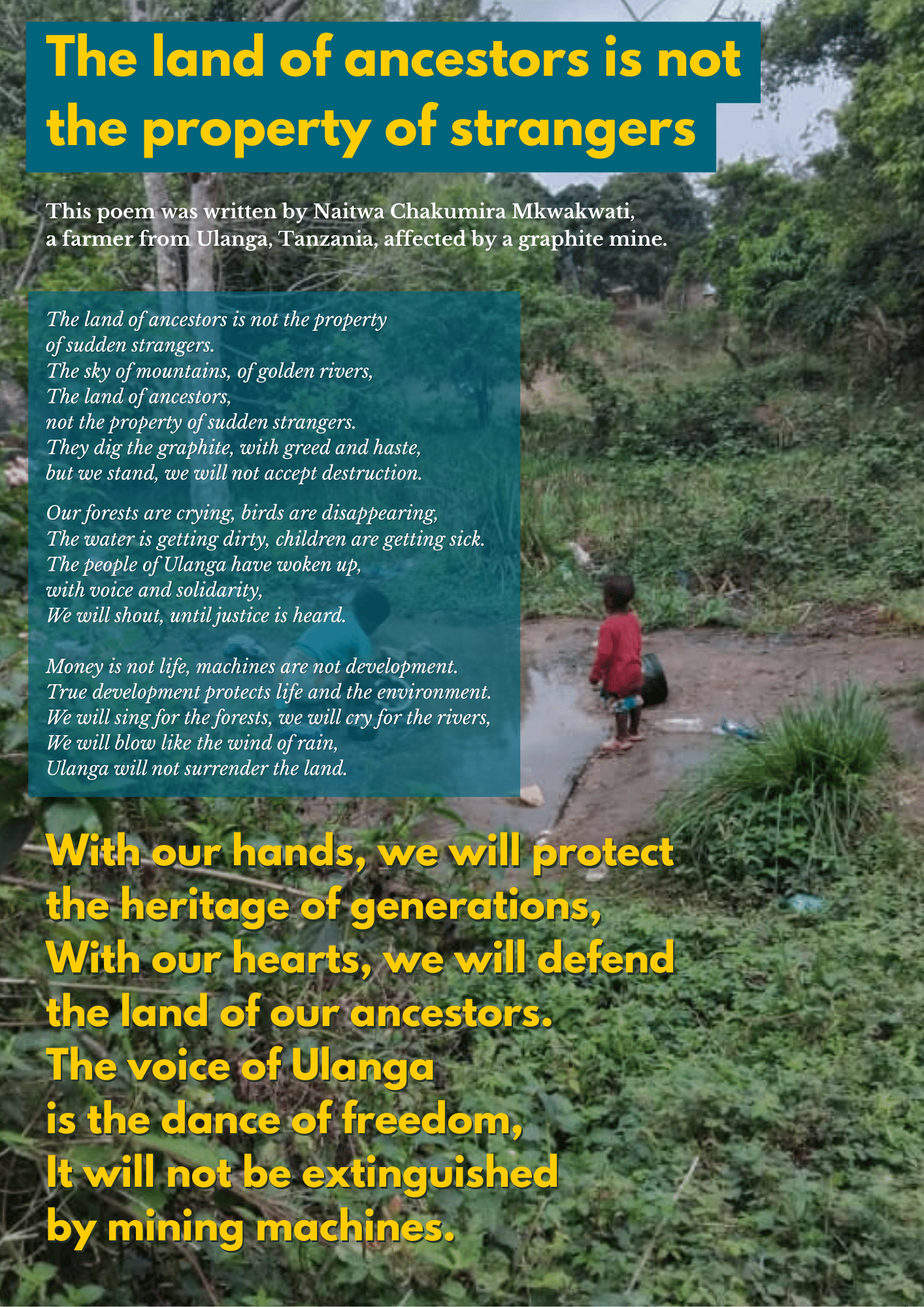
Ulanga (Tanzania)
In Tanzania, the Ulanga Graphite mine has raised deep concerns among local communities and civil society organisations. The project threatens to disrupt livelihoods dependent on farming and forest resources, with limited evidence of meaningful consultation or consent, and growing fear from threats and intimidation. Despite being promoted as a key contributor to global battery supply chains, the mine exemplifies how so-called green investments can reproduce extractive patterns that marginalise rural communities and place ecosystems at risk.
Goromonzi (Zimbabwe)
In Goromonzi, Mashonaland East (Zimbabwe), the Arcadia lithium mine owed by Chinese transnational Zhejiang Huayou Cobalt sits on land once farmed and lived on by generations of families. Its expansion has displaced entire communities, dried boreholes, and stripped away the water that sustained homes and crops. Despite promises of development, jobs bypassed locals, while migrant labour under short contracts deepened inequality. This exclusion falls hardest on women shut out of mine work and forced into precarious survival, some into sex work and leaving them vulnerable to rising sexual transmitted infections in a community with no clinic or health support. In place of care, armed security enforces silence, yet the community refuses disappearance. Through petitions and collective action, residents compelled the mine to tar and repair roads destroyed by heavy trucks. A breakthrough that proved accountability is possible. Goromonzi’s struggle exposes the hidden costs of green energy extraction in Southern Africa and raises a fundamental question: whose futures are being developed, and whose lives are sacrificed to make it possible?
Northern Cape (South Africa)
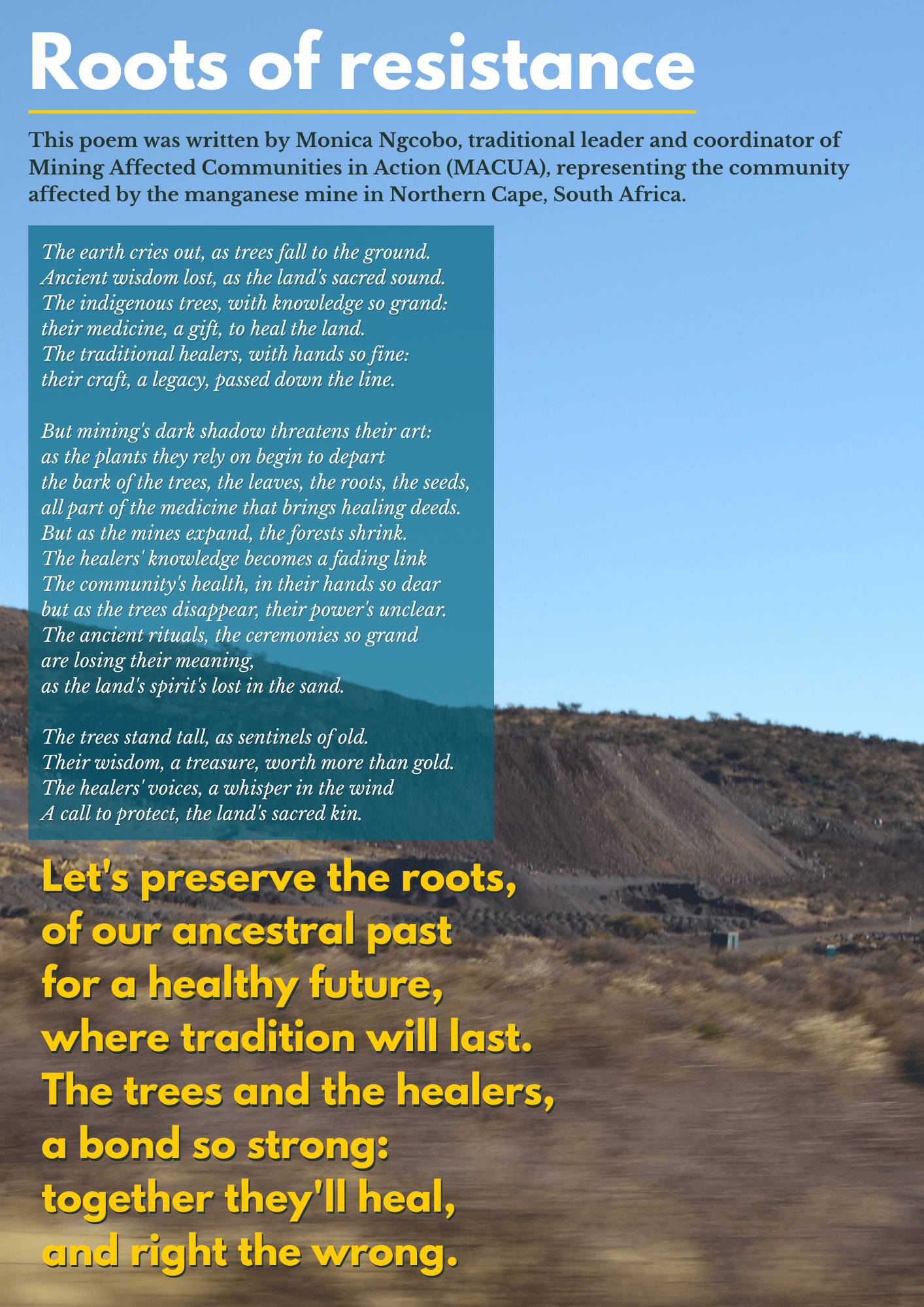
In the dust of Postmasburg, Laxey, Kuagung, Kuruman, Loopeng, and Boichoko (Northern Cape, South Africa), where nearly a third of the world’s manganese is mined, communities live beside some of the largest manganese mines in the world. But while the ore powers global steel and batteries, the people are left with cracked homes, poisoned air, and broken promises of Social and Labour Plans. For decades, blasting and pollution have shaped their lives: Postmasburg fights for healthcare and jobs; Laxey demands protection for children’s health; Kuagung remembers forced removals and fights for land rights; while Loopeng and Boichoko rise against dust and blasting. Through their own organising, strengthened by MACUA, they demand consent, accountability, and community ownership insisting that the wealth beneath their feet must not only serve corporations, but the people.
Testimonies from mining-affected communities
Community affected by CBG bauxite mine (Guinea)
Bauxite, the mineral used to make aluminum, is a major source of revenue for the West African country of Guinea. But bauxite mining has displaced and impoverished thousands of people living near project sites. As Guinea’s oldest mine prepares to expand—driven by growing global demand for aluminum for use in electric cars, solar panels and batteries—communities in its path are demanding a fairer deal.
Watch the testimony from one of the affected community members, Ibrahima Diallo, and read more in this report published by Inclusive Development International with Action Mines, ADREMGUI and CECIDE.
Phosphate Mining in Senegal
The communities of Darou-Khoudos, Taïba Ndiaye, Méouane, and Mboro are impacted by the activities of Industries Chimiques du Sénégal (ICS). It is one of the largest industrial complexes in Senegal and the largest producer of phosphate fertilizers in sub-Saharan Africa. ICS is a subsidiary of Indorama Corporation. Its activities have led to progressive degradation of the land and the environment, with communities concerned about noise, air, water, and soil pollution. This has seriously affected their livelihoods, which were mainly based on agriculture and livestock farming.
The host communities live in unspeakable infrastructural deprivation (in all four of the above-mentioned municipalities surrounding ICS, there are no health centers, despite the rapidly growing population of over 200,000 inhabitants, no fire brigade, let alone a hospital to treat all the illnesses caused by the company’s presence), not to mention the numerous gas leaks to which they are constantly exposed.
ICS shareholders include the Government of Senegal (15%), the Indian Farmers Fertiliser Cooperative Limited (IFFCO) with 6.78%, the Government of India (0.22%) and Indorama Corporation with 78% ownership.
Between 2015 and 2020, the company received financing from the following commercial banks: the International Bank for Trade and Industry, the Islamic Bank of Senegal, Attijariwafa Bank SA, Citigroup, and Crédit du Sénégal. It also received funds from the following development banks between 2016 and 2020: the French Development Agency, the West African Development Bank, and the European Investment Bank.
Finally, most of the phosphoric acid produced by ICS is exported to the IFFCO plant in Kandla, in the state of Gujarat, at a time when local producers, particularly those located in the site’s impact zone, regularly suffer from either a shortage of fertilizer or its high cost.
Fostering accountability, integrity and responsibility in Zimbabwe
When water does not come from the taps in Zimbabwe, it comes from women’s bodies — carried in buckets, waited for in queues, stretched across days already full of unpaid work. Community Water Alliance grew out of this reality. Formed in 2010, CWA works where water scarcity is not an abstract crisis but a daily negotiation. It organises around broken infrastructure, failing service delivery, and the quiet ways responsibility is pushed onto households, where women carry the heaviest load. Its work moves through community health clubs, water point committees, and local authorities, insisting that access to water is not charity, but a right. CWA played a role in securing the recognition of the human right to water in Zimbabwe’s 2013 Constitution. Since then, it has focused on what rights look like in practice monitoring services, building local capacity, and holding institutions to account. In doing so, CWA makes visible a simple truth: without water, there is no care, no health, no dignity and without collective action, the denial of basic human rights is normalised.
In partnerhsip with Water Witness and with support from the Royal Embassy of Netherlands in Zimbabwe, they prepared the documentary: “Fostering accountability, integrity and responsibility in Zimbabwe”.
Graphite mining: a hidden human rights crisis
Who holds the power over Madagascar’s minerals — the companies that dig, the state that licenses, or the people whose land and lives are at stake? OSCIE exists to make that question visible, where silence is expected. OSCIE is a platform of civil society organisations working on extractive industries in Madagascar. It brings together ten groups who follow what mining and petroleum projects look like beyond policy documents. In regions like DIANA, Melaky, and Atsimo Andrefana, this means tracking licences, sitting in community meetings, and documenting what changes when extraction arrives. Much of OSCIE’s work is about making information public in places where decisions are made elsewhere. It supports local demands for land, water, and participation, and challenges the idea that extraction automatically equals development.