Our Manifesto 2026 to 2030

Manifesto cover ENG (1)

A decade ago, we started planting the first seeds for our work. Now those seeds have sprouted roots and blossomed into trees: today, the Coalition for Human Rights in Development is an interconnected network of over a hundred groups in more than 50 countries across Africa, the Americas and Eurasia.

In our Manifesto – developed through a 18-month collective process, including the 2025 Members’ Gathering – we set the direction we want to take for 2026-2030, building on our strengths to respond to emerging opportunities and threats.

Our mission is to ensure that development is community-led and that it respects, protects, and fulfills human rights. To advance this, we will focus on four interconnected areas of work, that represent key opportunities to push for broader and system-level change, and key challenges we need to address if we want to strengthen and protect our ecosystem:

  • community-led development;
  • just energy and economic transformation;
  • reprisals and civic space; and
  • conflict and militarization.

The key values enshrined in our Manifesto are that we center love and care in how we work together, and that we are both member-led and community-led in our approach. With gratitude for what was done before us and humility for the work ahead, in our Manifesto we commit to a world where local communities – with Indigenous Peoples and women at the forefront – can shape their own futures.


Executive Summary


Executive summary (4)
3


Our Theory of Change


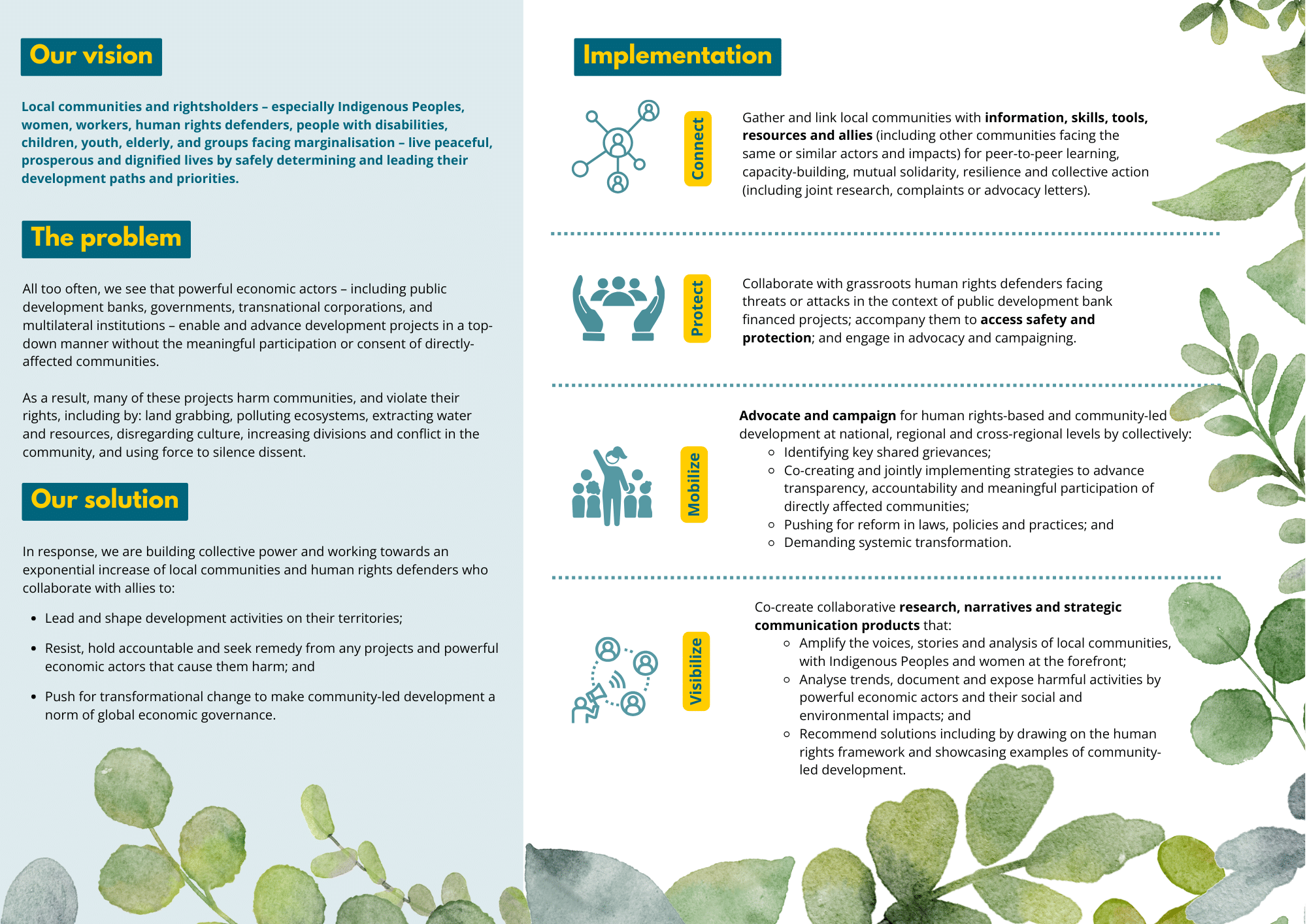
Our vision is local communities and rightsholders – especially Indigenous Peoples, women, workers, human rights defenders, people with disabilities, children, youth, elderly, and groups facing marginalisation – live peaceful, prosperous and dignified lives by safely determining and leading their development paths and priorities. All too often, we see that powerful economic actors – including public development banks, governments, transnational corporations, and multilateral institutions – enable and advance development projects in a top-down manner without the meaningful participation or consent of directly-affected communities. As a result, many of these projects harm communities, and violate their rights, including by: land grabbing, polluting ecosystems, extracting water and resources, disregarding culture, increasing divisions and conflict in the community, and using force to silence dissent.  In response, we are building collective power and working towards an exponential increase of local communities and human rights defenders who collaborate with allies to:  lead and shape development activities on their territories;  resist, hold accountable and seek remedy from any projects and powerful economic actors that cause them harm; and  push for transformational change to make community-led development a norm of global economic governance. Implementation: Connect: Gather and link local communities with information, skills, tools, resources and allies (including other communities facing the same or similar actors and impacts) for peer-to-peer learning, capacity-building, mutual solidarity, resilience and collective action (including joint research, complaints or advocacy letters).  Protect: Collaborate with grassroots human rights defenders facing threats or attacks in the context of public development bank financed projects; and accompany them to access safety and protection, and engage in advocacy and campaigning. Mobilize: Advocate and campaign for human rights-based and community-led development at national, regional and cross-regional levels by collectively: Identifying key shared grievances;  Co-creating and jointly implementing strategies to advance transparency, accountability and meaningful participation of directly affected communities;  Pushing for reform in laws, policies and practices; and  Demanding systemic transformation.  Visibilize: Co-create collaborative research, narratives and strategic communication products that: Amplify the voices, stories and analysis of local communities, with Indigenous Peoples and women at the forefront; Analyse trends, document and expose harmful activities by powerful economic actors and their social and environmental impacts; and Recommend solutions including by drawing on the human rights framework and showcasing examples of community-led development.


Theory of change
Executive Summary Manifesto for website (1)

Our Manifesto from 2026 to 2030