

For years, Agnes had watched decisions being made, repeatedly, by men who did not consider how their decisions would shape the lives of the women and children around them. She was uncomfortable with how the women around her chose silence despite their concerns, and decided that she would be different.
For Penina, gender is not a separate issue to land, health and culture, but a central to all of them. When she formed the Sotua Ang’ Community Based Organization over a decade ago, she explicitly structured it as a women-led organisation to ensure women could shape decisions affecting their lives.
Penina Nailantei Koilel and Agnes Koilel, despite not being biological siblings, call themselves sisters. They are both Kenyan Maasai women leaders who decided to challenge the patriarchal norms. In territories threatened by geothermal expansion, they confront not only patriarchy, but a broader configuration of power that places land, decision-making, and value extraction firmly outside the control of affected communities.
Agnes: refusing silence
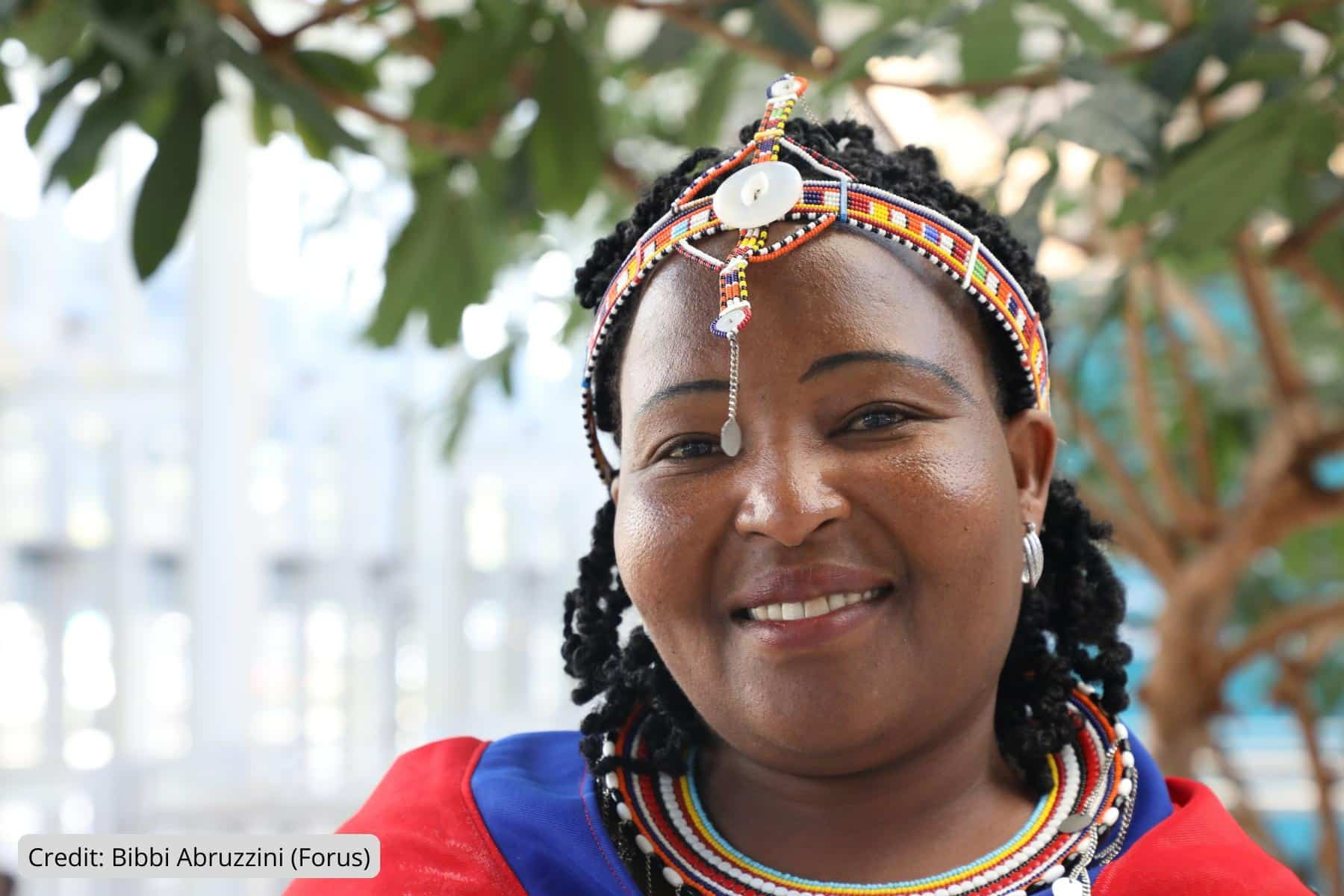
Agnes Koilel at the Finance in Common Summit (FICS) in Capetown, 2025
Agnes describes her decision to speak out as the result of years of witnessing injustice: “There are things I saw,” she explains, “and I knew they were not good for us.”
Agnes is one of the community leaders of the Narasha Community Development Group (NCDG), an organisation founded by Jackson Shaa to resist the displacement and loss of land linked to geothermal projects in Olkaria, around 100 km northwest of Nairobi in the Great Rift Valley. As Maasai in Nakuru County, they were a minority with limited representation, while decisions about their land were being made without them.
In early meetings with geothermal stakeholders, women were largely absent or ignored. Agnes recalls raising her hand repeatedly without being acknowledged. Eventually, she stood and spoke without invitation: “Now it is enough. I must speak,” she said. It was a refusal to wait for permission in a space where permission was rarely given.
Her decision was shaped by her foundational years growing up in a patriarchal society where women often had little say in household or community decisions. She sees her role in the CBO as challenging that expectation. “For the sake of the other women, I have to speak out.”
Agnes speaks openly about the tension this creates. Some recognise the value of women’s leadership, while others view it as a challenge to established authority.
As a trained teacher with a university degree, she also sees how education has expanded opportunities for some women. The arrival of energy projects has reinforced this. Employment opportunities are tied to qualifications that many local people do not possess. “People are coming from very far away, being employed… and for us we are denied that because of the lack of education.”
The push for schooling is therefore not only about girls’ empowerment, but also about how to survive and benefit within a changing economic landscape.
Penina: organising through knowledge

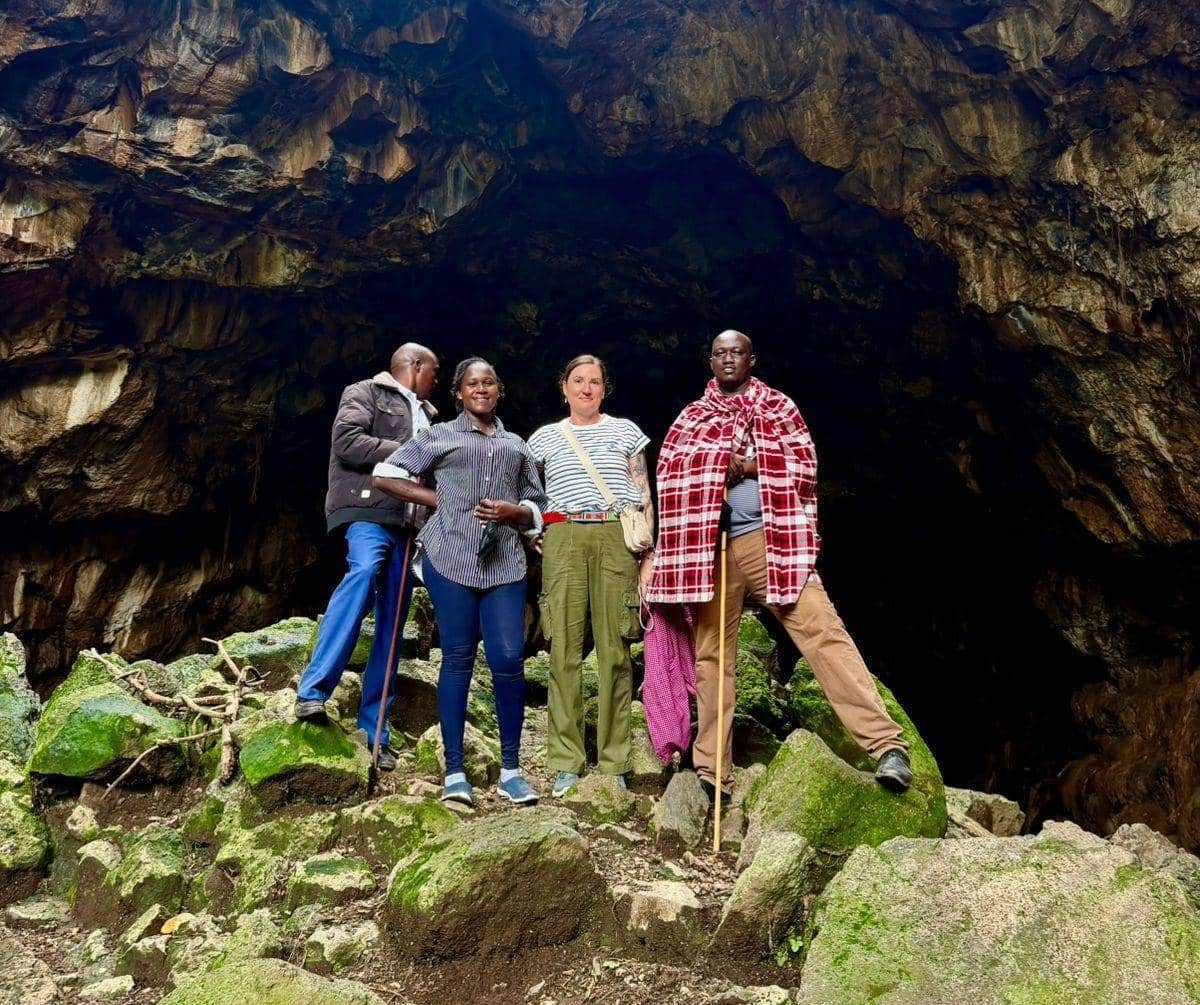
Penina Nailantei Koilel in Mount Suswa
After years of advocacy around human rights, land struggles and early marriage, Penina formally established the Sotua Ang’ Community Based Organisation in 2023.
“We realised that the cases we were dealing with were becoming very serious,” she says “We needed to organise ourselves as a group so that we could help ourselves, and also protect our names.”
Penina lives near Mount Suswa, one of Kenya’s several active volcanoes, south of Olkaria. As energy companies expanded into the region, her advocacy work extended into development and land rights in addition to women’s rights. But the questions remained similar: who decides, who is included, and who carries the consequences.
She recalls being labelled “aggressive” when she was younger, a criticism often directed at outspoken women. Studying gender and development at Egerton University helped her understand these experiences differently.
“I realised that the way I was behaving when I was young was actually leading me in the right direction,” she says.
Her interest in gender justice was shaped by her own family experience. Raised by a mother, who was also married off young, she wanted to understand the forces shaping women’s lives and find ways to challenge them. What started as a desire to support her mother expanded into broader community advocacy.
Penina is clear that this work involves navigating resistance both from government and project developers, and within her own community. To address this, she focuses on building relationships and explaining her work, using a distinctly feminist approach where leadership and authority is negotiated, built through conversation and recognised from within, rather than forced or assumed.
Education provides confidence, she explains, and the ability to understand laws, participate in meetings, and to defend one’s position.
Successes
For Agnes, the most immediate success is that “the community now at least has a voice.”
She points to the Olkaria 7 project, where KenGen – with funding from the African Development Bank among others – planned to build a new geothermal plant on community land, requiring the relocation of a school, churches and family homesteads. The initial public participation meeting was attended by only a handful of community members. Agnes and others rejected the process: “Twenty people cannot decide for the whole community”, she explained.
They insisted that the meeting be postponed until the wider community could participate. The geothermal plant went ahead, but crucially, not on community land, as it was relocated to land under the Kenya Wildlife Service. For her, this demonstrated that communities could influence outcomes.
She also notes a shift in how companies now engage with the community. While challenges remain, future projects are unlikely to proceed without greater community engagement.
For Penina, success is measured not only by outcomes, but by changes within the community itself. Her women-led organisation is now recognised and able to operate in the area, turning into reality what before was only an ambition.
Through training and awareness raising, Sotua Ang’ has supported community members to see that when projects are introduced on their land, they have a right to question them and to respond. Central to this has been introducing free, prior and informed consent (FPIC) as an ongoing process rather than a one-time event.
A proposed solar project in Suswa became a turning point. After learning that consent had been given under unclear conditions, the organisation worked to obtain project documents and engage community members directly. Women spoke about being excluded from earlier processes. Questions were then directed back at the company regarding participation and documentation. The involvement of the Kenyan National Commission on Human Rights brought further scrutiny, irregularities were acknowledged and the local government became involved. Ultimately, the project was stopped, demonstrating the power of information and collective action.
The risks
The work has produced results, but it has also brought them into direct confrontation with power.
Agnes speaks about the difficulty of advocating for land rights as a woman in a context where women are not expected to inherit land. She has faced criticism for speaking publicly and spending time outside the home. On one occasion, she was confronted by government officials while organising a community meeting. “It is not safe,” she says.
For Penina, the challenges are often logistical as well as political. Much of her work takes place in remote areas with poor transport, limited communication infrastructure and few resources. Meetings can involve standing alone in front of hundreds of men, in a context where women are not expected to speak.
Other women will tell you not to speak, she explains, not out of opposition, but out of concern for what might follow.
The work also involves translating legal and technical information into forms that communities can use, often without the tools needed to document or store that information securely. Phones are used to record meetings and share documents, but they are easily lost or stolen, along with the data they carry.
Support is often inconsistent. While both women work with national and international organisations, assistance tends to be concentrated in urban centres. “There are women on the ground risking their lives, and no one knows about them,” Penina says. Without the means to document and share these experiences, much of this work remains invisible.
There are efforts to build connections across communities facing similar pressures. Through networks such as CHRD, contacts have been established between Suswa, Olkaria, Menengai, and Marsabit. These exchanges provide support, but also reveal how widespread these challenges are.
Final demands
When asked what they would say, if given the chance to speak directly to the government, companies, and the banks that finance these projects, neither hesitates.
Agnes immediately identifies land. For her, respect for land is inseparable from health, livelihoods and cultural survival. Communities must be informed about both the benefits and risks of projects and promises made during consultations must be kept. Employment alone cannot compensate for the loss of land and livelihoods to pastoralist communities.
Her message extends beyond the state and companies to the institutions that enable these projects. Development banks, she argues, cannot remain distant. They must understand what they are funding and follow through on how their investments are experienced on the ground. “We are losing our land and changing our way of life,” she says. “Please come and see.”
Penina’s response is shorter, but no less pointed.
“Adhere to FPIC,” she says.
Not as a formality or as a document to be signed, but as a process that is real. Participation must happen within the community itself, not in controlled settings removed from everyday life. Consent must be free, informed, and ongoing. Without that, the process holds little meaning.
The distinction is clear: FPIC as consent, not consultation. It is a line that captures much of what Agnes and Penina have been working toward: not simply being included, but being able to decide.
Read more about the struggle against geothermal expansion in Kenya
Kenya: the true impact of the AfDB-funded Menengai geothermal project
Holding on to Land, Energy, and Justice: A Feminist Story from Mount Suswa to South Africa