

Billionaires capturing politics has become trite news, be it Elon Musk’s gutting of the American government, or Peter Thiel funding JD Vance’s rise to the vice presidency. But billionaire capture of global development finance is less spoken about, despite its enormous impacts on people living in the Global South.
It isn’t normal when a cotton company steals land from farmers in Uzbekistan. It isn’t normal when a fertiliser company in Nigeria makes employees work overtime and then delays paying wages. It isn’t normal when pollution from phosphate mining destroys the crops of rural communities in Senegal. It isn’t normal when schools are forced to temporarily close and residents are hospitalized due to a chemical leak from a polyester plant in Thailand.
All of these abuses can be traced to the Indorama family of companies, controlled by billionaire Sri Pakash Lohia. Despite communities and workers having repeatedly raised the alarm, public development banks – like the World Bank Group, the Asian Development Bank and the European Bank for Reconstruction and Development – continue using taxpayer money to fund projects of massive companies worth over a hundred billion dollars, more than the gross domestic product of more than a third of the countries of the world.
Indorama is not a lone actor: the entire system is broken. Instead of investing in real solutions – resourcing and respecting community-led models of development – development banks keep investing in private companies with known records of environmental harm, labour exploitation and human rights abuses.
This billionaire-led model of development has become the new normal, but it isn’t working. Research shows public development banks are failing to catalyse additional private finance where it’s needed in low-income countries. Instead, the export-driven system is draining resources from the Global South, increasing the wealth of the superwealthy, and failing to meet the needs of workers and local communities.

Stop the hypernormalisation
We need to avoid hypernormalizing this top-down model of development, whose goal is capital accumulation through increasing shareholder value. The global financial architecture that has created these problems cannot also offer solutions.
Across the world, from Argentina to Germany – and even within the United States, the imperial core of capital accumulation presented as development – working people are struggling with rising living costs, inequality, and climate catastrophes. The far-right and authoritarian leaders are exploiting these frustrations by scapegoating Indigenous Peoples, immigrants, unions, activists, and marginalised communities, while continuing to uphold the same exploitative systems driving inequalities.
The system’s failure is particularly evident in the rush towards the energy transition. In Chile’s Antofagasta region, for example, the Indigenous Chango communities were already affected by mining, industrial fishing and coal-powered plants that had resulted in contamination, rising cancer rates, and depletion of fish stocks. The region’s supposed transition to clean energy has brought wind farms, solar panels and green hydrogen initiatives. But behind the promises of sustainability, these projects – imposed with minimal to no consultation with the local communities – have resulted in further dispossession, depletion of water sources and loss of livelihoods.

What if community-led development were the new normal?
Let’s look towards development that is practiced and emerging from the ground up. Community-led development means flipping the top-down development model on its head, and recognizing local women, workers, Indigenous peoples and communities as experts and key decision-makers regarding their own futures.
In Chiapas, Mexico, Indigenous Tzeltal and Tzotzil communities have been building decentralised energy autonomy projects to generate renewable electricity. This has reduced reliance on corporate and state actors who often fail to deliver basic services. It is also an effort to build resilience while resisting militarisation and narco-state violence. As local organisers put it, “Energy autonomy is not just about solar panels, it’s about dignity, land, and the power to decide.”
In Senegal, women’s cooperatives in the Casamance region have developed agroecological farming systems rooted in traditional knowledge, allowing them to feed their communities, regenerate degraded ecosystems, protect against the volatility of global food markets, and adapt to climate chaos. Beyond being development projects, these are practices of care, resilience, and autonomy.
In Nepal, Indigenous Chepang communities in Dirang have led the development and management of renewable energy projects, such as the 15 kW Sankhar Khola micro-hydropower system, bringing clean electricity to over 120 households. These community-led initiatives, supported through local organising and solidarity networks, prioritise energy autonomy, environmental stewardship, and Indigenous self-determination, confronting a history of marginalisation while asserting energy justice in the face of extractivist state agendas.
These stories are part of a growing ecosystem of grassroots solidarity economy initiatives reimagining development by reclaiming collective power over the use of the commons; that is sharing resources for the common good rather than accumulation, privatization and speculation. They are examples of frontline resistances and refusal to be subject to unequal and unjust ‘development’ models.
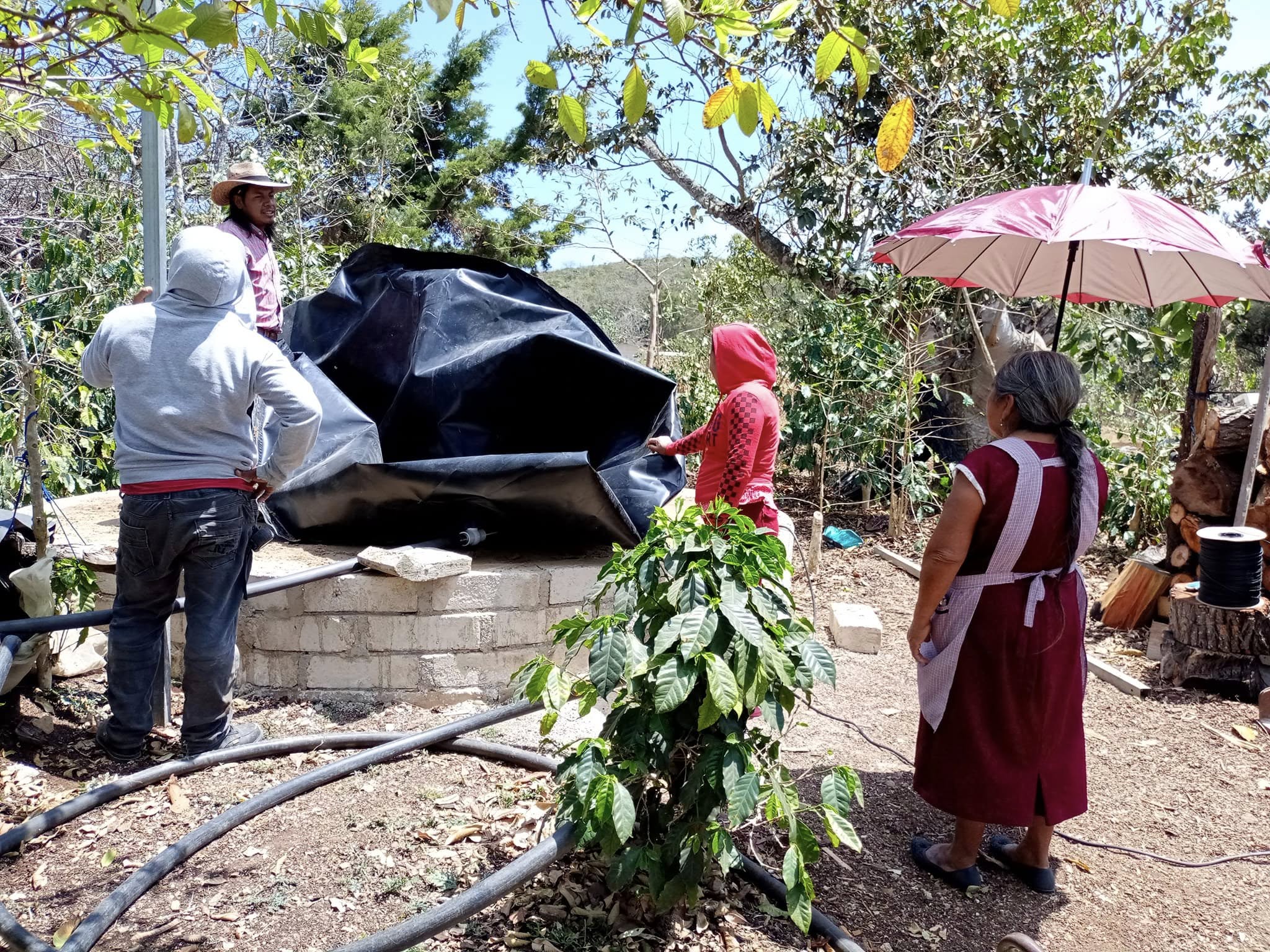
Community-led energy project in Chiapas, Mexico. Read more in this blog. Credit: Otros Mundos Chiapas
Walking the path forward
Community-led development models work. In Uruguay, the cooperative housing system was supported by a pioneer law passed over 50 years ago that affords access to land and financial assistance to communities organised in non-profit cooperatives based on mutual aid, management of resources and collective decision-making with communal land ownership.
To replicate this kind of development model communities must have access to funding and be able to work with power and autonomy. The current system of strategic divestment, political marginalisation, state repression, and co-optation is antagonistic to building community-led initiatives that will have long-term viability.
Supporting community-led development requires redistributing power and wealth. Development finance must stop backing corporations like Indorama and the elite-driven, extractive ‘development’ they pursue. Instead, it should be a tool for funding the efforts of communities already building alternatives. This requires rethinking not just what is funded, but how, by prioritising grants instead of loans, respecting community priorities, ensuring participatory accountability, and the willingness to cede control.
In a world threatened by authoritarianism and ecological collapse, the path forward is not paved with more centralisation and top-down control, but with solidarity, humility, and the leadership of those on the frontlines, particularly women, Indigenous peoples, and rural communities, who dare to imagine and fight for a more just world.
This op-ed was written by Siddharth Akali (Director at the Coalition for Human Rights in Development) and Rebeka Gluhbegovic (Strategy and Resource Coordinator).