

This article – authored by Rhoda Viajar, Sukgherel Dugersuren, and Robie Halip — was originally published by the Asia Sentinel.
For more than four decades, the Asian Development Bank has avoided direct investment in the mining sector. In recent years, however, with many of the world’s conflicts driven by the rush for fossil fuels and, increasingly by the demand for so-called critical minerals, it has radically shifted its stance. Last November, the Bank approved a new Energy Policy, which gives the green light to the extraction of critical minerals, claiming that this move will boost economic development in the region and advance the energy transition.
While the ADB speaks about “responsible and sustainable practices,”, Indigenous Peoples, affected communities, and civil society organizations across the region are sounding the alarm: this new rush toward critical minerals will exacerbate human rights violations and environmental destruction, forcing mining-affected communities to sacrifice their land and resources for the “greater good” amid heightened risks of conflicts and violations.
Yet, despite the inherent and systemic risks posed by the extraction of critical minerals – especially in conflict-ridden regions or in countries where affected communities cannot safely express their views on such projects – many financial institutions are now heavily investing in this sector. The case of the ADB is a stark example of how geopolitical interests and the priorities of economic elites are trumping the rights and needs of local communities directly affected by mining projects.
From widespread militarization in project areas to the use of critical minerals in the war industry, the mining sector is closely intertwined with violence and unrest.
Historically, mining-affected territories have been militarized to intimidate Indigenous Peoples and local communities, quell resistance and ensure “smooth” operations. When people raise their voices to defend their rights and speak out against the destructive impacts of mining activities, they often face reprisals. Private security personnel employed by mining companies, usually acting in coordination with military and police authorities, use excessive force and repress peaceful protests. Mining companies also file Strategic Lawsuits Against Public Participation suits (SLAPPs) to cow community leaders into silence. In the past decade, the mining industry has been considered the deadliest for defenders and communities, with 338 cases of killings and disappearances linked to it.
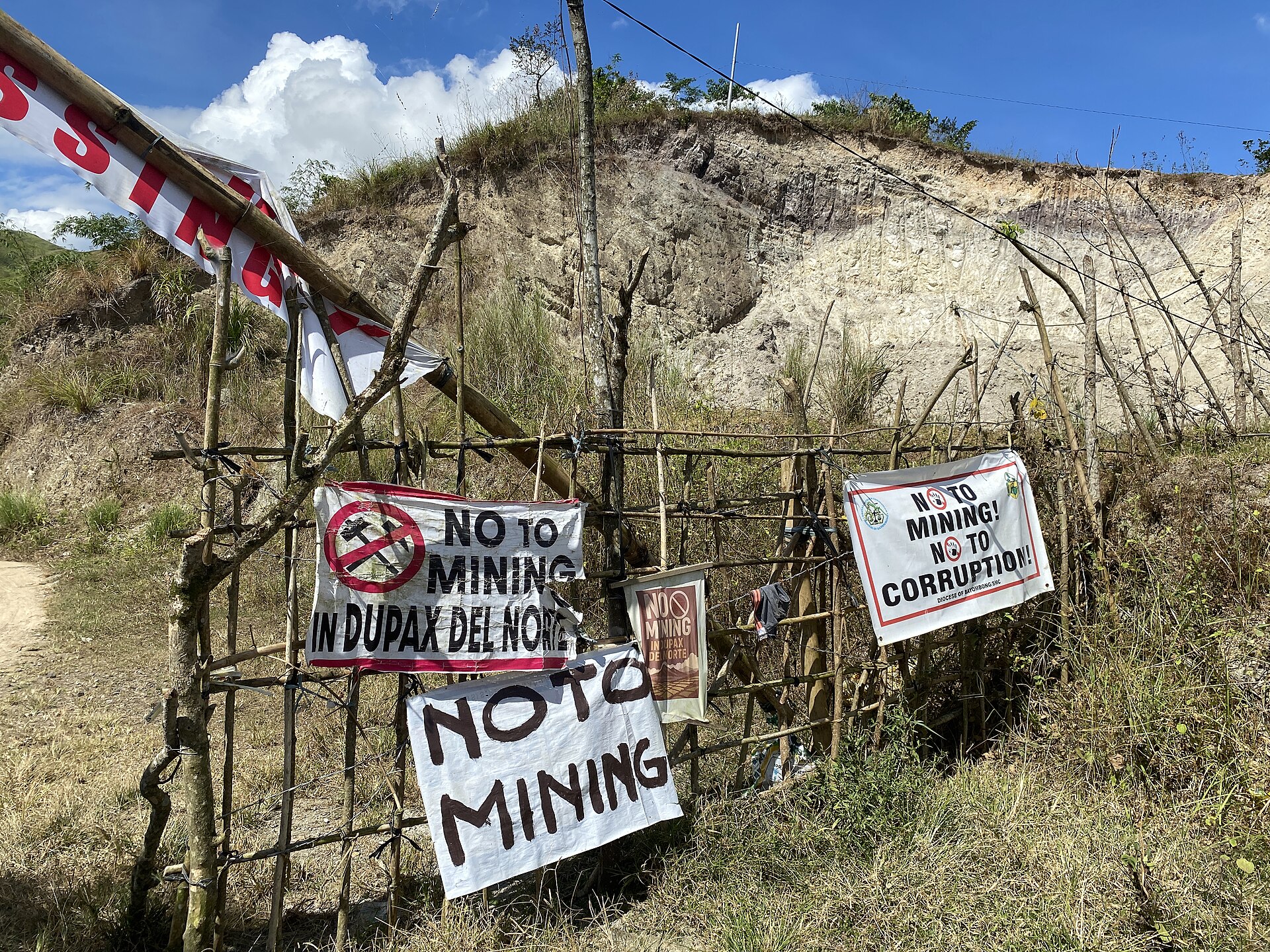
Dupax del Norte anti-mining protest. Credit: Kej Andrés (Ryomaandres) via Wikipedia
In January 2026, for example, the police violently dispersed an anti-mining protest in Dupax del Norte, Philippines, and arrested seven Indigenous environmental defenders. Since September, the local community had set up a barricade to resist copper and gold mining exploration by Woggle Corporation, a subsidiary of a UK-based company, citing concerns over water sources, farmland, and long-term environmental damage.
The violent repression of anti-mining protests is not unusual in the Philippines. In 2023, for example, police authorities forcefully dispersed community residents of Sibuyan Island, who were peacefully protesting the illegal mining activities of Altai Philippines Mining Corporation (APMC). The protestors set up a barricade to prevent trucks from carrying nickel ore, as the mining company had failed to secure the necessary permits. Instead of holding APMC accountable for their illegal operations, police personnel targeted the demonstrators and broke up the barricade, hurting two people. The company also filed SLAPPs suits, targeting the environmental defenders protecting the natural resources of the biodiversity-rich island, known as the “Galapagos of Asia.”
ADB’s growing investments in critical minerals come at an especially risky time when countries in the Asia-Pacific and Caucasus are experiencing increasing constraints to civic freedoms. According to the international NGO CIVICUS, in the large majority of countries in the region civic space is closed or repressed. Yet, as exposed in the report “Financing Repression” — published in 2024 by the Coalition for Human Rights in Development — public development banks are heavily investing in the region, even in contexts where they cannot comply with their own safeguards and uphold the right to meaningful participation.
Historically, development banks have been cautious in investing in conflict-affected areas, recognizing that large-scale projects could further fuel conflicts and that it is difficult to have full control of money flows during unrest. The ADB claims to seek to avoid adverse impacts and adopt a “precautionary approach” in fragile and conflict-affected areas. In 2021, for instance, it stopped sovereign funding to Myanmar, because of the violence by the military junta and widespread social unrest.
However, in September 2025, the Bank moved forward with its first critical minerals project in Balochistan, Pakistan, an intensely militarized region where civic space is extremely closed and that has recorded thousands of enforced disappearances and killings of human rights defenders. The Reko Diq mine risks exacerbating social tensions, attacks against peaceful activists, and environmental and social destruction. In such a context, where people can’t freely voice their concerns, there can be no pathway toward just, sustainable, and inclusive growth.
Before publicly announcing its intention to engage in direct investments in mining projects, the ADB had already begun supporting the sector. In 2023, for instance, the ADB approved a technical assistance project for a so-called “climate-smart” mining project in Mongolia, a country with large reserves of critical minerals (such as copper and uranium) and rare earths. The project was focused on developing a policy framework and advice for attracting investors in the rare earth minerals sector. While the ADB claims these minerals will be sourced to produce renewable energy technologies, they have failed to establish guardrails on where these resources will actually end up. For instance, the local community and CSOs protesting against the rare earth mining project in Khovd argue that it is high in uranium content and thus should fall under the ADB’s Prohibited Investment Activities LIst. Moreover, Mongolia lacks the technical, financial and human resource capacities to prevent nuclear proliferation.
This is especially worrying in the current context, where the growing demand for critical minerals – generally presented as a necessary step towards a greener, better future – is increasingly coming from the war and defense industries. According to the Stockholm International Peace Research Institute, the total global military spending reached $2.72 trillion in 2024, marking a 9.4% increase from 2023. The surge in spending also reflects a surge in the minerals extracted to build weapons and defense technologies. “Minerals demanded for the military drive conflict that fuels further militarization. Meanwhile, the world burns”, writes Cat Rainsford, investigator at Global Witness.
While the rhetoric around critical minerals is centered on economic growth and climate response, fast-tracking the energy transition by replicating a deeply unjust extractivist model creates more harm than good. Increased demand for critical minerals — driven by excessive consumerism — will force communities and Indigenous Peoples’ to sacrifice their lands, livelihoods, rights and way of life, without even getting any benefit.
Extractive projects have long been synonymous with conflict, forced displacement, human rights violations, and the silencing of those who dare to resist. Development banks should refrain from pouring money into mining ventures in countries where civic space is closed or in conflict-affected areas, where communities cannot safely speak out. They should also carefully oversee their supply chains to ensure that extracted minerals do not end up in the war industry.
People on the frontlines of these projects deserve more than empty promises of “consultation.” They need real avenues to raise their voices and effective, gender-responsive grievance mechanisms where they can raise their concerns. Indigenous Peoples’ right to Free, Prior, and Informed Consent must be treated not as a box-ticking exercise, but as a fundamental principle of self determination and justice. And most of all, if affected communities say no and reject a project, this choice should be respected: their voices need to be listened to, not ignored and silenced.
About the authors
Sukhgerel Dugersuren is a Mongolian woman human rights defender and executive director of Oyu Tolgoi Watch (OT Watch) and Rivers Without Boundaries,
Rhoda Viajar is a media and communications expert with the Philippines-based Alyansa Tigil Mina (ATM), a coalition of mining-affected communities and civil society organizations in the Philippines.
Robie Halip is the Executive Director of the Right Energy Partnership with Indigenous Peoples (REP) and coordinator of the Indigenous Peoples Major Group for Sustainable Development in the Philippines.