

In the heart of Kenya’s Rift Valley, the Menengai geothermal project—despite being presented as a green, sustainable solution advancing a “just” energy transition—is causing serious noise, air, and environmental pollution while negatively impacting the communities living near the construction area. Consultations around the project were flawed, and the concerns raised by local activists and community members have been repeatedly disregarded. Moreover, the project has failed to ensure benefit-sharing and equitable employment opportunities.
The project, run by Kenya’s state-owned Geothermal Development Company (GDC), is backed by a $198.4 million investment from international partners. The African Development Bank Group (AfDB) provided a $120 million concessional loan and helped mobilize additional funding from the Strategic Climate Fund, the Eastern and Southern African Trade & Development Bank, and the Finnish Fund for Industrial Cooperation.
The project currently includes three power plants. The first, built by the Nairobi-based Sosian Energy, is already operational. The second, owned by Globeleq, is expected to be operational by the end of 2025. Meanwhile, Kaishan/Orpower22 has begun constructing the third plant.
In March 2025, the grassroots organization Menengai West Stakeholders Forum (MWESFO) celebrated an important legal victory: recognizing the concerns about harmful impacts, the Environment and Lands Court of the Nakuru High Court revoked Sosian’s current license and ordered a new comprehensive environmental and social assessment.
Key concerns
 Power station at the Menengai geothermal project. Credit: AfDB
Particularly during the drilling and cleaning of geothermal wells in the first phase of the project, local communities reported the following impacts:
-
Noise pollution, which particularly affected children, youth, and the elderly during sleep. In particular, it affects children attending school classes and assemblies.
-
Air pollution, due to the emission of hydrogen sulfide (which produces a rotten egg smell) and the release of other greenhouse gases, metallic elements, and dust.
-
Ongoing acid rain, linked to open brine ponds, which has corroded metallic structures in the villages and led to environmental degradation.
-
Earth tremors during drilling.
-
Human-wildlife conflict, as the destruction of wildlife habitats has forced some animals (such as baboons) to invade local community lands.
-
Health impacts on humans, animals, and vegetation due to environmental pollution, including chest infections affecting children, youth, and the elderly.
In the second phase of the project—focused on constructing the three power plants—communities have expressed concerns about the lack of public participation, benefit-sharing, and equitable employment opportunities. There have also been concerns around the environmental impact assessment, that included information taken from another geothermal project in another region. Companies and local authorities have allegedly favored groups that support the project while silencing dissent. Both GDC and local authorities have reportedly intimidated local communities and their leaders through threats, public humiliation, and smear campaigns.
Affected communities
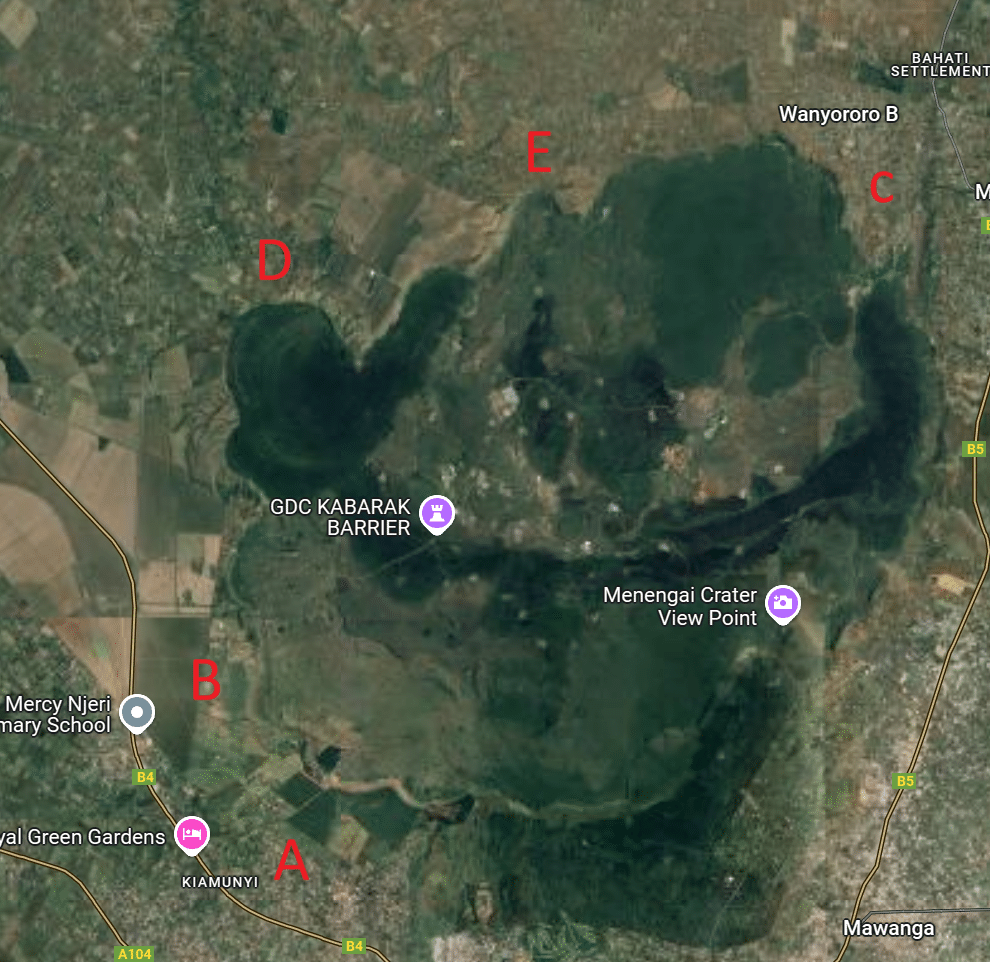 There are five communities surrounding the Menengai Caldera, each experiencing different impacts from the project:
Maciaro (A): Located northwest of the caldera in a rocky terrain unsuitable for cultivation. Seeking land compensation and relocation to arable land, this community supports the project.
Mercy Njeri (B) & Wanyororo (C): Situated along the tarmac road from Kabarak to Nakuru (Mercy Njeri) and in the southeast of the caldera (Wanyororo), these communities are far from the project site and experience minimal side effects.
Olrongai (D): Located on the northwest rim of the caldera, this community relies on animal and crop farming. Positioned on the windward side, they suffer the worst negative impacts.
Arahuka (E): Bordering Olrongai to the east, this community relocated from forest land and now consists mainly of small-scale farmers. They also face significant project-related effects.
The Olrongai and Arahuka communities, which bear the brunt of the negative impacts, have strongly opposed the project. Together, they comprise around 100,000 people. In 2019, they formed the Menengai West Stakeholders Forum (MWESFO) to advocate for their rights.
Project history
Phase 1
-
In 2007–2008, KenGen began exploring and drilling geothermal wells. During this phase, the company engaged with a few local, illiterate elders, informing them only about potential benefits (electricity and water connectivity, road construction, schools, hospitals, and other social amenities) while downplaying the risks. Despite this, the company considered this process as “public participation.”
-
In 2009, the state-owned Geothermal Development Company (GDC) took over the exploration of geothermal wells.
Phase 2
Three independent power producers currently operate in the area: Sosian Energy, Globeleq, and Kaishan/Orpower22.
-
In 2020, Sosian Energy began constructing the first power plant, completed in 2022, with work carried out by the Chinese-owned Kaishan company. The plant was supported by with a $68 million credit investment from the Development Bank of South Africa, while the AfDB is set to fund further exploration wells.
-
Globeleq, also funded by the AfDB, is constructing the second plant, expected to be completed by the end of 2025. This project has offered more community engagement, employment opportunities, and benefit-sharing, though concerns remain.
-
Kaishan/Orpower22 (associated with Sosian, as Kaishan built the first plant) has started constructing the third power plant. Concerns persist about employment opportunities and public participation. The company reportedly consulted only the Maciaro community—the most supportive of the project—when preparing its environmental and social impact assessment. Additionally, during a recent community meeting about the Kaishan/Orpower22 plant, local authorities allegedly discouraged the community from raising concerns so they could secure AfDB funding.
The Arahuka and Olrongai communities worry about further investments in the area, as rumors suggest KenGen is interested in expanding its operations.
The case against Sosian Energy
Sosian Energy is a Kenya-based energy company linked to a high-profile politician who owns land near the Menengai Caldera, close to the Arahuka and Olrongai communities.
Inside the caldera, Sosian operates one of the three power plants and plans to expand by drilling new geothermal wells—some less than 200 meters from schools, homes, public services (including a water tank and cattle dip), and community burial sites.
Concerns include:
-
Public participation: Sosian claims to have conducted consultations, but community members say the company invited people from villages up to 40 km away rather than those most affected.
-
Community division: Sosian has reportedly tried to sow discord among local communities, branding vocal opponents as “hostile.”
-
Employment discrimination: Only supporters of the project have been employed, while those most affected have been excluded—only 5 out of 200 employees are from Olrongai and Arahuka.
-
Failure in corporate social responsibility: Sosian has provided little support to local communities, apart from distributing 1 kg of rice and 1 kg of sugar to 25 families.
In April 2021, MWESFO filed an appeal against Sosian Energy and the National Environment Management Authority (NEMA), arguing that the geothermal exploration license was issued without adequate public participation and that the environmental impact assessment was substandard. The assessment:
-
Lacked baseline pollution data.
-
Failed to account for the cumulative impacts of multiple geothermal projects.
-
Incorrectly described the land as “not highly arable.”
-
The environmental impact assessment was conducted by a consultant without a regular license.
-
Downplayed the value of local properties.
On March 13, 2025, MWESFO secured a legal victory when the Environment and Lands Court of the Nakuru High Court revoked Sosian’s license, ordering a new comprehensive Environmental and Social Impact Assessment Study that must consider community concerns.