

The communities of Tambores and nearby towns, in northern Uruguay, have never had to worry about water shortages. Their territory is home to the Guaraní Aquifer, one of the largest freshwater reserves on the planet, shared by Argentina, Brazil, Paraguay, and Uruguay. However, a large-scale project — aimed at producing tons of e-methanol and green hydrogen to export energy to Europe — now threatens one of Tambores’ most precious resources.
“While in Europe they’re buying a clear conscience by consuming energies they call “green”, this territory will become a desert. This is called neocolonialism, and it’s anti-constitutional,” says one of the activists leading the resistance against the Tambor Project.
From Chile to Uruguay, green hydrogen is being promoted as the “magic wand” capable of simultaneously solving the region’s energy crisis, driving the post-fossil fuel transition, and boosting economic growth. Dubbed the fuel of the future, it has quickly become one of the most promoted energy technologies in recent years, capturing the attention of governments, development banks, and industries seeking to decarbonize the global economy. But who will really benefit from it, and who will be sacrificed once again?
Looking closely at the processes required for its production, it’s clear that green hydrogen is not as clean or efficient as it is often advertised. Debates surrounding its production and use reveal a much more complex picture that goes beyond chemistry or engineering, and forces us to talk about land, water, and justice.

What is green hydrogen and how is it produced?
Hydrogen is the simplest and most abundant element in the universe, but on Earth it almost never appears on its own: it must be extracted from water or compounds such as methane, a process that requires a lot of energy. Therefore, hydrogen is not an energy source like the sun or wind, but rather an energy carrier: it is used to store, transport, and use energy. It is light, versatile, and could help decarbonize polluting sectors such as steel, maritime transport, and aviation.
There are several types of hydrogen, such as gray, blue, black, pink, and green, depending on how it is obtained. Green hydrogen is the most “popular” and politically attractive because it is produced by electrolysis, a process that separates water into hydrogen and oxygen using electricity from renewable sources such as solar or wind.
As the world faces increasingly severe climate crises and new trade pressures, such as the European Union’s Carbon Border Adjustment Mechanism, hydrogen is positioning itself as a key component of the energy transition. On paper, it seems ideal because it does not generate direct greenhouse gas emissions.
But its appeal fades when we take a closer look. Producing green hydrogen requires large amounts of renewable energy, which means huge solar and wind farms that take up large tracts of land. These are often installed in rural areas or indigenous territories, replicating familiar extractive logic: land and resources are taken in the name of the “green transition,” but the benefits often travel far away, while local communities bear the cost.

Water use is also a critical issue. Electrolysis requires very pure water. In arid regions, desalination of seawater is proposed, but this process consumes a lot of energy and generates brine that can damage coastal ecosystems. In addition, hydrogen is so light that it easily leaks during transport and storage, affecting the chemistry of the atmosphere and indirectly contributing to global warming.
In reality, hydrogen is not inherently sustainable; it depends on where, how, and for whom it is produced. Today, there is a risk that the “hydrogen rush” will deepen inequalities between the global North and South, with projects in resource-rich countries primarily supplying export markets, without responding to local needs.
For example, as members of the Coalition for Human Rights in Development, such as Sustentarse and Recourse, have documented, Chile wants to become the world’s leading producer of green hydrogen by 2030, but 70% of the energy for its domestic consumption still depends on fossil fuels. The paradox is even more evident in Namibia, which will export green hydrogen to Europe, even though 45% of the local population does not have access to energy. In addition, the construction of green hydrogen facilities is currently being planned on the basis of very optimistic forecasts, but experts warn of a possible oversupply, given the uncertainty about costs and efficiency.
Green hydrogen thus moves between promise and paradox: it can be a tool for decarbonization, but it can also expand and intensify extractive practices, either by encroaching on new territories and seas or by deepening impacts in areas already affected by other industrial plants, as is the case in the Antofagasta region or the Isthmus of Tehuantepec in Mexico, where green hydrogen joins other mega-projects degrading the territory. Understanding its true dimension requires looking beyond its “clean” image and questioning the social, ecological, and political implications of its expansion.

The role of development banks
All major public development banks are investing heavily in the green hydrogen sector, presenting it as the ideal solution to the climate crisis and the need to explore new energy sources. However, organizations and communities denounce that “green” hydrogen is a false climate solution that reproduces extractivist and colonial logic by prioritizing the interests of the Global North.
In Latin America, among the main investors there are the Inter-American Development Bank (IDB) and the World Bank.
According to the IDB, Latin America is the fourth region with the greatest potential for H2V exports in the world, supplying “clean and cheap” energy to countries in the Global North. The European Union, Japan, and Korea would be the main importers.
In line with this, the IDB is supporting governments and private actors in the region to develop and establish an industry for the production, local adoption, and export of H2V and its primary derivatives, including ammonia and methanol, providing both technical assistance and financial support. The IDB actively supports green hydrogen through various initiatives, including direct financing, technical cooperation (it has supported the development of roadmaps for the development of the industry in 15 countries in the region), the creation of a clean hydrogen certification system, and the development of a regional mechanism to promote its adoption in Latin America and the Caribbean. In 2023, it approved a loan of US$400 million to boost this industry in Chile. However, to date, no industrial-scale projects have materialized in the region, and only in Brazil are there initiatives that are approaching more advanced stages for a final investment decision.
Chile has also received support from the World Bank, which since 2020 has contributed to the development of regulations and an enabling environment to boost demand for green hydrogen, both in the domestic and international markets.
In March 2025, following closed-door meetings with IDB Invest in Puna Arenas that sparked protests by affected communities, the Chilean government launched a US$1 billion fund to promote green hydrogen—with contributions from the IDB, World Bank, KfW, and the European Union—with the goal of leveraging up to US$12.5 billion in private investment for this industry.
To read more about IDB’s energy transition policy and key concerns, check out the briefing prepared by the IDB CSOs Working Group.

Photo credit: Agua es Vida Tacuarembó.

Photo credit: ACUE. Protest in front of hotel in Punta Arenas while IDB Invest meeting took place behind closed doors (March, 2025).
The case of Magallanes, Chile
In the Magallanes region, in the extreme south of Chile, the government is promoting four megaprojects for the production of “green” hydrogen. The projects include extensive wind farms in the Patagonian steppe—public lands erroneously classified as “unoccupied”—to produce and export hydrogen and derivatives such as ammonia. According to the official narrative, these projects are being presented as opportunities for decarbonization, regional development, and employment, positioning Magallanes as a “world leader” in clean energy. However, the Chilean government’s approach focuses almost exclusively on carbon and economic growth targets, without considering the profound social, environmental, and gender consequences that these projects could generate. The two largest projects are:
- HNH Energy: This is the largest megaproject in the country and includes a desalination plant, a wind farm, a multipurpose port, and underground power transmission lines. With an estimated cost of $11 billion, it is managed by a consortium made up of the Austrian companies AustriaEnergy and Ökowind, together with the Danish investment fund Copenhagen Infrastructure Partners (CIP).
- H2 Magallanes (TotalEnergies): consists of an ammonia production plant that will operate with nitrogen captured from the air and green hydrogen generated from wind energy, and desalinated and demineralized seawater. With an estimated investment of $16 billion, the project is managed by TotalEnergies H2, owned by the French multinational TotalEnergies.
Local communities and civil society organizations have expressed serious concerns about the socio-environmental impacts: massive land use, installation of industrial infrastructure in a fragile ecosystem, and insufficient state oversight. Thousands of foreign workers are expected to arrive, with demographic impacts, gentrification, and increased cost of living in an already unequal and isolated region. Ministries such as Women, Housing, and Social Development are barely involved in the process, and financing—through public debt with development banks—was decided without consultation or consent from the communities.
From an ecofeminist perspective, organizations such as A.C.U.E. warn of specific risks for women, girls, and diverse groups. The massive arrival of workers to areas with fewer than 500 inhabitants, already affected by high rates of gender-based violence, could deepen the masculinization of the territories, increase insecurity, and further burden women responsibile for unpaid care work.
Furthermore, these projects do not guarantee local access to clean energy. Magallanes depends almost entirely on fossil fuels for heating:
“In Magallanes, we depend on gas and fossil fuels for 99% of our heating; we live in an extreme area where heating is vital, and yet there is no real proposal to meet our needs. Green hydrogen is presented as a new wave of colonization, very neoliberal, imposing other forms of economy and life that are almost insulting when compared to Latin American realities,” denounces a local activist.

What are we talking about when we talk about false solutions?
By Loreto Vásquez Salvador (A.C.U.E.)
In the case of Magallanes in Chile, we see that the false solution of green hydrogen is being promoted without prior consultations and without guarantees of participation. This means the state is growing its debts to public development banks. This process is also leading to a profound transformation of our identity, as it is further masculinizing our territory, increasing the gender gap in employment, rendering invisible the support provided by unpaid care and domestic work, and making life more precarious in the absence of territorial and socio-environmental planning for such unprecedented scales of production. And all of this is being justified under the pretext that Magallanes will save the world from climate change.
The Chilean state has been totally irresponsible, failing to mention the negative impacts, the absence of buyers and financial security in the market, and promoting the narrative that it is green only because it’s produced through renewable energies, without considering the entire supply chain, production, and transportation.
We, the communities, have the answers, and real solutions that are not based on energy and food sovereignty that perpetuate inequality and dispossession, and that fail to provide climate justice or reparations.
In the face of the multidimensional crisis we are experiencing, what is needed above all is the strengthening of democracy, civic space, and the rearticulation of the social fabric. We need to find measures for adaptation and rethink how we can have dignity and a better life, leaving behind the neoliberal and colonial gaze.
In short, for the communities of Magallanes, these “green” hydrogen megaprojects do not represent a just transition, but rather a speculative business venture with no technological or market certainties. They fear that if it fails—as signs from the sector itself already suggest—it will be the communities who pay the price through more public debt, loss of social rights, and territorial deterioration. That is why they are demanding accurate information, binding participation, and alternatives that prioritize justice, reparation, energy sovereignty, and local well-being, rather than the export of “green” energy abroad.
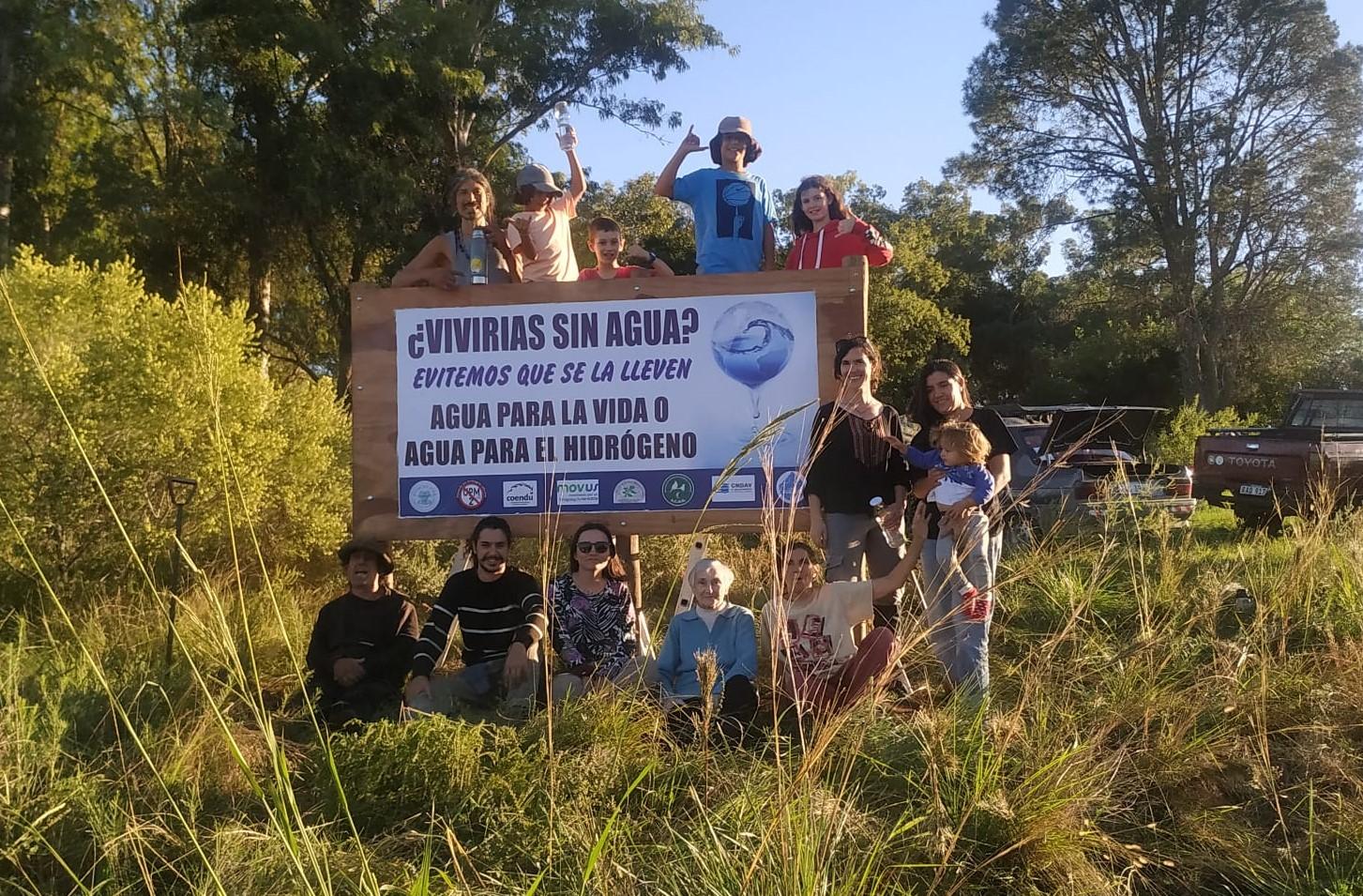
Photo credit: Agua es Vida Tacuarembó.
The case of Tacuarembó, Uruguay
In Tambores, a town in northern Uruguay, the Belasay SA group (created by the German company Enertrag and the Uruguayan company SEG Ingeniería) is promoting a megaproject that aims to produce e-methanol from green hydrogen and biogenic carbon dioxide. The project will include a solar park with 303,000 panels, a wind farm with 33 wind turbines, and an industrial plant to produce 84,000 tons of e-methanol per year, destined for Germany. It also requires associated infrastructure: roads, the passage of more than 120 trucks per day, a railway from Tambores to the port, and more than 1,000 workers in full operation.
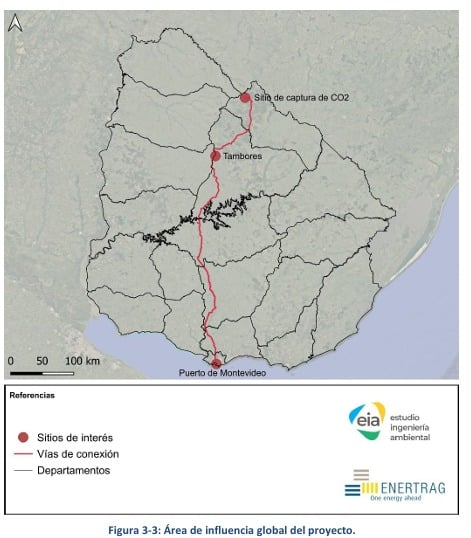
The impact extends beyond Tambores, with infrastructure that will span the entire country (see map below). It would reach Piedra Sola, Valle Edén, Tacuarembó, and other areas connected by water systems, in addition to involving CO₂ transport from Tranqueras and subsequent transfer of e-methanol to the port by train, with high use of fossil fuels. A key concern is that the impacts of these infrastructures are addressed separately in each report, without a comprehensive assessment of the environmental viability of the project as a whole.
“The company is providing water consumption figures, but it is constantly changing its discourse according to the audiences it is presenting to. The national government, and especially the departmental government, are just opening their doors to the company,” says Laura Villalba from the collective Agua es Vida.
The main concern is water: the area is a recharge zone for the Guaraní Aquifer and there are no solid studies on the impacts. There are fears that human access to water, food production, and the water cycle will be affected. The project would also mean the loss of more than 2,600 hectares of productive land, intensive use of fossil fuels and biomass, and effects on flora, fauna, and air currents, reinforcing an extractive model already present in Uruguay (for example, in the forestry, cellulose, and genetically modified soybean sectors).

The arrival of more than a thousand external workers could also lead to negative social impacts and transform small communities, with risks already known: violence, sexual exploitation, problematic drug use, increased cost of living, and loss of traditions. In addition, the report itself—questioned by the Ministry of the Environment in February and still without a new version—anticipates that the few permanent jobs would be for a final group of highly specialized workers, mostly external.
Added to this is a democratic deficit: the environmental report (1,000 pages) was difficult to access and the community was not heard, despite the Constitution, the Law on Access to Public Information, and the Escazú Agreement would require to do so. The Departmental Board first gave space to the company and only agreed to receive citizens after public complaints, but with an inaccessible schedule and several restrictions.
In response, groups such as Agua es Vida and Eco Tambores are coordinating legal, educational, and community actions, together with national networks and specialists. For the community, the project represents an excessive use of water, land, and energy, with benefits concentrated outside the country, while the impacts would remain within.
What are we talking about when we talk about false solutions?
by Pauline Mouton, member of Agua es Vida
We are aware that any human settlement and industrial venture has an impact and, however small, affects someone or something in the surrounding environment. We also know that the necessary changes cannot happen quickly or easily, simply because of the intersection of interests and ways of seeing and being in the world that still coexist and will continue to do so.
But who decides what is included and what is excluded? What is the real cost? Who really benefits? We are also firmly convinced that the small area in which we live cannot withstand further excessive use of water, soil, and air.
Without water, there is no life for people, animals, or plants. Without water, Tambores and the surrounding areas will become a desert, while in Europe they buy a clear conscience by consuming energies they call green. That is neo-colonialism, and it is unconstitutional.
Water is not for sale or export. What do we want? False promises of work and progress, or a Uruguayan countryside that cares for, loves, and enjoys its natural resources with sovereignty and sustainability?

Photo credit: Agua es Vida Tacuarembó.
The case of Paysandú, Uruguay
In the department of Paysandú, on the banks of the Uruguay River, a megaproject is underway to produce synthetic fuels from green hydrogen for export. It is led by HIF Global, an international electrofuel company founded in 2016 by the Chilean-Peruvian company AME and backed by German car manufacturer Porsche AG. The project envisages an e-fuel plant in Constancia, 15 km from the city, alongside two large renewable energy parks—the Lucía Solar Park and the Elenam Wind Farm—which will supply the plant.
The project is still in its initial phase and construction is expected to begin in the second half of 2026. HIF Global submitted a 372-page technical report to the Ministry of the Environment to request “environmental feasibility of location,” a preliminary step to the Environmental Impact Study.
Although it is being promoted as a commitment to decarbonization and employment, various voices are questioning these promises. They warn that most of the jobs would be temporary, while the operation would require little labor and could displace current jobs, especially those linked to tourism. They also point out that the fuels produced would be mainly destined for export, with no direct benefit to the local population.
Local organizations and the National Network Against Green Hydrogen denounce secrecy, recalling that the Memorandum of Understanding signed in February 2024 includes a confidentiality clause that prevents its content from being disclosed. Communities also question the narrative of “green hydrogen,” referring to the plant as a synthetic fuel refinery. They fear that, under the discourse of energy transition, an extractive model with intensive use of land, water, and energy will be deepened, with impacts that would fall on the territory.
Community resistance is growing. The collective Paysandú por un Uruguay Soberano – UPM2 No (Paysandú for a Sovereign Uruguay – UPM2 No) promoted a popular initiative to enable a departmental plebiscite on the installation of hydrogen plants. In a few months, it gathered the 15,000 signatures required and continues to gain support. Actions include rallies on the General Artigas international bridge under the slogan “No to the hydrogen plant opposite Colón,” cross-border caravans with Argentian activists (because Paysandú is opposite Colón, Argentina), public interventions, and cultural activities.
The movement also denounces the pressure of international financial architecture and the role of multilateral banks in promoting Uruguay as a producer and exporter of hydrogen and e-fuels, conditioning public policies. In a territory with high unemployment and social vulnerability, many families see the project as an economic opportunity, generating internal tensions in the face of socio-environmental risks.
At the same time, community networks and cultural collectives organize art, festivals, and gatherings as forms of creative resistance and community building. The slogan is linked to struggles for water, land, and sovereignty, connecting the local with global debates on environmental and energy justice.

Photo credit: Movimiento Soberano Paysandú UPM 2 NO. Social media graphic to raise awareness about green hydrogen impacts.
Conclusion
The promises accompanying “green” hydrogen—development, employment, decarbonization, and global leadership—become blurred when looking at its real impacts on the ground. In Magallanes, Tambores, and Paysandú, megaprojects are moving forward under a familiar logic: land and water appropriation, public debt, opacity, lack of consultation, and a savior narrative that justifies new forms of extractivism under the guise of “green.” Far from democratizing energy, these projects prioritize exports and corporate interests, deepening historical inequalities between the global North and South.
In the territories, communities are not rejecting the energy transition; they are questioning what transition we are talking about, for whom it is being produced, and at what cost.
They point out that without binding participation, without energy sovereignty, without redress for socio-environmental injustices, and without a feminist and intercultural approach, the so-called “green” transition ends up being a continuation of the same extractive model it claims to replace.
To be truly just the transition must be led by communities, have a feminist and inclusive approach, and be based on principles of justice. Otherwise, it is merely a step backward rather than forward.