

Between April 24 and 29, 2026, the First Conference on Transitioning Away from Fossil Fuels was held in Santa Marta, Colombia, convened by the governments of Colombia and the Netherlands. The gathering brought together leaders from 57 countries, financiers, communities, organizations and social movements, traditional communities, and Indigenous peoples with the goal of advancing toward an orderly, just, and equitable phase-out of fossil fuels, in a context marked by the lack of concrete agreements in multilateral climate negotiations to reduce global dependence on oil, gas, and coal. This context is also shaped by geopolitical conflicts that highlight the need for a different approach and the urgency of transitioning beyond fossil fuels.
Unlike traditional climate summits focused on technical negotiations, this was not an official negotiation space. Rather, it sought to identify the main political, economic, and social barriers to a transition away from fossil fuels. It also aimed to discuss possible pathways to overcome these barriers while building consensus to help shape the roadmap for the COP30 process and subsequent steps toward COP31.
In this context, the Coalition participated in the various civil society and social movement coordination spaces, alongside communities where we were able to debate and exchange ideas together in order to influence discussions on climate justice and energy transition. We emphasized that a truly just transition cannot reproduce the same extractivist logics that have historically affected Indigenous peoples, Afro-descendant communities, peasant communities, and other territories across the Global South.
Faced with proposals focused exclusively on technocratic solutions or on the expansion of new sacrifice zones for “critical” minerals, organizations stressed the need to place human rights, the self-determination of peoples, the protection of territories, and the effective participation of communities — including governance over their own territories — at the center of any energy transition. They also underscored clear messages that access to energy is a right and rejected false solutions. A just transition is not merely a substitution of energy sources, but a transformation of the model itself, with real actions and commitments to break with patterns of exploitation and domination over people and nature.

Panel discussion at the event ‘Women’s Fossil Fuel Phaseout Forum: Halting Extraction and Advancing a Just Transition’ organised by Women’s Earth and Climate Action Network (WECAN) | 25 April 2026
Participation in spaces organized by communities and territories
From 24 to 26 April, the People’s Summit took place, organised under the leadership of Climate Action Network (CAN), Demand Climate Justice (DCJ) and the Permanent Council for a Just Energy Transition, as international organisations and networks acting as facilitators to discuss and develop contributions for the official High-Level Segment, where state actors came together to shape the outcomes of the Conference.
In parallel, and with overlapping participation, several organisations present at the People’s Summit also took part in the Conference for Fossil-Free Territories, a self-managed forum. Both forums engaged in exchanges to enrich contributions and share future agendas, looking beyond Santa Marta.
Here you can read the People’s Summit Declaration and the Declaration of the Conference for Fossil-Free Territories
From the coalition, we also participated with several members and allies in the March for Climate Justice and the End of Fossil Fuels, which took place on 27 April in Santa Marta.
The mobilisation brought together indigenous peoples, environmental organisations, youth groups, trade unions and social collectives from different territories, in coordination with international networks and processes present at the conference. Throughout the day, public actions and collective statements were made, questioning the continuation of the extractive model and warning that the transition cannot be built by repeating the same logic of dispossession.

March for Climate Justice and an End to Fossil Fuels
Reflections on the conference
Santa Marta leaves us with a bittersweet feeling: on the one hand, the exchanges and debates between organisations, movements and communities point the way towards hope regarding how to bring about real change.
Where the wisdom of indigenous peoples and other communities regarding coordination and ways of life in harmony with nature is a reality.
Here, the importance of care work and the sustainability of life is central, recognising the role played by women in particular, and the need to advance this vision of acknowledging our eco-dependence.
Here, the importance of community participation in defining their own development paths was emphasised, with real mechanisms for governance and decision-making on actions and policies towards the energy transition.
But it also became clear that when it comes to engaging with decision-makers, this wealth of vision and approach is often reduced to technocratic formulations, where effective and diverse participation in shaping national and global changes is not guaranteed.
One thing is very clear to members and allies of the Coalition: the demands we are building for a just transition will continue to be a fundamental part of our work, including coordination for advocacy with state and funding actors, because a truly just energy transition cannot be built without community visions.
The networks and alliances we have forged have emerged stronger from Santa Marta, enabling us to amplify and continue advancing the alternatives that communities are already developing.
Likewise, we will continue the process of incorporating the contributions from Santa Marta into the following forums and, above all, towards COP 31, monitoring and advocating so that States assume their differentiated responsibilities, changes occur among finance actors whereby they take responsibility for the steps they must take to achieve real change that makes a just transition viable, and private actors also respect human rights, whilst all are held accountable for their actions.
Ivahanna Larrosa at the meeting with Elisa Morgera, the United Nations Special Rapporteur on climate change and human rights
Our demands for a truly just transition
A truly just energy transition requires recognising communities as key decision-makers — with women and indigenous peoples at the forefront — and placing their knowledge and priorities at the heart of global energy policies.
See our demands and position paper, drawn up by the members and partners of the Coalition for Human Rights in Development, to find out about our key demands.
XXXXXXXXXXXXXXX
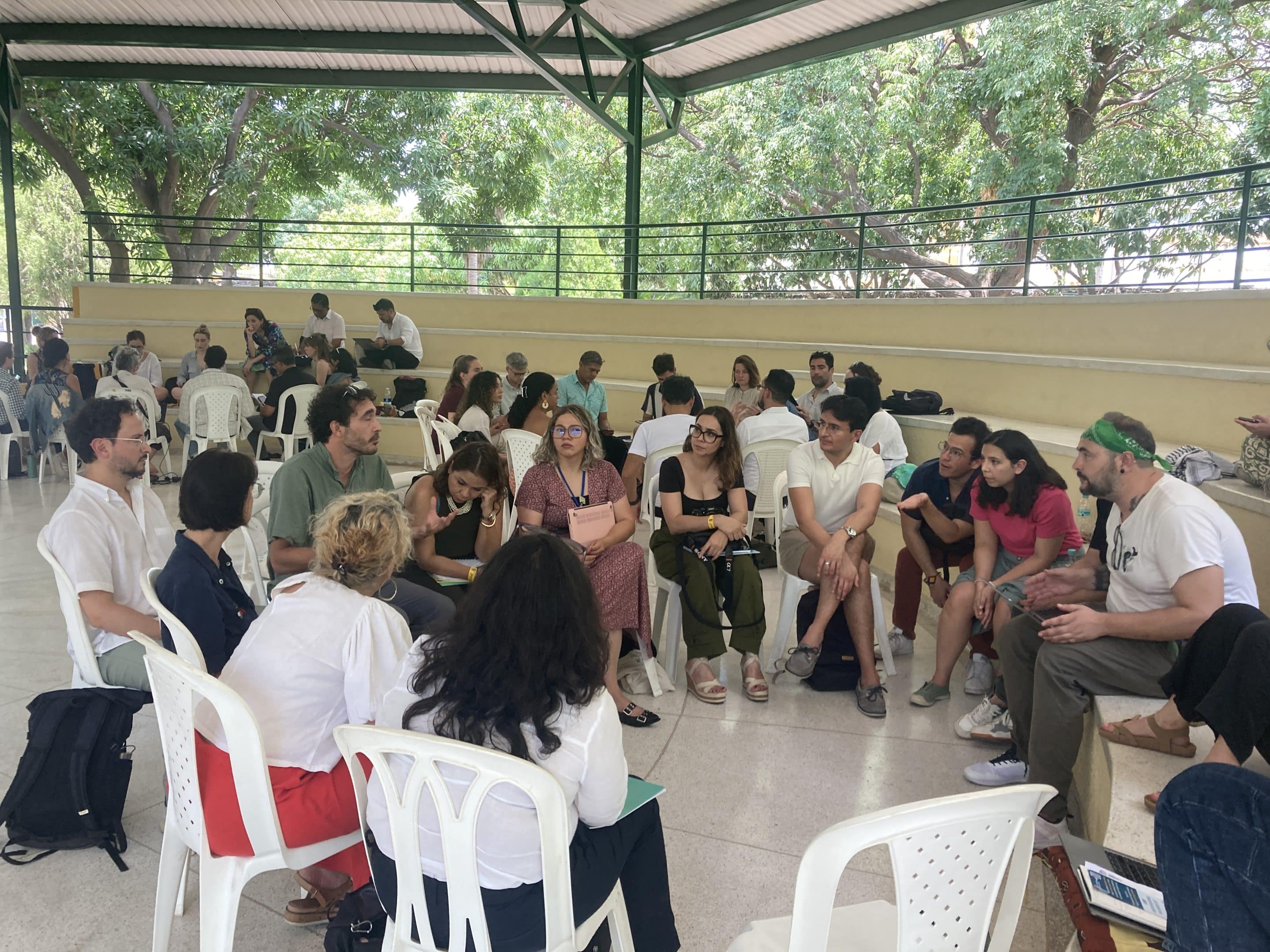
NGO Sector Meeting at the People’s Summit
Reflections from our members and partners:
- Santa Marta: a starting point for moving towards a just socio-ecological transition (FARN)
- Santa Marta’s Test: Turning Fossil Fuel Commitments into Rights-Based Action (GI-ESCR)
- Monitoring actions: Transition beyond Fossil Fuels: CAUCE at the People’s Summit and the International Conference (CAUCE)
- From everyday life to the energy transition (Environment and Society)
- LATINDADD’s reaction to the outcomes of the 1st Conference on the Transition Beyond Fossil Fuels (LATINDADD)
- Financing, justice and the fossil fuel phase-out: reflections following Santa Marta (GFLAC)