

About the project
The Anhui Congo d’Investissements Miniers (SACIM) operates an industrial diamond mine at the Tshibwe deposit in the Kankangayi sector of Miabi Territory, around 45 km from Mbujimayi in Kasaï Oriental. SACIM was established in 2013 following the collapse of previous mining ventures at the Tshibwe deposit. It is a 50/50 joint venture between the Government of the Democratic Republic of Congo and the Chinese company Anhui Foreign Economic Construction (AFECC).
The communities living around the mine depend heavily on subsistence agriculture and artisanal diamond mining for their livelihoods. Many households already face food insecurity and limited access to basic infrastructure, including safe water and sanitation. Against this background, the expansion of industrial mining has created significant tensions over access to land, compensation, livelihoods and the distribution of mining revenues and benefits.
According to a CRONGD investigation involving community members in the sectors of Kakangayi and Tshilundu, the impacts of SACIM’s operations include forced displacement, displacement without compensation, insufficient compensation, destruction of agricultural fields, loss of agricultural land and livelihoods, environmental pollution and health problems. The investigation recorded 50 cases of forced displacement and 27 cases of displacement without compensation, alongside 52 cases involving loss of agricultural land and 55 cases involving loss of livelihoods.
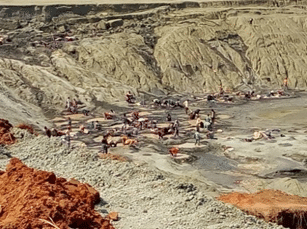 The environmental impacts documented by CRONGD include water and air pollution, soil degradation, destruction of agricultural fields and biodiversity loss. In Kakangayi alone, community testimonies recorded 20 cases of water pollution, 15 cases of air pollution, 16 cases of soil degradation, 55 cases involving destruction of fields and 23 cases of biodiversity loss. The investigation also recorded cases of waterborne and respiratory diseases that communities associate with mining-related pollution.
Community grievances extend beyond the direct environmental and land impacts. The project operators have failed to conduct prior consultation and there is limited community participation, insufficient transparency and numerous unfulfilled commitments by the company. The 2021 community development specifications reportedly included a commitment of US$5 million over five years, but CRONGD states that implementation has been inadequate and that communities continue to face serious deficits in access to health services, water and roads.
Workers have reported serious concerns regarding labour rights, including prolonged salary arrears, dangerous working conditions, alleged physical mistreatment and significant disparities between Congolese and Chinese workers. Women are particularly underrepresented, with CRONGD reporting only three women among 526 workers.
The conflict takes place within a wider context of mining expansion in Kasaï Oriental. Historically dominated by artisanal diamond mining, the province is now seeking to diversify towards critical minerals. In June 2026, the government launched geological prospecting and exploration work for a copper deposit by the Société Minière de Cuivre du Kasaï (MICKA) in Miabi and Kabeya Kamuanga. Although this is a separate project from SACIM, the experience of communities affected by SACIM highlights concerns about how future industrial mining projects will manage land rights, consultation, environmental protection and community benefit-sharing.
ABOUT THE COMMUNITY-LED STRUGGLE
CRONGD is working to strengthen the ability of communities affected by SACIM to document abuses and turn individual grievances into collective demands. The organisation trained and deployed five investigators who gathered testimonies from men, women and young people across villages in Kakangayi and Tshilundu. The resulting research documents violations affecting land, livelihoods, health, the environment and community participation.
The struggle has included collective complaints, engagement with judicial authorities, community testimony, civil-society advocacy and demands for greater transparency and accountability. Six formal complaints were brought before judicial authorities concerning issues including displacement without adequate compensation, destruction of plantations and deaths. The organisation is also calling for regular public forums, or “Tribunes d’expression populaire,” where communities can raise concerns directly and improve communication with the company and authorities.
CRONGD’s advocacy is directed at several levels. It calls on SACIM to respect the Mining Code, fulfil its community-development commitments, provide adequate compensation, rehabilitate damaged ecosystems and improve its relationship with affected communities. It calls on provincial and national authorities to enforce mining legislation, improve the management and traceability of mining revenues, strengthen environmental oversight and ensure that communities receive the benefits to which they are legally entitled.
The organisation is also seeking to raise the profile of community concerns nationally and internationally in order to influence investors, mining companies and government authorities. Its stated objective is not simply to oppose mining, but to ensure that extraction takes place with respect for human rights, environmental safeguards, meaningful community participation, adequate compensation and genuine local development.
A central focus of the campaign is therefore the gap between the economic promises associated with mining and the lived experience of communities around the SACIM concession. While the company has generated employment and some infrastructure, CRONGD argues that these benefits have been outweighed by land loss, environmental damage, inadequate compensation, weak implementation of community commitments and persistent poverty.
CRONGD’s work also seeks to ensure that the experience of SACIM informs the province’s emerging transition towards copper and other critical minerals. By documenting the impacts of existing mining operations, strengthening community capacity and advocating for transparency and participation, CRONGD is seeking to prevent new mining projects from reproducing the same patterns of displacement, environmental degradation and exclusion from decision-making.
FURTHER RESOURCES
A qui profite le diamant du Kasaï Oriental (Southern Africa Resource Watch, 2021)