


By Tala Batangan, CHRD Asia Regional Coordinator
In the first week of May, civil society groups, members of affected communities and human rights defenders came together and attended the 58th Annual Governors’ Meeting of the Asian Development Bank (ADB). Collectively, they raised concerns regarding specific projects that have been harming their communities, risks posed by ADB’s policies and operations to people’s safety and rights, and demanded the bank to contribute to a vision of development that respects self-determined priorities by communities, protects natural resources and the environment, and answers to the calls for accountability and justice.
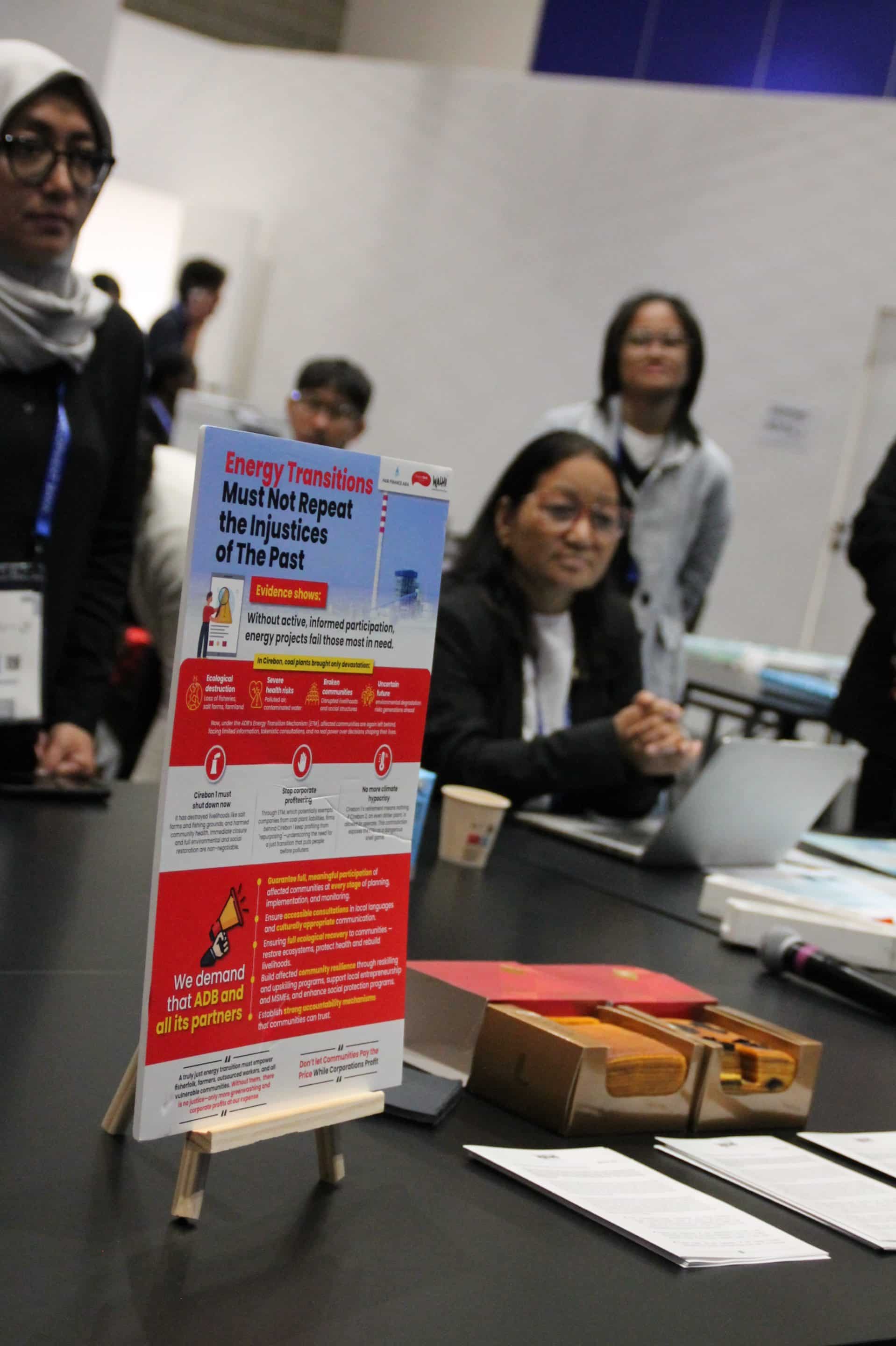 The theme for the meeting, “Sharing Experience, Building Tomorrow”, seemed to suggest that the bank would be listening to all its various stakeholders to improve its operations to build a better future. However, some voices are given more privilege and weight than others. The discussions focused on the benefits of further privatization, large-scale infrastructure development and false solutions for the energy transition – all of which run counter to the calls and demands of civil society. Civil society and affected communities have “been talking about our issues only on the sidelines,” Sukgherel Dugersuren of OT Watch Mongolia says.
Within the limited spaces reserved for them, civil society groups held their own sessions on urgent and important topics – shrinking civic space and reprisals, concerns around the just energy transition, digitalization, and mutual reliance. Along with its members and partners, the Coalition for Human Rights in Development organized the panel discussion “Lessons from the Frontlines: How ADB should step up its response to shrinking civic space and reprisals”, to continue the conversations around civic space started in the previous Annual Meeting in Tbilisi, Georgia.
In the session, defenders from India, Kyrgyzstan, Indonesia, and Thailand highlighted how reprisals and closed spaces have worsened risks and impacts of projects. While the ADB has been making steps in recognizing closed civic space as a risk for its investments and putting in place reprisal protocols, it should do more in measuring and monitoring civic space contexts, as well as advocating with governments and other institutions to promote an enabling environment for communities to participate in development processes. This is especially important in the context of the new Environmental and Social Framework that looks at civic space as a contextual risk and the Accountability Mechanism under review, as reprisals remain as a barrier that can prevent communities from filing a complaint.
 Robie Halip of the Rights Energy Partnership highlighted how Indigenous Peoples call for more safe spaces and that “given the increasing [cases of] reprisals, the ADB has a responsibility to put in place a protection mechanism and not put the responsibility only to borrowers and clients.” This is especially important as the ADB is holding its next Annual Meeting in Samarkand, Uzbekistan, a country with closed civic space.
As the ADB invests in a region with growing threats to civic space, its operations are exposed to multiple risks.
These risks are also more pronounced with the rush for critical minerals and large-scale renewable energy projects. Governments, private actors and development banks are touting these projects as crucial, urgent and strategic solutions to address energy needs and the climate crisis. The bank is presenting its support for mining of critical minerals as “climate-smart”, claiming they are extracting crucial materials for renewable energy technologies with limited environmental impact. However, the ADB still promotes the extractive model of development wherein the tradeoffs are being shouldered by Indigenous Peoples, women, workers, farmers, fisherfolk, and their communities with serious threats to their land, livelihoods, health, traditions and rights.
“The bank should ensure that in the whole process and in the supply chain there is justice, and it should not prolong the devastating impacts on the local community. We want to push the ADB to put people at the centre of this process and not only at the end, says Novita Indri of Trend Asia.
Communities have been clear in stating that any energy project that violates their rights and does not promote their self-determined development are false solutions. This message was delivered loud and clear in the case of the Assam Solar Park. Shortly after the Annual Meetings, the ADB withdrew its USD 434 million loan as a result of the continued mobilization and protests by the community to the project that would risk displacing them from their lands.

There needs to be a mindset shift with the energy transition framework of ADB. As Titi Soentoro of Aksi! for Gender, Social, and Ecological Justice asserts, “the mindset is big-scale investment but [they are] not trying to find out what people can develop within resources in their area… the alternative is developing [energy projects] according to their needs and according to their resources, and it can be small-scale.”
Members and partners of the Coalition continue to demand for the ADB to ensure the principles of community self-determination and meaningful participation, equity in development finance and energy access, accountability, environmental and rights protection are reflected in its energy transition investments.
The ADB, its member governments and private sector clients cannot build tomorrow alone. Sustainable and inclusive development, as well as the energy transition, rests on the participation and cooperation of workers, Indigenous Peoples, communities, defenders and civil society. They must not be excluded or pushed to the sidelines. In order to do that, the ADB must ensure that they are able to partake freely in development processes, without fear of attacks and intimidation, their voices are heard, and their right to self-determination is respected.
Read our key demands on how a just energy transition should look like
Read more
📌Statement to the ADB for its 58th Annual Meeting (NGO Forum on ADB)
📌 Assessing the Asian Development Bank’s progress on just energy transition (by Recourse)
📌 ADB Geothermal Debacle (by Aksi! for gender, social and ecological justice)
📌ADB still backing new coal in Indonesia, despite climate pledges (by Recourse)
📌 Smog and Mirrors report (by Inclusive Development International)
📌Not Fit for Purpose: ADB’s Energy Transition Mechanism (by NGO Forum on ADB)