

By Claudia Romero, Regional Facilitator for Latin America, Community Resource Exchange
From 12 to 15 September, in Lima, organisations, communities and networks from 13 countries gathered for the fifth Latin American and Caribbean Meeting for Climate Justice, to continue the intercultural and intergenerational dialogue that has been taking place both within and outside the various exchanges held in Colombia, Honduras, Venezuela, Panama, Bolivia, Chile and Peru in recent years.
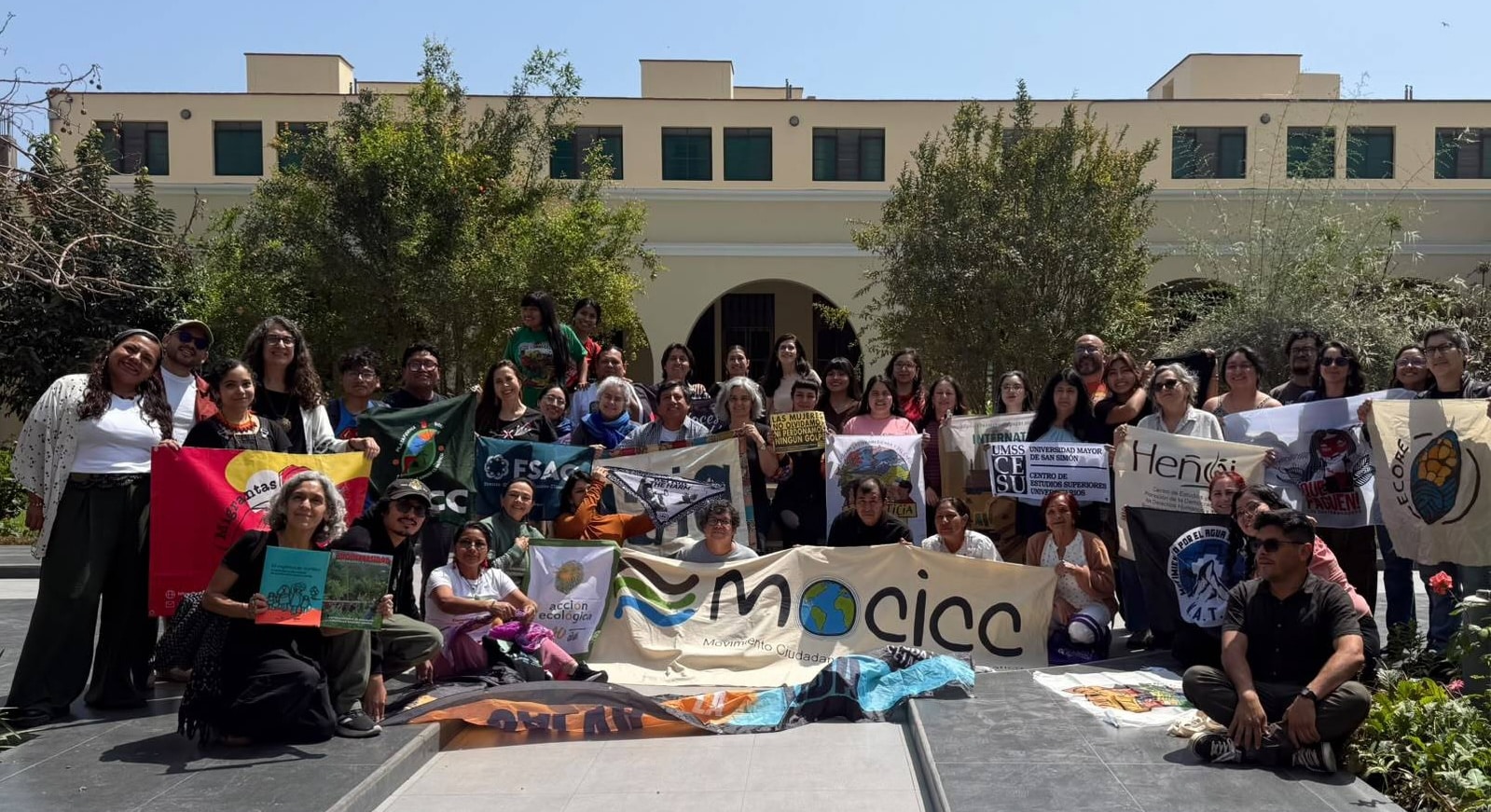
The process of learning, strengthening, and collective building, preceded by other organizational efforts and further developed in 2023 through the project “Stopping Climate Capture in Latin America,” implemented by the Plataforma Latinoamericana y del Caribe por la Justicia Climática (PLACJC) and the Campaña Global Para Exigir Justicia Climática (DCJ-LAC), brings together grassroots organizations from different countries with ecological, anti-patriarchal, anti-racist, and anti-capitalist perspectives. These organizations share the common goals of stopping multinational corporate capture, promoting just transition models, and strengthening collaboration among organizations rooted in their territories.
Each gathering has created spaces for organizing, community coordination, public denunciation, and the development of tools for collective action in response to the dynamics that cause and intensify the climate crisis.
These include the Climate Justice Glossary and the Guide to Understanding and Resisting False Solutions to the Climate Crisis. These two tools propose a common language for addressing technological and financial projects presented as “solutions to the crisis,” whose effect is not to solve the crisis but rather to perpetuate the expansion of extraction in order to sustain consumption in the Global North. Through rhetorical narratives, they divert attention away from extractivism and from the repression faced by those who oppose it.
The guide provides tools for recognizing false solutions in their many forms by identifying who is promoting them, who makes decisions about natural resources, who benefits from them, and who bears their costs. In doing so, it seeks to challenge the misleading narratives that legitimize the dispossession and human rights violations associated with new projects of death.
XXXXX
XXXXX
The False Solutions Map, another collaborative tool for documenting and denouncing these practices developed within the framework of these gatherings, identifies 219 cases across Latin America. Its analysis provides a regional perspective on the political regimes and financiers behind these projects and reveals, for example, that development finance institutions are the second-largest source of funding for false solutions.
XXXXXXX
XXXXXXX
Furthermore, the Guide to Popular Education Methodologies for Climate Justice, which emerged from the 2025 meeting and is currently being adapted to nine different contexts across various regions, was developed by Latin American educators and activists who drew on experiences and approaches from popular education, peasant schools and community-based feminism, with the aim of discussing, reflecting on and taking action against false solutions.
An Open Process
Over four days of work, members of collectives and organizations, community leaders, young people, and others who participated in the gathering reflected on the histories of their territories, trend analysis, exchanges of experiences from different struggles, strategic planning, and popular education methodologies.
The different spaces fostered discussions on ways to connect mapping initiatives and campaigns; broaden an inclusive understanding of justice to encompass wildlife, coastal areas, and nature; expose new false solutions linked to the expansion of digital technologies; and continue to approach the climate struggle through an intersectional lens. This included the perspectives of trade unions that challenge the false dichotomy between “jobs and environmental protection”; young people, children, and older adults through intergenerational schools; struggles for water; the defense of food sovereignty; and feminist movements that go beyond the concept of body-territory.
They also provided an opportunity to take stock of achievements and refine the vision for a growing network that is strengthening the struggle for climate justice through both educational and analytical tools, the identification of false solutions, and the questioning of the dominant narrative through which these solutions “become mechanisms for maintaining the same extractive model under a new language, now called carbon credits, sustainable development, and energy transition.”
At the public forum “Resistance to False Climate Solutions in the Context of Political and Environmental Crisis in Latin America and the Caribbean,” testimonies from different territories highlighted how the discourse of an “energy transition”—which in practice entails occupied territories, imposed projects, extracted resources, and speculation—ultimately operates as a hegemonic concept disconnected from the transformation that such a transition is supposed to entail.

Communities are resisting new forms of extractivism as well as old forms of extractivism repackaged in new ways. In Bolivia, for example, the energy crisis has prompted the emergence of quick but ineffective solutions, such as biofuels, which fail to address the root causes of the problems and, on the contrary, place greater pressure on territories while providing a new justification for expanding agribusiness. In Chile, a renewed boom in copper and lithium—both historically exploited resources—along with a drive to expand renewable energy, is threatening the conservation of fragile ecosystems such as salt flats and wetlands.
The space also provided an opportunity to discuss the structural factors that, beyond specific megaprojects, enable particular economic forces to take increasing control of the region, putting its ecosystems and populations at risk. These include the expansion of a system for protecting foreign and private investment through bilateral agreements and free trade agreements, as well as corporate capture of multilateral spaces.
At a critical moment in the global climate breakdown, characterized by energy crises, disruption of food systems, extreme weather events, and wars, restrictions on civic space are adding further challenges for environmental and climate movements across Latin America, which were also examined. The region’s shift to the right and the authoritarian governments associated with it; the rollback of agrarian and environmental legislation; the dismantling of institutions responsible for protecting ecosystems and rights; institutional attempts to erase historically mobilized groups such as peasant communities and trade unions; punitive and regulatory responses targeting civil society organizations; and increasing stigmatization and criminalization—all of these factors facilitate processes of recolonization through the seizure of land and common resources by transnational corporations and foreign governments.
At a politically difficult moment for Peruvian civil society, the solidarity shown by organizations from across the region, together with the memory of resistance preserved through art—as expressed, for example, in the popular theater group “Arena y Esteras” and its portrayal of the struggle of Villa El Salvador—spoke volumes.

The Movement Is a Path Under Construction
It is in this context that the gathering’s contribution to building a regional movement for climate justice demonstrates a hopeful process of strategic coordination: identifying needs, developing shared narratives from the territories, strengthening ties, and generating proposals, strategies, and agreements to continue moving forward together.
At this point, the invitation is to keep watering and spreading the seeds. To use the tools, document cases on the map, apply the methodologies, and share the experiences that emerge in order to expand collective learning. To get information to others, and to do so in different ways. To build solidarity among struggles and, above all, to continue reflecting on real solutions—those other realities that already exist in the territories: realities that protect nature, are community-based, embrace degrowth, prioritize prevention and regeneration, pursue restoration, and are rooted in the community management of our common resources.