

Welcome to the first Community Resource Exchange (CRE) bi-monthly bulletin, where we provide key updates about the CRE, highlights from the powerful struggles led by our community partners around the world, and useful resources.

Updates from the CRE team
- In August 2024, we launched a new call for proposals. We are now working with 23 grantees (8 in Asia, 9 in Africa, 6 in Latin America) and collaborating with dozens of other communities. We’re organizing learning exchanges among communities facing similar challenges, facilitating access to resources and allies, building capacity on different strategy areas, and amplifying communities’ voices. Check out our new Frequently Asked Questions section to learn more about the CRE!
- This year, the CRE will be transitioning into phase 2 of its pilot. You can read more about the transition and what will be the next steps in this blog.
- In July 2024, a new Regional Facilitator for Latin America joined the CRE team: you can read more about Claudia’s experience and passions here.
Updates from our CRE partners
With the support of the CRE, communities around the world are holding development banks and international investors accountable, mobilizing to advance their rights, and building solidarity with other communities facing similar challenges. Below, we highlight some of their powerful struggles.
Africa
- In Uganda, a CRE partner supported local communities in filing a complaint with the accountability mechanism of the German development bank KfW, raising concerns around land-grabbing and other harmful impacts linked to a renewable energy project. After filing the complaint, some communities are now being compensated.
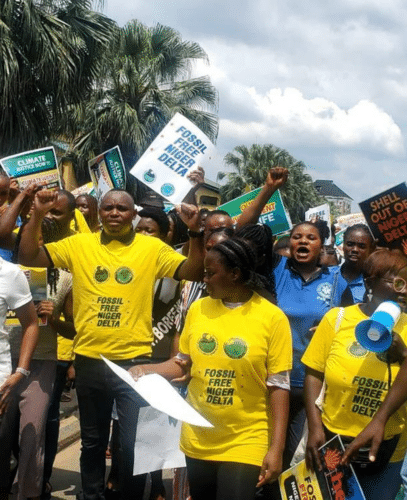
- In October 2024, the Nigerian CRE partner Lekeh Development Foundation organized the Niger Delta Climate Change Conference. Over 100 climate activists met to strategize together, plan collective advocacy actions ahead of the COP29, and mobilized around community-led solutions. They also exchanged learnings with two Ugandan representatives of EACOP-affected communities, who then wrote this blog to share their experience at the conference.
Latin America
- In September 2024, together with Inclusive Development International (IDI), we organized a Follow the Money training in Buenos Aires, attended by 23 participants from 11 organizations and 9 countries in the region. It was an opportunity to learn how to understand corporate structures and who is behind harmful projects. In January, there will be the second phase of the training, exploring how to deploy effective advocacy strategies.
- In October, various organizations and representatives of Indigenous communities from Chile, Bolivia, Argentina, and Colombia participated in a thematic hearing before the Inter-American Commission on Human Rights on the impacts of mineral extraction in the context of the regional energy transition. Among them, there was our CRE partner Asamblea Pucarà (Argentina), who used this opportunity to speak out about the irreversible damage caused by lithium mining activities in the Salar del Hombre Muerto.


Asia
- In September 2024, together with several partners (AIPP, ZTI, REP, APNEE, PRI, LAHURNIP), we co-hosted a session at the UN Responsible Business and Human Rights Forum in Bangkok, Thailand. During the session, Indigenous leaders from Nepal, Philippines, Malaysia and Indonesia shared their perspective on effective remedy approaches, gaps in justice mechanisms, and recommendations to prevent and address human rights violations (read more in this blog).These demands were also reflected in the Asia-Pacific Indigenous Peoples Caucus Joint Statement, as well as in the Indigenous Women and Youth Call for Urgent Actions for Just Energy Transition.
- In the Philippines, our CRE partner, Negros Anti-Mining Alliance (NAMA) – a coalition of fishing communities, faith-based groups, and NGOs – organized the Mining Forum Week in October. During the forum, they called for an immediate halt to illegal dredging and offshore and coastal mining activities in the Negros and Panay Islands.
CRE collaborator spotlight
Becoming a human rights defender was not an easy choice. But for Aryampa Brighton, it was the only possible one. In this blog, our CRE collaborator Aryampa (Executive Director at Youth for Green Communities) shares how he gave up a more traditional legal career to join the collective struggle to stop the EACOP pipeline and defend the rights of oil-affected communities in Uganda.

New reports and useful resources
- “Just Power: A Guide for Activists and Changemakers” | JASS
- “Human rights in Southeast Asia’s renewable energy transition: Analysing company policies” | Business and Human Rights Resource Centre
- “Practical Guide to Community-Based Security for Women Defenders of Economic, Social and Cultural Rights” | ProDESC