

Evaluation of the first phase of the CRE pilot
In November 2020, the first phase of the Community Resource Exchange (CRE) pilot was launched. Three years later, as the CRE pilot started transitioning into its second phase, an external evaluation was commissioned to document the key achievements of the first phase, assess its strengths and gaps, and provide recommendations on next steps and ways forward. At least 120 individuals participated in the evaluation, through surveys, focus group discussions, and interviews with key stakeholders.
What is the CRE?
The CRE is a collaborative system to share knowledge, facilitate linkages and mobilize resources, to ensure that local communities have access to the skills, tools, resources and allies they want to defend their rights in the face of harmful international investments and development activities.
 This evaluation report – prepared by independent evaluator Pamela A. Grafilo – covers the first phase of the pilot (November 2020 to December 2023) and includes:
♦ an overview of the CRE;
♦ a methodology section;
♦ key accomplishments and success stories; and
♦ key results of the evaluation and recommendations for the next phase of the CRE.
These reflections and the lessons learned during the first phase serve as a valuable guidance for the CRE to refine its techniques and strategies, ensuring its work is impactful and sustainable.
By building upon its successes and addressing the identified challenges, the CRE is poised to become a cornerstone of community-driven development and a key player for positive change in the face of harmful international investment and development activities.
 In September 2025, join us for a webinar where we’ll present the key findings of the evaluation of the Community Resource Exchange (CRE) program.
You can join one of these two sessions:
Wednesday, September 17 (English / Spanish / Portuguese)
8 am Mexico City | 11 am São Paulo | check your local time here
Register here
Wednesday, September 24 (English / French)
3 pm Manila | 10 am Nairobi | check your local time here
Register here
Key achievements and impact
The CRE’s achievements presented in this evaluation report demonstrate the power of collective action and the importance of accompanying communities in their efforts to defend their rights and protect their future. The added value of the CRE lies in its role as a trusted platform and a safe space, where communities can leverage available resources, connect with new allies to exchange knowledge and skills, and strengthen their collaboration and solidarity networks.
The data analysed in this report shows that the CRE met the objectives set in 2020, and even exceeded some of them. In particular, the CRE:
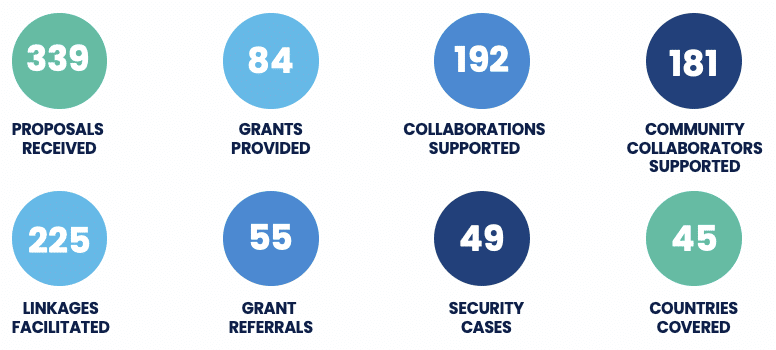
- facilitated 192 collaborations (going beyond the 150 initially planned), benefiting 181 community collaborators across 45 countries;
- facilitated 225 linkages;
- successfully conducted two open and two targeted calls for proposals, that received over 339 submissions;
- provided 84 grants and facilitated 55 grant referrals; and
- set up a database with over 6000 contacts. This also includes contacts of CRE collaborators and a case database, allowing to track progress and analyse useful data.
The CRE has been able to empower communities, strengthen their advocacy efforts, and build collaborative networks. Positive results were evident in the following areas:
- increased awareness and understanding of rights among community collaborators;
- enhanced community cohesion, solidarity and engagement;
- strengthened advocacy capacity;
- successful cases of resistance against harmful projects;
- improved legal representation and access to institutional remedies;
- creation and strengthening of support networks;
- amplification of community voices through media engagement and visibility actions; and
- stronger linkages between local community-led struggles and international campaigns.


The survey results show collaborators have highly valued working with the CRE, and the initiative’s impact across all strategic areas. In particular, they appreciated its effectiveness in aligning with community collaborators’ needs and priorities, in enabling linkages and access to resources, and in co-creating effective strategies that empowered communities to defend their rights. Survey respondents also expressed strong satisfaction with the usefulness of the grants and the user-friendliness of the forms, although there were concerns regarding the clarity of the application and selection process.
At the heart of this success lies the CRE’s commitment to reflection and innovation, and its capacity to serve communities’ needs and be responsive to their changing priorities, mobilize allies, build partnerships, and foster knowledge exchanges and mutual learning.
- Peer-to-peer learning exchanges: by connecting communities facing similar challenges, the CRE has created a space for knowledge-sharing and mutual learning. Through these exchanges, participants can gain insights that enhance their advocacy efforts and strengthen their community-led struggles.
- Capacity-building activities: after identifying the gaps and the needs, the CRE — in partnership with its ally collaborators — has facilitated key capacity-building activities (such as the “follow the money” research training).
- Sister networks are organizations/networks that share similar values and goals. The CRE has deepened the collaboration with them, establishing partnerships that delegate responsibility and avoid duplication.
- Visibility: strategic communications and awareness-building efforts have helped amplify community voices. This outreach has not only fostered greater understanding of the communities’ struggles, but has also mobilized public support for their advocacy and helped drive systemic change.

LAC Indigenous activist standing against Sal de Vida lithium mine. Credit Asamblea Pucara.
These achievements were made possible thanks to the solid governance structures created. During the first months of the pilot, the CRE set up a decentralized governance structure, made of a global Advisory Committee and the Regional Grant Working Groups, to guide the program implementation and strategic direction. The role of these structures evolved during the course of implementation, reflecting the CRE’s commitment to flexibility and responsiveness to the requests and priorities of community collaborators.
The CRE — which is hosted by the Coalition for Human Rights in Development — also worked closely with the Coalition’s Regional Coordinators (to link community struggles to broader policy change work) and the Defenders in Development campaign, which is also hosted by the Coalition (to facilitate requests related to protection of human rights defenders and civic space issues).
Key recommendations and areas for consideration
The implementation process is not without challenges. The CRE has faced difficulties in navigating the different regional contexts, advancing its work despite limited resources, and addressing the intricacies of each community collaborator request. Ensuring transparency and efficiency in the grant distribution process, while balancing the diverse expectations of stakeholders, has added another layer of difficulty.
Community collaborators have also indicated the need to deepen collaborations to ensure long-term impact (through skills sharing, more networking opportunities, etc.) and to provide stronger support in the advocacy work, to address deep-seated systemic issues both at the regional and global level.
This evaluation identifies the following areas for improvement:
- Deepen engagement with existing collaborators, while mapping and engaging new ones, to meet the diverse priorities of all the communities the CRE serves while continuing to expand its reach. The CRE could consider employing a combination of the following approaches: supporting communities of action; conducting focused outreach activities targeting countries where the CRE hasn’t worked yet; and building partnerships with other sister networks.
- Expand the network of expert collaborators, particularly in two areas: 1) scientific and technical expertise; 2) engagement with international private companies.
- Better define and coordinate the collaborative work with the other Coalition programs (Regional Coordinators and Defenders in Development Campaign), especially on cases involving development banks.
- Strengthen internal and external communication: the CRE needs to move beyond basic information sharing and foster a more dynamic and collaborative communication approach, particularly storytelling and data that generates insights on strategy, progress, learnings and impact of the CRE system and its work with collaborators.
- Strengthen the Monitoring, Evaluation, Accountability and Learning systems, to make the CRE even more robust and effective.
- Optimize the Advisory Committee Regional Grant Working Groups. These key governance structures, which have served as valuable pillars of the program, require strategic adjustments to ensure greater efficiency, inclusivity, and responsiveness to the program’s evolving priorities.
- Ensure long-term sustainability, introducing some strategic adjustments to establish a more robust and secure resource base. The CRE Secretariat — with the guidance of the Coalition’s Steering Committee, and the support of the Advisory Committee and Regional Working Groups — could spearhead this process.
By leveraging its successes and addressing the challenges identified above, the CRE is well-positioned to continue being an effective platform for grassroots and community groups to build and strengthen collaborations and linkages with diverse allies and together drive positive change in the face of harmful international investment and development activities.
Emerging trends
The key trends emerging from the 192 collaborations facilitated by the CRE during the first phase of the pilot. It provides insights on the type of human rights violations and challenges faced by community collaborators, which types of economic actors are being targeted, and the diverse range of sectors.
A. Types of human rights violations in the 192 collaborations facilitated by the CRE.

B. Types of economic actors identified or targeted in the 192 collaborations facilitated by the CRE.

C. Types of sectors in the 192 collaborations facilitated by the CRE.

Measuring performance, results and impact
To better assess the CRE’s performance in program implementation, a survey was conducted and administered to community and ally collaborators. There were a total of 61 respondents (51 % from Africa; 29 % from Asia; and 20 % from Latin America). Ninety percent of the respondents were either from local or community-based organizations (51%) or national organizations (39%), therefore most of this feedback comes from key partners of the CRE.


Full report