


Credit: Michaela Kožmínová
By Mark Fodor – Coordinator of the Defenders in Development campaign
“Civil society […] provides us with the deep local knowledge which complements our knowledge”
“The depth of the knowledge which civil societies can bring to us is invaluable”
“[Civil society] bring the trust with communities […] and real credibility to our operations”
These words were all uttered over the weekend at the European Bank for Reconstruction and Development (EBRD)’s Annual Meeting in Riga, Latvia. The person expressing these views during the session “From volatility to resilience: civil society as a catalyst for impact” was Nadia Petkova, the EBRD’s Managing Director for Impact and Partnerships and a member of the bank’s senior leadership group.

Credit: Michaela Kožmínová
The bank was stressing the importance of civil society in informing its operations and strategies, and serving as a partner to the bank. The focus was Ukraine and the message was clear: we not only value civil society, we need them to make sure we do it right.
Wonderful, I thought. But what does this mean for our partner in Uzbekistan, who cannot register an organisation, has been interrogated for attempting to engage with development banks, and has been threatened with arrest for monitoring bank-funded projects? What about the Tajik journalist and mother of two young children who is currently serving an 8-year sentence for trying to conduct a survey on the influence of Chinese development finance in her country? Or what about the scores of activists in Georgia, Kyrgyzstan, and beyond who risk jail simply for trying to help ensure that development in their countries best serves people and the environment?
Untangling limitations from excuses
Meeting after meeting, the bank’s message from the top-down was two-fold: a combination of “yes we agree with you, this is important, please share more, we really need to think about how to address this” and “we’re limited by our mandate, there is only so much we can do”.
Honestly, I often couldn’t tell when the limitations were real or simply excuses, particularly when what we were asking the Bank to do in one country was merely to replicate actions it had already taken elsewhere. For instance, when Georgia was preparing to adopt the law on “transparency of foreign influence”, effectively criminalizing civil society, the Bank sent a clear message to the government expressing concern about this repressive legislation. Yet, when Kyrgyzstan approved a similar law, the response was far more muted, and the EBRD took no decisive action.
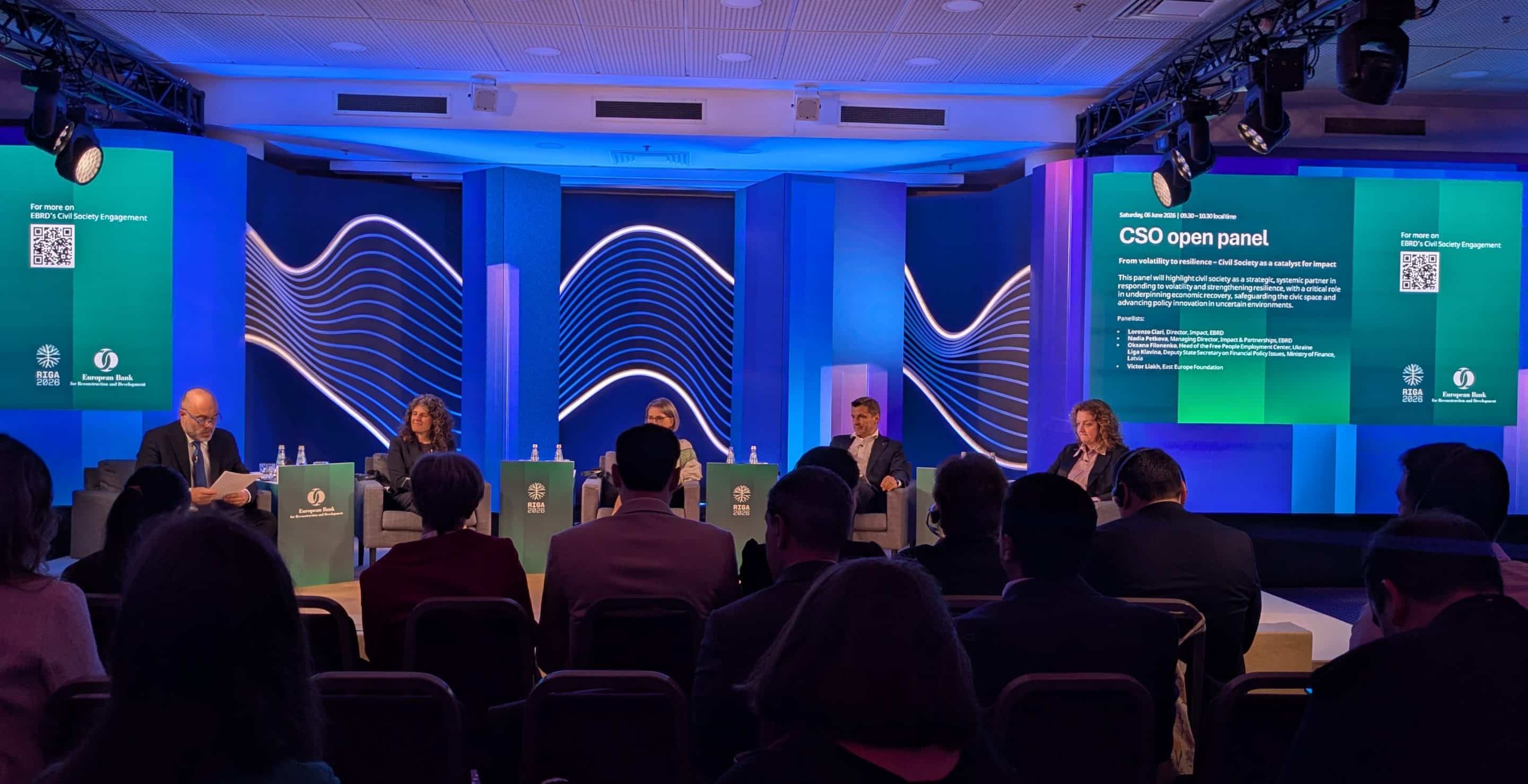
CSO Open Panel / Credit: Michaela Kožmínová
So many nice words, but who is hearing them?
In meetings with civil society, we heard the Bank’s leadership explicitly express concern about the shrinking of civic space. Yet I couldn’t shake the feeling that these concerns were only voiced when we were in the room, that the importance of civic space was acknowledged in conversations with civil society, but rarely communicated with the same clarity or urgency to governments or other stakeholders.
To their credit, however, the EBRD does have a stated strategic objective of “Developing the safety and openness of the civic space” in its approach to civil society engagement. Additionally, the Bank’s new approach paper on economic governance, a strategy that came up repeatedly during our conversations, does acknowledge the importance of civic space, albeit indirectly. It does so by relying on the World Bank’s Worldwide Governance Indicators, which themselves directly refer to civic space issues. Yes, you read that correctly: the EBRD has a new approach that refers to another approach developed by another bank, which in turn refers to civic space issues. It is hardly the most visible acknowledgement of the issue, but it is a direct link nonetheless.
The real test of the Bank’s commitment
I come to this issue with concern for the people who face threats and attacks for voicing their opinion about development in their country, people whose names and identities are becoming increasingly dangerous to share. The EBRD has told us it shares this concern with us and that it is explicitly mandated to shape the environment for development. They’ve also acknowledged the importance of this issue for their operations and expressed a clear and strong commitment to work with civil society. The real test for any commitment is not how they perform when it’s easy, but how they do so when it’s hard. If they are ready to live up to that commitment, we’re ready to be their partners in doing so.
Credit: Michaela Kožmínová