


Gathering of the Chango people of the Antofagasta Region, Taltal, April 28, 2023.Credit: Sustentarse
Brenda Gutierrez is fighting for the simplest, yet most complex of the rights: the right to exist. Only in October 2020, the Chilean government finally recognized her community, the Chango peoples, as the 10th indigenous group in the country. It was the result of a long and uphill battle, led by grassroots activists who grew up knowing they belonged to “Pueblo Chango”, even though authorities were saying that their ethnic group was extinct.
Despite this formal recognition, however, their right to exist continues to be threatened. The Changos live in the coastal areas of northern Chile, in territories that have become “sacrifice zones” due to the historical impacts of mining and its associated industries, such as thermoelectric plants and other polluting activities. And now investments supposedly “green” are further harming their territories and their already fragile ecosystems, endangering their livelihoods and health.
Antofagasta is a key energy hub. Located in the north of Chile, between the desert and the sea, this land is rich in mineral resources and hosts already many factories and energy plants. For the local Indigenous communities, the arrival of green hydrogen is only the last drop in a long history of exploitation.
“They say that green hydrogen is fantastic and it’s not going to harm us, but these are just lies”, says Brenda. “Only the countries importing it will get some benefits, but what are we going to get? We will be left only with the risks, the pollution, the diseases”.
Dubbed as the energy of the future, green hydrogen is being presented as a fuel that has the potential to enable the much-needed energy transition, moving away from fossil fuels. It is produced through the electrolysis of water, breaking down its molecules through a chemical process that can be entirely powered through renewable energy but that is quite energy-intensive. And once the infrastructure is in place, green hydrogen and its derivatives (such as ammonia, a key component of many fertilizers and explosives) can be exported at a relatively low cost.
According to the World Bank, which committed US$350 million in financing to the Chilean government and approved the first loan of US$150 million, the Chile Green Hydrogen Facility will “primarily benefit local communities where clean hydrogen will be produced and used, and help create green jobs, stimulate the economy, and decarbonize local industries.” But this is simply too good to be true: several local and international organizations, such as the Chilean NGO Sustentarse, are highlighting how green hydrogen projects are not clean, they’re disrupting local economies, they are primarily benefiting foreign corporations, and production will be mainly destined for export markets in the Global North.
“The World Bank and other development banks should be more cautious and proceed with good governance when investing in green hydrogen”, write Alison Doug (Recourse) and Maia Seeger (Sustentarse), in a recent article for Energy Monitor.
In the article, the authors also highlight another paradox: although Chile wants to become the first producer of green hydro in the world by 2030, 70% of the energy for its national consumption still relies on fossil fuels. The paradox is even starker in Namibia, which will export green hydrogen to Europe, even though 45 % of the local population does not have access to energy. Moreover, the construction of green hydrogen facilities is currently being planned on the basis of very optimistic previsions, but experts warn of potential oversupply, given uncertainties about costs and efficacy.
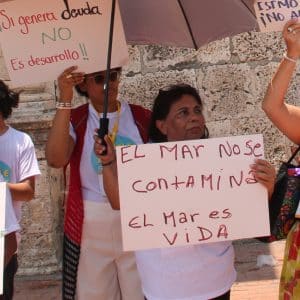
Brenda Gutiérrez during a protest, during the Finance in Common Summit in Colombia (September 2023).
Brenda says that around 15 “renewable” energy projects are being planned in her region – funded by development banks such as the World Bank and the Inter-American Bank (IDB) among others – but receiving accessible information is very hard. Recently, for example, her community managed to access a preparatory document about the construction of a new hydroelectric dam: but it was a document of thousands of pages, written in a highly technical language, impossible to understand. And since only a very limited number of people have been formally recognized as belonging to the Chango people, so far the State does not require companies to comply with the requirements to conduct consultations with local Indigenous Peoples.
According to a report published by Recourse and authored by Maia Seeger, “some communes in the Antofagasta region have already suffered for decades high levels of pollutions due to a large number of thermal power plants, but this historical debt has not been recognized and local communities have not even been informed about the plans to develop here this new green hydrogen industry”.
Moreover, often the projects are presented as isolated, failing to recognize their cumulative impacts. The green hydrogen industry, for instance, requires huge quantities of fresh water and energy. In Antofagasta, this means that companies are rushing to build new solar and wind energy plants, as well as desalination systems that can heavily impact the coastal ecosystem and the livelihoods of local fishing villages. The production and transportation of ammonia is also raising many concerns among the Chango peoples, but information about the possible risks is severely lacking.
These projects also risk displacing local communities and impacting their cultural rights: “Our history has been interrupted”, says Brenda. “We are trying to save our language, our traditions, the tales of our ancestors, the richness of our culture. But these projects are being built where there are our archeological sites, and they don’t care about this. We’d like to map out the sites and build a museum here, but they are taking away our land”.
Despite the extremely limited resources and the challenges, Brenda and the other activists united under the Antofagasta Regional Council are continuing their struggle to defend their rights. They’re pressuring European embassies, holding meetings to raise awareness, and organizing protests.
“My dream is to leave for my sons and nephews the possibility to live with dignity, in a clean environment”, says Brenda. “If we keep like this, in 30 years we will have to buy oxygen to be able to breathe. The only thing we dream of is a future without pollution, with clean air, clean land, a clean sea, where everyone can live in harmony with nature.”
Read more
- “The World Bank’s Role in Promoting Green Hydrogen in Chile” – Report by Recourse (authored by Maia Seeger | Sustenarse) – Sept 2023
- “The Energy Transition in the Antofagasta Region and the invisibilization of the Chango People” – Blog by Natalia Lueje | Sustenarse – May 2023
- “Beyond the H2ype: why the World Bank should be cautious on green hydrogen” – Op-ed for Energy Monitor by Maia Seeger and Alison Doig – Nov 2023