

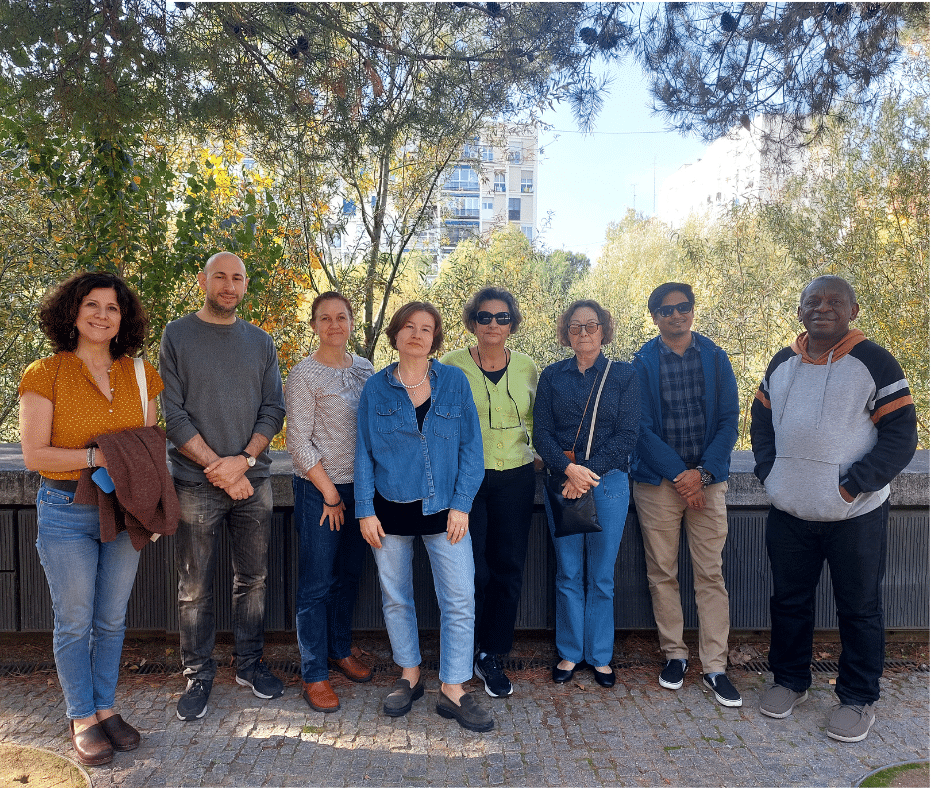
Steering Committee members during their first in-person meeting (Madrid, November 2024)
The governance model of the Coalition for Human Rights in Development is built on the principles of shared power and collective decision-making, which are essential for fostering inclusivity and collaboration. By focusing on participatory processes and ensuring accountability, the Coalition’s Steering Committee strives to create a governance approach that reflects the diverse voices and needs of our members.
At the end of last year, the Steering Committee met together in person for the first time. While several of us (or our organisations) have been building the Coalition from the beginning, all of us are new in this role. We were appointed in March 2024, through the first ever Steering Committee election process in the Coalition.
Current members of Steering Committee are:
- Sukhgerel Dugersuren (OT Watch | Mongolia)
- Prabindra Shakya (Community Empowerment & Social Justice Network, CEMSOJ | Nepal)
- Kazi Zaved Khalid Pasha Joy (Initiative for Rights View | Bangladesh)
- Paulina Garzón (Latinoamérica Sustentable, LAS | Latin America)
- Gonzalo Roza (FUNDEPS | Argentina)
- John Brownell (Green Advocates International | Liberia)
- Amy Ekdawi (Arab Watch Coalition | Middle East and North Africa)
- International Accountability Project (Global)
- Nina Lesikhina (Bankwatch | Europe and Central Asia)
- Petra Kjell Wright (Recourse | Global)

Our first in-person meeting took place just after the International Secretariat team retreat, giving us an opportunity to meet with them and better understand their current priorities.
During our meeting, we spent significant time unpacking how the Coalition is structured and how the various collective decision-making processes work, with the goal to understand the division of roles and responsibilities between the Steering Committee, members, partners and the secretariat.
We felt understanding these different roles and responsibilities was crucial, to be able to better play our role as the governing body for this large, complex, diverse network, and to provide oversight for a healthy secretariat.
This year, which marks the Coalition’s 10 year anniversary, one of our key priorities will be to help facilitate and oversee the development of the strategic plan, a process underpinning the Members Gathering in Kenya (July 2025). As a members-led Coalition, our ultimate accountability lies with our members, and the gathering will be a key opportunity to engage in deep conversations with them. It will be a moment of pride and celebration, where we want to look at the incredible work that Coalition members have advanced in the past decade and to draw lessons from our collective achievements. But more importantly, it will be a space to look forward, where we can set key strategic directions for the next five years and identify next steps to advance our collective power.
How does decision-making in the Coalition work?
- Coalition’s members set the overall strategic framework, including the mission, vision, and the broader program areas and overall ways of working.
- Members and partners advance collective work through various program areas (like the Community Resource Exchange and the Defenders in Development campaign), as well as the regional campaigning and advocacy efforts, based on their own interests and priorities.
- The Secretariat plays a facilitative and enabling role by coordinating advisory bodies, committees, and working groups of members and partners, to set and implement programmatic strategy collectively.
- The Steering Committee, made up of Members of the Coalition, acts like a governance board, approving budgets, supporting sustainable growth of the Coalition (including by reviewing applications for new Members), overseeing the secretariat and ensuring the Coalition is working in accordance with its strategic framework.
Other key priorities for the work of the Steering Committee in 2025 will include:
- In collaboration with the Secretariat, draft and implement a code of conduct which will provide us with a clear framework for ethical decision-making, promote accountability, and foster a culture of integrity and mutual respect within the organization.
- Finalize the revision of the Steering Committee terms of reference, based on our learnings so far (e.g.: allowing some members to stand for re-election to ensure continuity and some overlap between old and new members when the Steering Committee is renewed).
The first in-person meeting of the newly elected Steering Committee was a significant milestone for the Coalition. Going forward, we look forward to accompanying the Coalition in its journey, to guide its next steps so it can continue to operate efficiently and sustainably, and to build together a future where communities can shape their own development.