

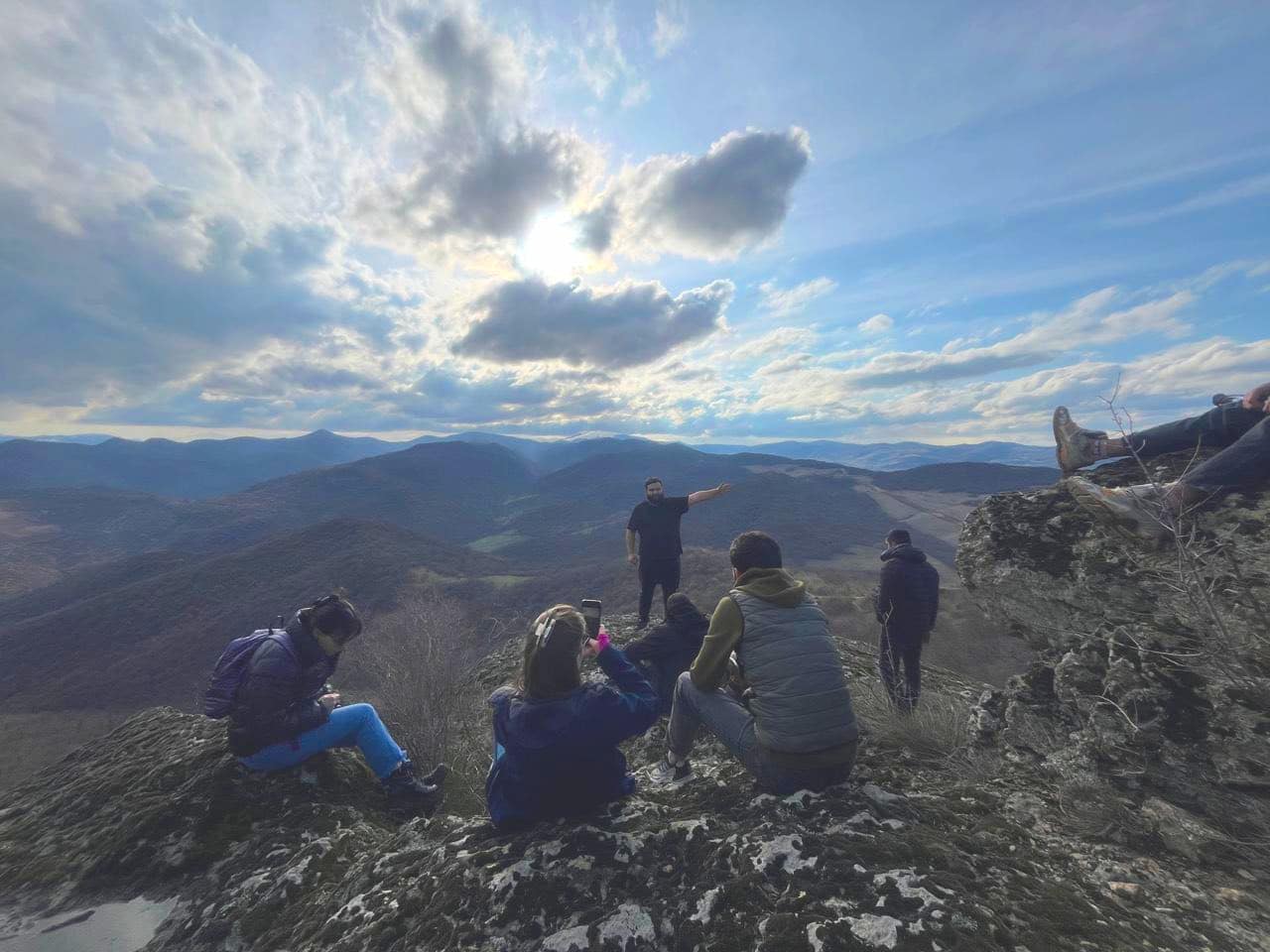
Tours with journalists in the territory around the village of Geta.
Blog by Rabil Ismail, environmental activist and co-founder of the Salam Platform, and collaborator of the Community Resource Exchange
Since I was a child, I wanted to protect our environment and the green hills where I grew up. I knew my territory was under threat, and I knew one day I would have to speak out to protect it.
Located in southern Georgia, the Kvemo Kartli region has long faced the harmful environmental, social and cultural impacts of mining projects. Even as a school kid, I remember hearing local people complaining about the mines. But their concerns have been routinely ignored. In 2014, for example, the mining company RMG Gold destroyed the Sakdrisi archaeological site despite widespread resistance from local communities and academics.
| About the RMG Group
According to a briefing by the Business and Human Rights Resource Centre, RMG Copper and RMG Gold are subsidiaries of “Rich Metals Group”, a Netherlands-based company with a complex chain of ownership. Journalists have traced RMG’s ownership to an apparent parent company, Eulachon, based in the Isle of Man and owned by two Russian billionaires, Dmitry Korzhev and Dmitry Troitsky |

Civic mobilization in the village Mushevani in 2022. Credit: Salam Platform
The first time I joined a mobilization against a mine was in 2022. Some friends from the village of Mushevani asked me to support a campaign to stop the expansion of the RMG Group, which was extracting gold, copper and silver in the district of Bolnisi. In just a week, we were able to mobilize the local community and to create a committee.
According to the Environmental Impact Assessment (EIA), mineral extraction would be undertaken at less than one kilometer from the village, using an open pit extraction method. This process involves one or two explosions every week, and the transportation of the ore extracted usually happens 24 hours a day, causing air and noise pollution. In addition, there were additional large-scale infrastructure projects planned in the area (such a manufacturing company, a parking for the machinery, and access roads, and a 25.7-hectare landfill for waste rock near the quarry).
Both the documentation of the National Environment Agency, as well as an independent evaluation of the EIA produced by the environmental Georgian NGO Green Alternative, confirmed that the company’s assessments were flawed.
With the help of lawyers from the Center for Social Justice, we then prepared a letter to the authorities, arguing why this project should be stopped and explaining how the population was being affected. In just a day, we were able to collect signatures from approximately 50 % of the villagers and to submit the letter to the National Environment Agency.
When we collected the signatures, we immediately drew the company’s attention. A white jeep was spotted driving around the village, with someone taking pictures of the media organizations that were covering our initiative, the activists involved in the mobilization, and the youth that were participating. Paradoxically, those trying to protect the village were being surveilled as if they were dangerous people.

Mobilization of the local community in the village of Mushevani in 2022.
From July to December 2022, the village continued to advance its struggle to protect the territory and the rights of the local population. We organized democratic gatherings and debates, where some ideological conflicts started to emerge. Several activists were intimidated and threatened. Some were warned that they could be addressed, others were bribed and silenced. Unfortunately, the company succeeded in dividing the local population, turning some villagers against each others and convincing some to accept its deals.
However, the villagers who were leading the resistance against the mine managed to have some of their requests met. For example, the budget allocated as compensation for their village was increased from one to four million GEL (equivalent approximately to 1.4 USD). The villagers also created an initiative to monitor the mineral extraction.
In the meantime, we found out that the government had granted the RMG Group an additional license to mine gold in six other villages, where there is a total of 8000 people. It was clear that, for Georgian political elites, our region is an open pit mining field, where villages can be sacrificed and disappeared to make space for more mines. It’s the curse of gold.
Things could have been different. Our region, historically a multicultural place, has ancient roots. Currently here the majority of the people belong to ethnic minorities: 65% ethnic Azerbaijani, 5% Armenians and 30% Georgians. Since 2019, we have been advocating to put the needs and concerns of the ethnic Azerbaijani community on the political agenda. We believe Georgia can become a country where everyone can access fair and equal opportunities, but we need to keep challenging the current development model and advocate for alternatives.
The State is treating these territories as a sacrifice zone, deliberately neglecting them and seeding a sense of hopelessness among the local communities. Villagers here are either forced to leave, or they are left facing with big corporations that can easily take away their future and their resources.
All our eyes are now on the village of Geta. The RMG group was planning to build a new tailing storage plant there. Tailings are particularly harmful: they are reservoirs where the mineral minerals are washed to be processed, and – as they are full of cyanide and other chemicals – they damage everything around them. Soil and water in these territories, once polluted, cannot be recovered.
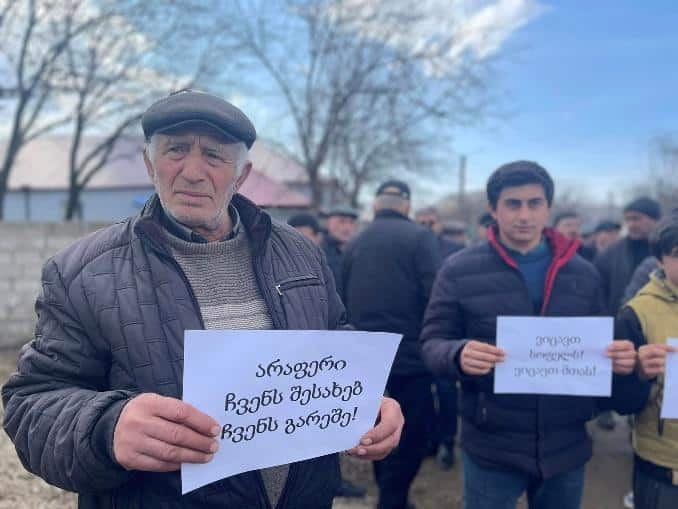
Protest against the expansion of a mine in the village of Geta, in March 2023.
Geta’s residents have clearly stated their opposition and expressed they don’t want the company to enter their territory to build the tailing. Interestingly, although the National Environment Agency was yet to take a decision on the project, RMG started preparatory work.
But thanks to the community-led campaign and advocacy efforts, the company has for now stopped its activities. In March 2023, the villagers met with the company representatives and with local authorities. During the meeting, they presented their concerns and asked to recognize that the public land around the village should belong to them, the people. The meeting was followed by a series of demonstrations, engagement with the media, and petitions. We collected signatures and approached all the relevant institutions, from the President to the Prime Minister and the Speaker of Parliament. We knew – after the experience in the village of Mushevani – that time was of essence and we needed to act fast.
Day and night, we were discussing with local activists and thinking what else we could do. We knew that the company would soon start calling local people to try to coerce some of them and to convince them that protesting was pointless, offering them money in exchange for their silence. But we had learned our lesson in Mushevani. We reminded people not to fall into their traps and to refuse to sign unclear documents or shady deals.

Protest in the village of Geta, March 2023.
During the Novruz Bayram holidays, we invited everyone – friends, activists, lectures, civil society organizations and the media – to celebrate with us in the village. It was an opportunity to make our struggle even more visible and to make our concerns heard all over the country.
After a while, we noticed how the company was moving its equipment out from the valley, leaving behind some fallen trees and their wild ambitions. For us, it was a big victory. The key of our success was the unity of the villagers and our common objectives. We proved that – when united – local communities can stop big projects. Now more than ever, the village of Geta is for us a beacon of hope.
These are dark times for Georgia. The political party in power, Georgian Dream, shares no dream with the common people with whom I walked in the streets of Geta and other villages. In May, the Georgian government approved the “foreign representatives law”, a bill that imposes strict requirements for independent media and civil society organizations. The law has been widely criticized by local and international groups, as it is a clear attempt to stifle dissent. From September on, our organization might not be able to operate, because we will refuse to register as “foreign representative” in a registry that we consider defamatory and anti-constitutional. We will work until the last hour we can, but we refuse to give up and register.
But we remain hopeful. The story of Geta shows that harmful projects can be stopped. Together, we can build a fair, equal and prosperous Georgia.