

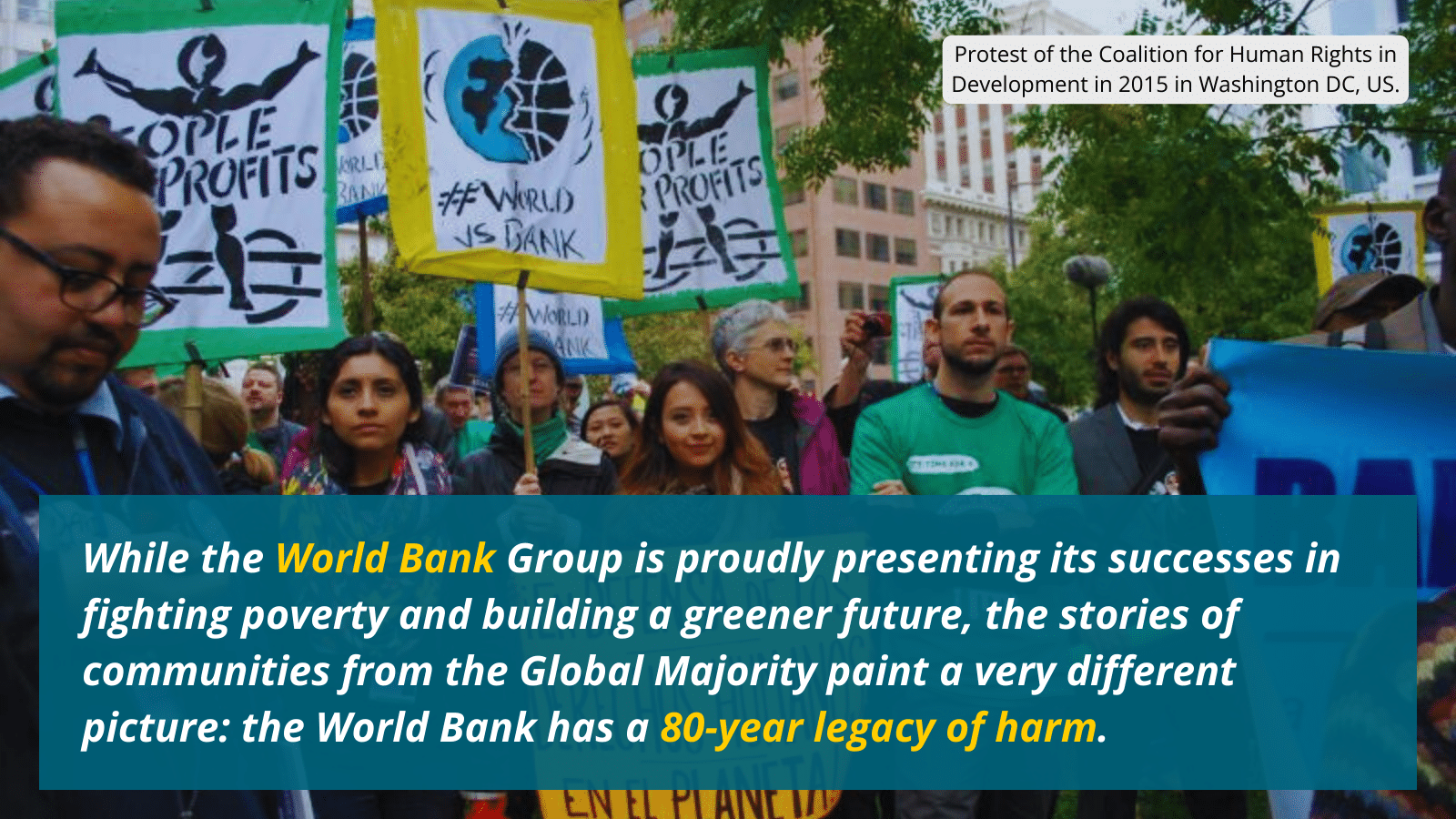
On July 22, the World Bank celebrates its 80th anniversary. But for women and communities across the Global South there is little to celebrate. From new controversial projects to old ones where communities never found justice, the World Bank has a 80 year legacy of harm and impoverishment. Since its creation, the World Bank has fueled the spiraling debt crisis, growing inequality, and climate change, with a disproportionate impact on women and children.
To mark its anniversary, on July 22 members and partners of the Coalition for Human Rights in Development joined a social media campaign to share stories of communities around the world who are speaking out against the harmful impacts of World Bank activities, protecting their territories, and standing up for human rights. Below, you can check some of these stories.

ASIA
- In Tajikistan, the World Bank & other development banks are supporting the construction of the catastrophic Rogun hydroelectric project, that risks displacing 50.000 people & destroying fragile ecosystems. Read more and check this social media toolkit.
- In Nepal, the Upper Trishuli–1 hydro project (funded by the International Finance Corporation & other development banks) is violating the rights of the Tamang Indigenous Peoples. The IFC claimed the process to obtain their free, prior and informed consent was “the first of its kind in Nepal”. A closer look, however, reveals a different story. You can read more in this report by LAHURNIP, AIPP and IWGIA.
- In the south of Kathmandu, the World Bank financed the Chobhar dry port, amidst opposition by affected Indigenous Newar communities and other local landowners. The Inspection Panel failed to provide any accountability for the grievances related to disputed land used for the dry port. At the same time, the port has provided minimal return on the investment and added to international debt of Nepal. You can read more in the website of our Coalition’s member CEMSOJ.
- In Indonesia, the IFC-funded toxic Java 9&10 coal power plants have caused forced evictions, destroyed local businesses, and risks causing thousands of premature deaths. They’re the dirtiest coal-fired power station in Southeast Asia. Now, in response to a complaint filed by local communities – supported by Recourse, Trend Asia and Inclusive Development International, the IFC Accountability Mechanism CAO will investigate the harm caused. Read more.
- The negative impact of World Bank projects can be long lasting. In 1985, +27.000 people were forcibly evicted by the military, to make space for the World Bank-funded Kedung Ombo Dam in Indonesia. Forty years later, the harm inflicted remains unaddressed. Read more in this op-ed published by Devex.
- In Uzbekistan, cotton producer Indorama – funded by IFC and the European Bank for Reconstruction and Development – since 2018 has been responsible for serious labour rights violations, anti-union activities, and reprisals. Our partners Uzbek Forum for Human Rights and CEE Bankwatch network have documented dozens of violations, including +50 cases of retaliation against workers & monitors who spoke out against rights abuses. Read more.
- In the last 80 years, communities across the Global South have led powerful campaigns to resist harmful World Bank projects. Read the inspiring story of the community in the Philippines who led the resistance against the Chico Dams here.
- In the Philippines, in 2020, the World Bank funded the SPLIT project. It was aimed at improving land tenure, but contributed to concentrate land in the hands of powerful economic elites. See more in this primer by IBON. A recent analysis by IBON International also shows how World Bank activities in the Philippines are perpetuating systemic violence against women by exacerbating resource plunder, debt burdens, exploitation of women’s labour, militarisation and reprisals.
- In India, thousands of people in the state of Tamil Nadu haven’t received proper ownership of their homes despite paying for about a decade. Tamil Nadu executed three World Bank-funded projects, mainly in Chennai, between 1977 and 1988, through which plots were sold to those residing in slums on a hire-purchase basis. The beneficiaries were to pay a monthly installment for about 10 years to get ownership of the land. The research conducted by IRCDUC found that 64 percent of the rights holders in Chennai and 67 percent of the rights holders in Madurai have yet to receive sale deeds to date. Read the interviews with the rightsholders here and about the research in the website of our member International Accountability Project.
AFRICA
- In Uganda, IFC gave a one million loan to Agilis Partners, for an agribusiness project that has led to forced evictions, attacks against defenders (including abduction, arrests, and torture) and cases of sexual violence. Check the website of our Coalition member Witness Radio to learn more.
- In Kampala, Uganda, a community already affected by a World Bank funded drainage project, is now facing new threats of forced evictions, while still waiting for compensation & justice. Read more here.
- In Liberia the IFC funded the Salala rubber plantation, owned by agribusiness giant Socfin. The project has led to serious violations, including evictions, sexual violence & labour rights violations.
Socfin is now looking to divest from Salala, without first addressing the issues & providing remedy. In an open letter, local communities are seeking justice. The community, supported by our members Green Advocates International and others, also submitted a complaint to the CAO. The long-awaited investigation has not been made public yet, but it’s expected to confirm the serious violations & non-compliance with the Bank’s policies.
- In Malawi, the community affected by the World Bank-funded Salima Solar Power Project faced a non-transparent involuntary resettlement process, which was carried out without their meaningful involvement. You can explore the full story of the advocacy efforts with Salima Solar Project-affected communities in the Medium Page of the International Accountability Project.
- In Cameroon the World Bank funded the Nachtigal dam. The local community – with support from Green Development Advocates filed a complaint. The dam was imposed without peoples’ participation & led to forced evictions, loss of livelihoods, deforestation & destruction of sacred sites. Read more in this op-ed.
LATIN AMERICA
- In Argentina, IFC funded the Sal De Vida lithium mine, saying it would advance the green #energy transition. But this project has a catastrophic environmental impact, risks drying up the already scarce water sources & violates the rights of the local Indigenous Peoples. Read more.
READING LIST
- Did you know that the World Bank – once again – is rolling back commitments to ensure that governments meaningfully engage with their citizens? Read this analysis by Rachel Nadelman (Accountability Resource Centre) for the Brettons Woods Project.
- 80 Years Of Broken Promises: The BWIs, Neocolonialism, And The Urgent Need For A Feminist Global Economic Order – Check out this series of blogs compiled by MENA FEM (MENA Fem Movement For Economic, Development And Ecological Justice).
- As the World Bank group’s Board discusses IFC’s draft framework on remedy, civil society groups around the world are calling on Board members to ensure this policy fulfills the Bank’s duties & responsibilities under international law to provide remedy for harm. Read here the key demands.
- In this brief, IBON International critiques the World Bank for:
1. The bias for private capital and finance
2. Its denial of the history of its harms
3. The influence of dominant powers within the Bank to pursue geopolitical and economic interests.
- Recourse’s latest report shows how the IFC is indirectly financing “captive coal” in Indonesia