

By Claudia Romero, CRE Latin American Facilitator, CHRD
In a World Out of Balance
This November, the United Nations Climate Change Conference (COP) will take place in Belém do Pará, a geopolitical recognition of the Amazon—one of the Earth’s most vital regions for climate regulation and carbon absorption, now severely threatened by deforestation. While COP debates have long centred on political and financial actors and their decisions, communities continue weaving their own efforts, drawing on ancestral wisdom and local knowledge to contribute to the struggle against climate change.
In a world marked by mass species loss, pollution, growing scarcity and disputes over natural resources—alongside climate imbalances that translate into cyclones, hurricanes, floods, or droughts triggering humanitarian crises across continents—every warning comes with concrete damage. Each statistic is a life project disrupted: fishers without fish, farmers without cultivable land, families displaced from their homes. Precarious daily life is unfolding everywhere, but in unequal ways. In a world still shaped by structural inequalities, injustice is the clearest expression of the climate crisis.
For years, communities and social movements have denounced how the supposed benefits of development projects do not reach city and countryside alike, nor privileged and rural, Afro-descendant, and Indigenous populations equally. Women, in particular, bear the heaviest costs of their environmental impacts.
Climate change deepens inequality in a world where the richest 1% controls nearly half of global wealth. In the fossil economy, the wealthiest countries and sectors bear the greatest responsibility for environmental devastation, while thousands of communities—less responsible—suffer its consequences. The countries most exposed to climate disasters often lack resources to recover, while some take on greater commitments than the world’s biggest emitters. Development finance institutions (DFIs) impose conditionalities that restrict public spending. Governments in 54 developing countries spend around 10% of their budgets just on debt interest payments, often more than on health or education.
A Historical Debt of Justice?
The pursuit of climate justice has entered the agenda of international forums where geopolitics are redefined. Yet the promise of justice feels distant in contexts where livelihoods and infrastructure are damaged daily, lives, species, homes, and cultures are lost, and extreme temperatures erode health and food security. Justice is not abstract—it is lived in territories that dry up, burn, flood, or degrade. It is claimed by movements demanding dignified living conditions, risk prevention, and reparations for harms.
In Latin America and the Caribbean—one of the world’s richest natural regions and also one of the most affected by climate change—agribusiness, extractive industries, and urban expansion are compromising ecosystems and with them, rights to water, a healthy environment, health, life, and Indigenous peoples’ self-determination. Indigenous peoples protect 80% of the world’s biodiversity. In this region of stark inequalities, about 27% of global socio-environmental conflicts occur, along with two-thirds of the world’s murders of environmental defenders.
In countries such as Panama, El Salvador, Ecuador, and Peru, new regulations are advancing that restrict civic space. In Panama, the Movimiento por la Defensa de los Territorios y Ecosistemas de Bocas del Toro halted a planned electricity transmission line shortly before heavy repression of Indigenous uprisings in defence of territory. In Ecuador, the women’s collective Saramanta Warmikuna faces reprisals from the mining industry, while in Chile the newspaper El Mercurio de Valparaíso launched a public smear campaign against organizations challenging energy projects.
Across the Global South, where most of the countries worst positioned to face climate change are located, a neocolonial imprint still prevails—privileging economic interests over life systems and the communities resisting them. Industries export to these territories both their most polluting operations and the projects that facilitate the energy transition of the Global North, creating new sacrifice zones in the process.
A Just Transition?
In this scenario, for the energy transition to be truly just, it must not only reduce dependence on fossil fuels but also avoid replicating the same extractivist patterns of the carbon economy. Decarbonization cannot come at the expense of populations affected by alternative energy projects, nor exclude them from decision-making about their territories, in disregard of their right to free, prior, and informed consent.
So-called “green solutions” often reinforce dispossession, as in Alto Jequitinhonha, Minas Gerais, Brazil. There, bioenergy projects framed as fossil fuel alternatives threaten to deforest native forests inhabited by quilombola communities, replacing them with eucalyptus monocultures for charcoal production that largely feeds the steel and mining industries. Far from sustainable, these vast plantations destabilize ecosystems and livelihoods in communities that have already endured centuries of racism and colonial injustice.
Faced with industrial powers’ refusal to cover the climate debt, diverse groups and movements—including strong participation from women and youth—have secured recognition of injustice. They have advanced precedents in international courts on states’ obligations regarding climate change, and pushed for the creation of the Loss and Damage Fund, though the challenge remains to ensure it truly compensates the most vulnerable countries, those least responsible for the crisis.
As projects for electricity generation and transmission drive a growing demand for critical minerals, communities are organizing. In Argentina, the Indigenous Atacameños del Altiplano community and the PUCARA Assembly (Catamarca Peoples in Resistance and Self-Determination) have blocked new lithium mining permits in Río Los Patos, Salar del Hombre Muerto. In Valdivia, Chile, the collective Viento Sur demonstrated how the pulp mill biomass combustion plant—promoted as a fossil fuel alternative—generated high black carbon and greenhouse gas pollution affecting Mapuche communities. In Antofagasta and Magallanes (Chile), Tambores (Uruguay), and elsewhere in the region, communities are sounding the alarm over the risks of green hydrogen projects, particularly their intensive use of water and land.
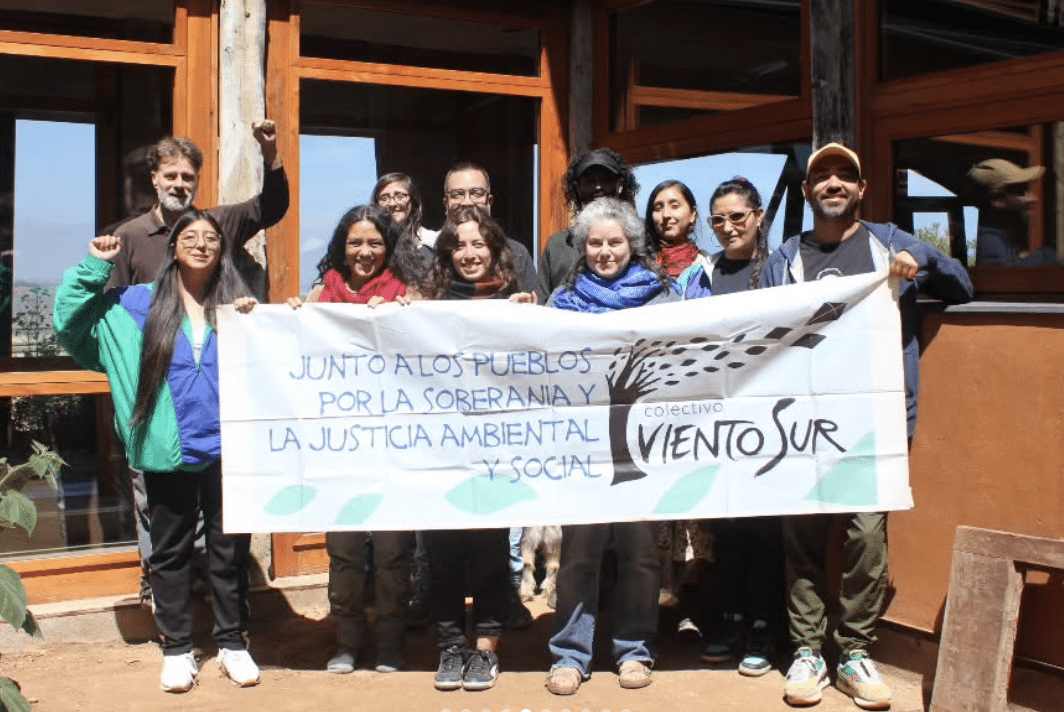
Colectivo Viento Sur, Chile. Photo credit: Colectivo VientoSur instagram @vientosurcolectivo
Communities resist and propose
In the face of these threats, communities not only resist but also preserve and propose. In the Andes, the Epuyen Assembly works to conserve forests under threat from mining projects and to restore those lost to wildfires. In El Salvador, the Asociación de Mujeres Ambientalistas promotes activities to secure energy and food sovereignty, while in Mexico the Nuntajiyi’ communities of the Sierra de Santa Marta advance similar initiatives.
The demand for climate justice, centres on the question: who bears responsibility, and on whom do the costs fall for pushing nature’s limits to the brink of life’s continuity? It will only have practical meaning if historical responsibility and structural, socioeconomic, and intergenerational inequality are addressed.
Through the coalition, communities and organisations are coming together in spaces such as the Grupo Regional para una Transición Energética Justa en América Latina y el Caribe to join forces, amplify voices and push recommendations so that development finance does not fund projects that increases debt and inequality, and to ensure climate change financing is distributed equitably without greenwashing.
Peoples worldwide demand that both development and transition be community-led, grounded in effective participation and respect for their ways of life. This means development projects must follow human rights safeguards, accountability mechanisms must be accessible and culturally appropriate, financiers must assume responsibility for repairing the damage caused by the projects they finance, and ensure projects have responsible exit policies. They must also prioritise development indicators based on social well-being as opposed to macroeconomic indicators.
Beyond the urgency of mitigation and adaptation, the aspiration for climate justice, which is also social, environmental and restorative, requires systemic action to recognise that climate change is not only about carbon emissions or energy generation, but about reconfiguring the ethical and political roots of the crisis.
The Peoples’ Summit and the Mesoamerican Caravan for Climate and Life, both convened from the Global South, will be important spaces to advance a community-centred vision of climate justice. The path forward involves simultaneously conserving and restoring the ecosystems that sustain life, increase resilience, stabilise the climate and safeguard the Earth’s integrity. The voices of the communities that inhabit and defend these ecosystems, which have been long sidelined in favor of industrial and corporate discourse at past COPs, are essential to shift away from the green commodification of nature toward holistic care for territories.

“We are the answer”; indigenous peoples protest in Brasilia, April 2025, Acampamento Terra Livre (ATL). Photo credit: Ana Pessoa/Mídia Ninja