

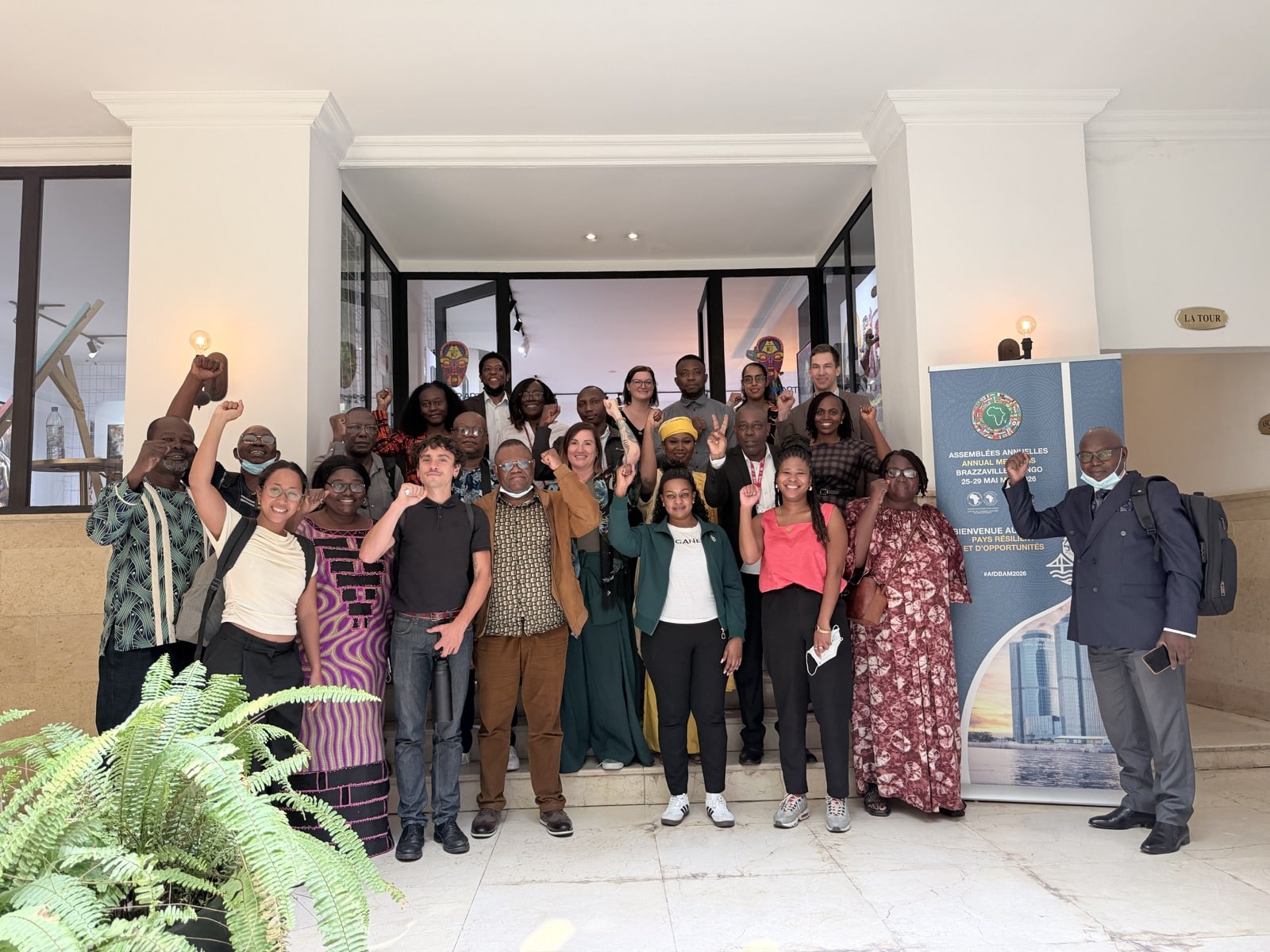
From 25-29 May 2026, dozens of civil society organizations (CSOs) joined the African Development Bank’s 61st Annual Meetings in Brazzaville, Republic of the Congo to demand accountability, stronger safeguards and meaningful participation. Once again, however, the Annual Meetings showed the wide gap between the Bank’s commitment to CSOs engagement and the realities of participation in practice.
In his opening remarks at the official CSO event, AfDB President, Dr. Sidi Ould Tah described CSOs as “legitimate and unavoidable partners” because of their close work with communities. Yet the discussion that followed focused little on the Bank’s relationship with, or plans for, civil society engagement.
A “Civil Society Declaration” was also presented at the end of the panel, without any clarification on who drafted it, what consultation process informed it, or how participating organisations were expected to contribute to or endorse its content. Members of the AfDB Civil Society Working Group, representing more than 70 organisations across the continent, were not given an opportunity to review or shape the declaration beforehand.
For the first time, this year’s Annual Meetings featured two events where CSOs could engage the Bank’s senior management: the Civil Society event and the Civil Society roundtable. However, both sessions confirmed that the Bank and civil society are often speaking different languages, and that much of the meaning is lost in translation. While the Bank speaks in the language of policies, safeguards and the normative value of participation, civil society speaks in the language of lived experience, shrinking civic space, broken promises, and communities struggling to secure a meaningful say over decisions that shape their futures.
The CSO Event
Rather than centering participation, accountability or civic engagement, the official “Civil Society Event” functioned primarily as a showcase for the New African Financial Architecture for Development (NAFAD). NAFAD is a recently launched AfDB initiative designed to address Africa’s estimated US$400 billion annual development financing gap by mobilising a portion of the continent’s estimated US$4 trillion in domestic savings and directing it towards productive investments within Africa.
The session brought together representatives from NAFAD, a technical adviser on resource localisation from Burkina Faso, the MANSSAH Think Tank and the ONE Campaign. Discussions focused overwhelmingly on resource mobilisation, philanthropy, sovereign wealth funds, and the potential of diaspora finance.
Following a promotional video on NAFAD, a representative of a Congolese civil society organisation stressed that CSOs are not merely observers but active actors shaping debates on policy and development across the continent. MANSSAH echoed this statement, noting that civil society can “bring the value of communities to the table” and help ensure that development initiatives improve people’s lives. Ironically, the newly elected AfDB President, Dr. Sidi Ould Tah, entered only towards the end of the intervention, missing most of these remarks.
Throughout the discussion, civil society organisations were frequently referenced as important actors for transparency and monitoring. Yet the structure of the event left little room for civil society itself to do precisely that.
The moderator selected questions exclusively from the “online submissions”, never once turning his gaze nor microphone to the attendees in the room. The chosen questions felt like perfect set ups for the panel to gush over NAFAD, presenting it as a panacea to the continent’s financial woes. The event avoided politically difficult topics and there was little acknowledgement of the realities facing civil society organisations in countries where civic space has shrunk significantly. For example, the technical adviser on resource localisation from Burkina Faso praised his country’s technological advances that allowed for greater tax revenue collection, without acknowledging Burkina Faso’s military government aggressively shutting down civic and political space through sweeping mass dissolutions, legal restrictions, and political bans. A whole delegation of Congolese Youth, dressed in matching black and blue outfits and brought in specifically for the event, provided a symbolic and orchestrated audience of smiling young faces for the roving camera, rather than contributing to the discussion.

The CSO-Board Roundtable
While the Civil Society Event felt carefully staged the Civil Society Roundtable offered a more revealing conversation as it allowed direct questions from participants. This session marked the first dedicated engagement of its kind between the Board and civil society, and brought together the bank’s Executive Directors (EDs), senior management, Civil Society and Community Engagement Division and CSOs.
This type of engagement is a step in the right direction. However, as it was held in the last session of the last day, it felt like an add-on rather than a meaningful event to inform the bank’s internal reflection process.
The Roundtable created a rare opportunity to bring these different perspectives into the same room and search for common ground. Several Executive Directors described civil society as a strategic partner and acknowledged that concerns around gender, climate commitments, accountability and project affected communities are also debated within the Bank itself. Yet good intentions are not enough when communities continue to experience displacement, exclusion and unfulfilled commitments. If the Bank is serious about partnership, it must move beyond defending its systems and begin addressing the gaps that communities and civil society organisations have been documenting for years.
Three themes dominated the discussion: Mission 300, NAFAD, and the broader relationship between civil society and the Bank. CSOs largely welcomed Mission 300’s ambition to expand energy access across Africa. However, Jacquiline Kimeu from Christian Aid and several other organisations raised concerns that consultation around Energy Compacts has been extremely limited at country level, with many learning about such processes through informal networks rather than through structured engagement. Some described having only a few days to mobilise and respond to consultation opportunities, while others noted the lack of publicly available information on where individual countries stand in the Compact development process.
View this post on Instagram

The moderator of the roundtable, from One Campaign, suggested that the Bank create a public dashboard showing timelines, consultation opportunities and progress within each country so that CSOs know when and how to engage.
The Bank’s response clarified institutional responsibilities but did not fully address the concerns being raised. Officials repeatedly emphasised that Mission 300 is country-led and that governments drive the Compact process, while the AfDB provides technical assistance and support. Consultation with communities and civil society, they stressed, remains a requirement during implementation. The Bank also emphasized the role of AI in monitoring and measuring citizen engagement with AfDB-financed initiatives, raising concerns about whether communities’ lived realities will be prioritized or simply filtered out by algorithmic assessments. NAFAD generated similar questions, with CSOs repeatedly asking where communities fit within this architecture.
“Where does civic space fit within NAFAD?”, asked Ony Soa Ratsifandrihamanana, Africa Regional Coordinator at the Coalition for Human Rights in Development. “If civil society is expected to perform monitoring and accountability functions, what happens in contexts where civic space is shrinking?”
Others questioned why discussions focused so heavily on governments, financiers, philanthropists and diaspora actors while largely overlooking local communities themselves.
While the Bank acknowledged the importance of civil society voices, fundamental questions about power, participation and representation remained unanswered. These concerns extended into broader discussions about the relationship between civil society and the Bank. Participants repeatedly highlighted difficulties accessing information, engaging meaningfully in project design and influencing policy processes. Several argued that existing engagement mechanisms do not adequately reach grassroots organisations or communities directly affected by development projects.
One participant from Nigeria, for example, highlighted that many rural women do not have access to online platforms, databases or digital consultation processes. How, she asked, will these women participate in initiatives such as NAFAD if engagement increasingly relies on digital tools? Others raised concerns about access to Bank financing itself. Representatives described experiences of applying to climate and energy financing windows, receiving little feedback and struggling to understand decision making processes.
Again, the Bank’s response focused primarily on existing mechanisms, encouraging participants to register, engage and make use of these channels. Officials highlighted annual Civil Society Forums, country-level Open Days, an interactive online platform and a database of approximately 5,000 civil society organisations.
In response to a question on the appointment of the Independent Recourse Mechanism (IRM) Director, a hiring process that has been on the cards for almost 2 years, board members confirmed that recruitment was underway and the long list of candidates was expected to be complete within the coming months.
Throughout the discussion, Bank officials stressed that projects cannot proceed without environmental and social assessments, consultation requirements and compensation frameworks. Civil society organisations did not dispute that these policies exist. Instead, they questioned whether those policies are reflected in community experiences.
An intervention by Bertha Letsoko of the African Climate Reality Project captured this disconnect clearly: “The ISS and IRA policies are great, brilliant even, but the reality on the ground does not match what is written on paper. It does not reflect the struggles that communities in Mozambique are facing, nor the impacts experienced by communities in Lepalala, South Africa, as a result of mega projects.”
Ultimately, CSOs are not asking for more policy documents. We are asking for meaningful responses to letters, recommendations and concerns raised by communities. We are asking the Bank to engage with evidence from the ground rather than continually referring back to institutional frameworks. We are asking for communities not to be symbolically consulted after priorities have been set, but to participate in shaping those priorities from the outset and share in the benefits that flow from development.