

March 1, 2026, marked ten years since the sowing of Berta Cáceres. From the Coalition for Human Rights in Development, we join in full solidarity with the commemoration led by the Consejo Cívico de Organizaciones Populares e Indígenas de Honduras (COPINH), honoring Berta’s life and recognizing the continuation of the struggle that COPINH carries forward in her memory. In a global context marked by the growing power of corporations, repression, and the criminalization of those who defend their territories, the organization and resistance that Berta helped strengthen continue to light the way forward.
The assassination of Berta Cáceres was not an isolated act, but the direct result of a model that prioritizes investment over the lives and rights of peoples. She was murdered for her central role in COPINH’s resistance to the Agua Zarca hydroelectric project, which was illegally imposed on the Gualcarque River, sacred territory of the Lenca people. This project, emblematic of the expansion of extractive industries in Honduras following the 2009 coup d’état, was sustained by a web of economic and political interests operating with violence and impunity.
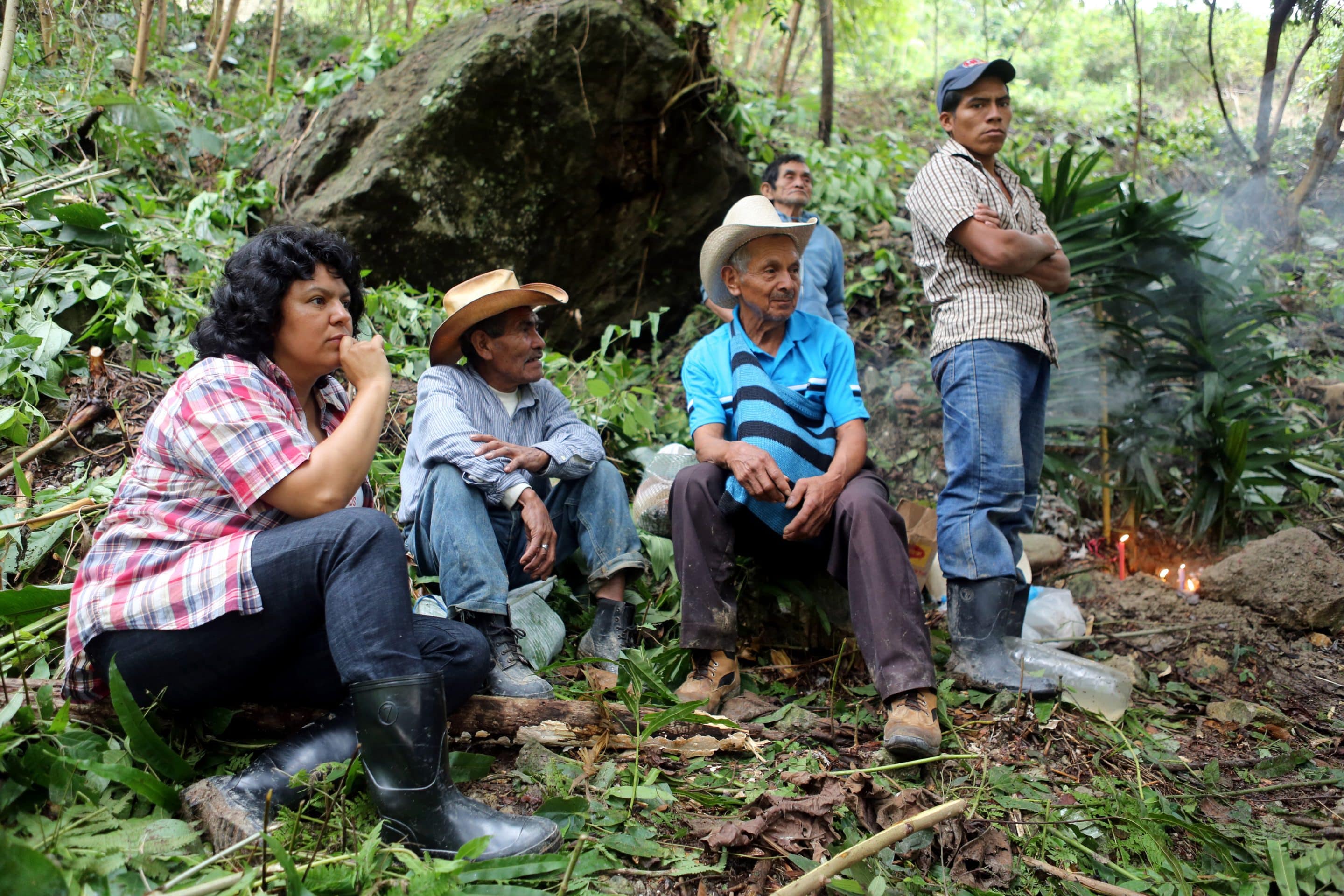
Berta Cáceres at the banks of the Gualcarque River in the Rio Blanco region of western Honduras (Photo: Goldman Environmental Prize)
Inversiones Las Jacarandas S.A., linked to the Atala Zablah family, together with the company DESA, formed part of a network that used its power and influence to systematically harass and attack Berta and COPINH, culminating in her assassination. This structural violence, sustained by corruption and institutional capture, was also backed by international financing, including from the Central American Bank for Economic Integration (CABEI) and the Dutch development bank FMO, which provided economic viability and legitimacy to a project imposed without prior consultation and in the midst of a widely documented territorial conflict.
The Interdisciplinary Group of Independent Experts (GIEI) has contributed key findings to clarify the crime and identify responsibilities. However, justice remains incomplete. It is urgent that the Honduran state capture and prosecute all those responsible, including the intellectual authors who still remain in impunity.
Ten years after her planting, COPINH and the Lenca people continue to defend the Gualcarque River as a source of life, culture, and autonomy. In the face of militarization and criminalization, their struggle remains an affirmation of rights and dignity. Berta’s memory lives on in collective organization, in the defense of territory, and in the persistence of COPINH. Remembering Berta, we reaffirm our solidarity and our commitment to their struggle for justice.
GIEI Report
In January 2026, the Interdisciplinary Group of Independent Experts (GIEI) published its final report on the assassination of human rights defender Berta Cáceres, the related crimes, and measures for comprehensive reparations.
The GIEI concluded that the assassination was the result of an organized criminal operation, carefully planned and carried out through a structure of coordinated participation that included hired gunmen, intermediaries with military training, personnel and executives from the company Desarrollos Energéticos S.A. (DESA), as well as networks of support, tolerance, and omission within different sectors of the state.
The report also determined that funds disbursed by international development banks—primarily the Central American Bank for Economic Integration (CABEI) and the Dutch development bank FMO—formally intended for the Agua Zarca hydroelectric project were diverted from their original purpose and used to finance illicit activities linked to the violent management of the territorial conflict. These included illegal surveillance and intelligence operations, armed incursions, logistical support and associated payments, and ultimately the assassination of Berta Cáceres.
Berta was assassinated in a context marked by violence, militarization, corruption and concentrated economic power in Honduras, where the post-2009 push for extractive and energy projects, pushed by state authorities, private companies and international development banks, advanced in Indigenous territories without consultation, prioritising investment over human rights.
The GIEI was established as an extraordinary and independent mechanism with the mandate to contribute to a comprehensive clarification of the crime and the events linked to the Agua Zarca project. Its creation responded to the need to overcome the limitations of a fragmented criminal investigation—focused primarily on the material perpetrators—and to examine in a more integrated way the structural, corporate, financial, and state dimensions involved.
