

By Daniela Sepulveda, Communications Facilitator at the Coalition for Human Rights in Development
I have always been passionate about the right to information. This began as a bit of a selfish curiosity— constantly wanting to know what the adults were talking about, and asking “why” to anything and everything my parents told me, much to their annoyance.
So, it felt only natural that I would pursue a career in journalism after completing my degree in International Relations and Politics. Working as a correspondent in Madrid in the aftermath of the 2008 recession, I witnessed the daily rhythms of community organising and protest that filled the city’s squares. I covered movements like the “Indignados,” where thousands camped for months in public squares to protest the brutal austerity measures that were choking essential services like healthcare and education. I stood among those who resisted the tightening grip of repression, reporting on the “Ley Mordaza,” a law that silenced dissent and sought to shrink civic space.
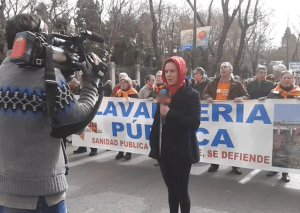
Covering a protest against austerity measures in public health care. Feb 2016, Spain.
While these experiences were quite formative, I came to realise that I wasn’t cut out for the ruthless, fast-paced environment that many journalists thrive in. My heart had begun to shift, drawn more toward the question of how communities could not only access information but wield it—empower themselves with it. My focus shifted from simply reporting to understanding the broader, more meaningful realm of civic participation.
This led me to discover the field of media information literacy, and something clicked. Media literacy is about more than just analysing information with a critical eye. What captivated me was the deeper reflection on power, the structures that shape our world, and the actions we can take to challenge them. Brazilian educator Paulo Freire’s concept of praxis—the intertwining of reflection and action to liberate oppressed communities—became a guiding principle for me. Freire emphasised the importance of examining the power structures that shape our lives, highlighting the inequalities embedded within them and the potential for transformative action.
When I saw the opportunity to work with the Coalition for Human Rights in Development, I didn’t hesitate. At the core of the Coalition’s mission is access to information—not as a passive right, but as a tool for communities to shape their own destinies, to decide their own development paths.
In my role as Communications Facilitator, I hope to support communities in amplifying their voices, in telling their stories on their own terms. Their narratives and struggles for human rights deserve to rise above the noise of those in power—those who too often try to silence, distort, or erase the efforts and commitments of the people advocating for justice.