

Across Kenya’s Great Rift Valley, dormant volcanoes have become the focus of an ambitious geothermal energy programme. Since the 1970s, the government, with the support of development finance institutions such as the African Development Bank, has invested heavily in expanding geothermal generation at Olkaria, Menengai and Mount Suswa as part of a broader vision to establish Kenya as a regional leader in renewable energy. The communities living in these landscapes are rarely consulted, yet they continue to assert their right to shape their own futures and define what development should look like.
In this blog, which is part of a larger analysis of the geothermal expansion in Kenya, we present some of the key livelihood strategies and alternative visions of communities living near geothermal fields. From community-managed conservation, locally designed water systems and livelihood initiatives in Mount Suswa to family farms in Menengai and women’s craft markets in Olkaria, these examples reveal a vision of development rooted in stewardship, self-determination, and the ability of communities to shape their own futures.

Mount Suswa: a rare example of community-led land stewardship
Since 1996, Mount Suswa has been under the care of the local Maasai through the Suswa Conservancy Trust. Unlike the nearby Mount Longonot or Hell’s Gate national parks, which are managed by Kenya Wildlife Services, Mount Suswa remains collectively owned, with individual and communal land rights preserved under Maasai customary tenure.
The Conservancy illustrates a community-led development model grounded in cultural heritage, land stewardship and locally controlled tourism. Managed through an elected board, it regulates access to the area and ensures that economic benefits remain within the community. Through activities such as guided hikes, cave exploration and homestays, the Conservancy supports livelihoods, funds education bursaries and builds local skills, while maintaining community control over land and resources.
Although challenges remain around the inclusion of women and youth in decision-making, the conservancy demonstrates a viable alternative to extractive development, showing how communities can draw on existing cultural and ecological assets to shape their own development pathways and retain value locally.
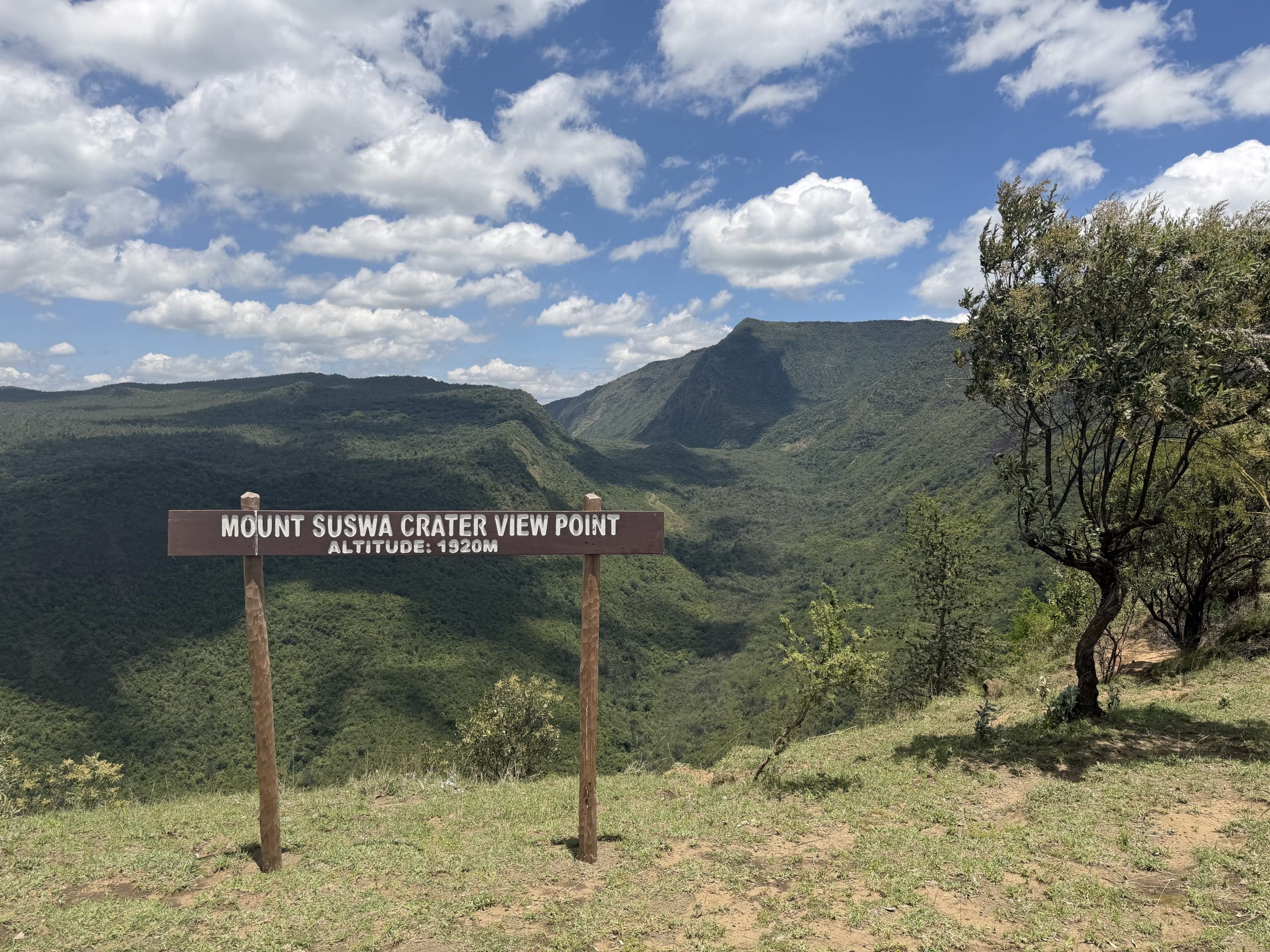
Mount Suswa. Credit: Charlize Tomaselli / CHRD
Kitchen gardens and local water systems
In 2023, a group of local Maasai women from Mount Suswa came together and founded the Sotua Ang’ Community Based Organisation to defend community rights, mobilise residents, and advocate for meaningful participation in decisions that affect their future.
The organisation is also supporting women to explore alternative, cleaner cooking solutions. Recognising that many households rely on charcoal for income and to cook, the organisation has introduced cow dung as an alternative fuel source. The organization’s founder Penina Nailantei Koliel explains, “As much as we are trying to talk of climate change and we want the community to change, there’s no way you can tell them to stop immediately because that is what they do to take their kids to school. But we are trying to introduce the use of cow dung instead of charcoal”.

The organisation also promotes ‘kitchen gardens’, small crop gardens for each homestead. As pastoralists, crop farming is a new addition for many Maasai families. Maintaining the gardens is challenging in such a dry area, making local water systems especially important. For decades, villagers have harvested clean drinking water directly from the steam vents. Steam is captured through simple pipe systems, cooled and condensed into tanks, producing water that is mineral rich and, as residents describe it, slightly sweet. This locally-developed system — based on their Indigenous knowledge – has sustained water security over time, including during periods of drought, and reflects a deep, place-based understanding of the geothermal landscape.
The expansion of geothermal development now threatens to disrupt this system. Plans to redirect steam flows to the power plant risk cutting off the very source of water that the community depends on. Yet, Geothermal Development Company (GDC) has not meaningfully engaged with the community on this issue, nor outlined any clear or viable alternatives for water provision.
Community choices: the SafariCom cell tower
In late 2025, Sotua Ang’ Community Based Organisation helped the community petition Kenya’s largest telecommunications provider, Safaricom, to build a cell mast on Mount Suswa. The absence of reliable telecommunications created challenges during emergencies, isolating residents from social life beyond the slopes, and limiting access to information as life increasingly moves online.
The Mount Suswa community, like many African communities living next to extractive sites, has been labelled as anti-development or anti-modernisation due to its resistance to the building of roads through fields and the drilling of wells that disrupt water sources, human and environmental health, and social cohesion. The example of the Safaricom cell tower shows this is a lazy attack, and not an accurate one.
The community researched the process, drafted the request, signed it collectively, and sent it off. Safaricom then worked with the community to co-design the location of the mast and signed a land rental agreement, providing the community with rental income. This is a clear example of community-led development in a modern context, pushing back against the accusations levelled by those who seek to pave through their land, their culture, and their autonomy.

A small-scale commercial family farm in Menengai
Timothy Ngetich, founder of the Menengai West Stakeholders Forum (MWSF), grew up in the fertile area close to Menengai caldera, one of the main geothermal sites in the country. His father had purchased a parcel of land, where together with his wife built a home and a farm. They planted bananas, avocados and other crops, and raised livestock including cattle, sheep, goats and various birds. Timothy and his three other brothers were then given a portion of their father’s land, while his sister moved to her husband’s land.
Timothy now lives and works in Nairobi with his family, employed in the safari tourism sector, but they return to the farm as often as they can. This is where they feel most settled, where routines are familiar, and where a different pace of life takes hold.
From his front door, Timothy can see the banana grove where his mother is buried. He describes her grave as an anchor to the land. The prospect of geothermal expansion raises concerns that cannot be reduced to questions of compensation. To leave the land would mean leaving his mother behind.
Timothy keeps chickens, turkeys, guinea fowl, ducks and other birds that provide eggs and meat. There is a designated area for cattle and goats, which he tends to with particular care. He is also a keen gardener and has kept an area for Indigenous flowers, such as plectranthus, strelitzia and lobelia, valuing the presence of colour and diversity alongside food production.
The farm itself operates through a set of interlinked, sustainable systems. Among the animal stalls, Timothy has built a small biogas processing unit. Organic waste is placed into a plastic tunnel, where it decomposes and releases gas. This gas is captured and channelled through pipes directly to a stove inside the home. Cooking becomes as simple as turning a dial and lighting a match. What remains from the process is returned to the soil as compost, used to grow sweet peppers, beans and other vegetables.
Water is managed in a similarly contained way. During the rainy season, Timothy collects rainwater and stores it in large tanks raised on wooden platforms. Every possible surface has gutters attached. Every splash of water is collected. A small solar powered pump is used to move water into the tanks, after which gravity distributes it across the household and fields. These systems are connected, each feeding into the next, reducing waste and limiting reliance on external inputs.
Timothy does not describe this way of living as an “alternative”. It reflects how his parents and other families in the area have always lived. It is a way of working with what is available, maintaining a degree of independence, and passing on this knowledge to ensure that land remains productive across generations. He speaks of his hope that its children will one day inherit it.
The Maasai Craft Experience, Olkaria
Within Hell’s Gate, just off the main route that leads visitors toward the dramatic gorges that give the park its name, sits a small Maasai craft market. It is easy to miss. There is no signage to announce its presence, no structured pathway guiding visitors toward it, no indication from the park authorities that this is a place worth stopping. One finds it, if at all, through chance or through the insistence of a local guide who knows where to turn.
The market serves both economic and social functions. Women gather to bead, share stories and produce handmade jewellery and crafts that reflect Maasai cultural traditions. The work is collaborative, with income and labour shared across family and community networks. At first glance, it resembles many other craft markets across the continent. But it does not function in the same way. There are very few tourists. The stalls are full, the work is of high quality, yet the customers are largely absent.
The market operates under highly constrained conditions. Vendors often travel long distances and incur significant transport costs. Despite operating in the area for many years, there has been little investment by either Kenya Wildlife Service or the geothermal companies whose projects dominate the surrounding landscape. The market is treated as an informal add-on, something that exists at the margins of the park rather than as a legitimate component of its economic ecosystem. The vendors are allowed to be there, but this permission is framed as a favour rather than a right.
There are practical ways to improve the market’s visibility. Simple signage along the main route and better access roads would make it easier for visitors to reach the stalls. Another option is relocating the market closer to the park entrance, where every visitor must pass through. Yet, vendors are hesitant at this suggestion. While it could increase foot traffic, it would likely bring formalisation and rental fees that could erode the already thin margins.

This tension points to a deeper accountability. Both KenGen and Kenya Wildlife Service have a clear obligation to create meaningful opportunities for local communities. For Maasai communities displaced from land and grazing routes, the craft market is one of the few accessible livelihood opportunities that remain. Supporting it through investments in visibility, infrastructure and access should be understood not as a favour, but as a small and necessary act of redress.
The Masai craft market and the other examples challenge the assumption that development must arrive from outside, delivered through large infrastructure projects or corporate investment. They demonstrate the plurality of development possibilities, some that can co-exist with geothermal powerplants, some that provide alternatives to extractivism, but all rooted in local control. A just transition is only just when it recognises the hopes, ambitions and cultures of the affected-communities themselves.
This blog was written by Charlize Tomaselli (Research and Learning Facilitator at the Coalition for Human Rights in Development), as part of a wider research project on the impact of energy transition projects and community-led approaches to the energy transition.
Photo credit: Charlize Tomaselli / Coalition for Human Rights in Development.