

Background
The Coalition for Human Rights in Development is a member-led coalition, whose mission is to ensure that development respects, protects and fulfills human rights, and is community-led. We are governed by a Steering Committee composed of 10 member organizations and facilitated by an international secretariat.
During our last members gathering, in 2017, we charted the path forward on strategic approaches and priorities. The next members gathering is planned for March 2025, to mark the ten year anniversary of the Coalition.
During 2024, the secretariat will be working with the Steering Committee to facilitate a collective reflection on current Coalition work, changes in context and relevant trends, opportunities, and options for strategic priorities. Below, we highlight some key achievements in our collective work, and outline how we implemented the key strategic decisions that emerged during our last members gathering.

Members gathering in 2017
Key achievements
- Following a two and a half year co-design and co-creation process with around 400 community groups and their allies, in 2020 we launched the pilot of the Community Resource Exchange (CRE). The CRE enables community participation in development finance and international investments by linking grassroots partners with information, resources and allies (including when there is limited civic space for activists). Over the last three years, members and partners have collaborated with over 200 communities during the first phase of the CRE pilot. The CRE works closely with sister networks, like the Early Warning System (EWS) and others to avoid duplication of work.
- In 2017, local and national groups pushed for greater regionalisation of the Coalition’s work to Africa, Latin America and Asia. Since then, regional working groups have been building collective capacity and mobilizing on regional development banks like the InterAmerican Development and African Development Bank. Regional working groups have been pushing for transparency, accountability and participation, including by creating spaces for local and national groups to meet with banks and contributing to policy frameworks like Access to information or Environmental and Social Safeguards. They have also come together to mobilize on crucial issues such as the global response to the pandemic, just energy transitions and protection of forests.
- Communities and defenders came together with protection groups and civil society organizations to launch the Defenders in Development (DiD) campaign. The campaign responds to escalating reprisals and closing civic space by leveraging development finance to enable participation, and prevent and remedy reprisals. Since the campaign launched in 2018, most of the largest development banks have adopted policies indicating zero tolerance to reprisals, and several are continuing to engage on the topic. The campaign’s security working group also facilitates access to protection and security for grassroots defenders who face reprisal risks.
Ways of working
- Greater communications infrastructure: The Coalition’s quarterly newsletter supports greater cross-sharing across members and partners. We are also using communications as a tool for movement-building/ solidarity-building (for e.g., helping communities reach out to other communities through social media and radio), and advocacy (for e.g, amplifying community voices, and creating unbranded materials for collective campaigns).
- More representative structures/ working groups for programs: The Coalition works through regional and thematic working groups and committees which include members and partners. These advisory committees and working groups – such as in the CRE, DiD campaign, and campaigns on regional development banks – also set objectives, strategies and work plans. For the first time in the history of the Coalition, in March 2024 members voted for the Steering Committee in order to ensure more transparency, representation and accountability to members. All committees and working groups are composed to ensure broad geographic distribution and gender diversity, as well as representation of Indigenous peoples, grassroots groups and those who are active in social movements. Check out this infographic to learn more about our organigram and governance structures.
Key principles and strategic approaches
- Centering the work at the community level: The CRE, including its regranting program, are the largest part of the Coalition’s budget. In addition to systematizing the community work, the CRE has also worked with the Coalition’s regional coordinators, the DiD campaign, and other sister networks to connect communities to policy and systems change processes. Communities have used these linkages to speak directly to governments, intergovernmental processes, development banks, companies and other actors. The DiD campaign has also been working with grassroots defenders to amplify their policy recommendations to development banks.
- Employing multi-level strategies: Indigenous Peoples, traditional communities and grassroots activists are working with national, regional and international groups on crucial issues at the national level (lithium mining in Argentina/green hydrogen in Chile), regional level (like protecting the Amazon) and international level (like how closing civic space creates barriers for grassroots groups to shape climate finance).
- Building accountability: Members and partners have been using courts, national administrative processes, independent accountability mechanisms and special procedures to demand accountability on a range of impacts related to international investments and development finance. Additionally, concerted pressure over development bank shareholders has also made development banks more answerable to civil society.
- Broad coalitions: Over the years the Coalition has been deepening relationships with defender protection groups, climate activists, press freedom groups, womxn’s groups, social movement groups, donors, and others in the economic justice movement.
- Early intervention before harm occurs: The policy work around human rights due diligence has focussed on avoiding risks before they occur. Additionally the CRE and EWS have been collaborating to enable communities to raise concerns about projects prior to project approval and implementation.
- Challenging the development model: Members and partners have used moments like the Finance in Common summit of development banks and World Bank Evolution Roadmap process to challenge the top-down, private-sector focussed model of development. Our recent collaborative report Demystifying Development Finance critiqued the dominant development model for being more focussed on geopolitical interests, market development and private profit than on peoples and the planet.
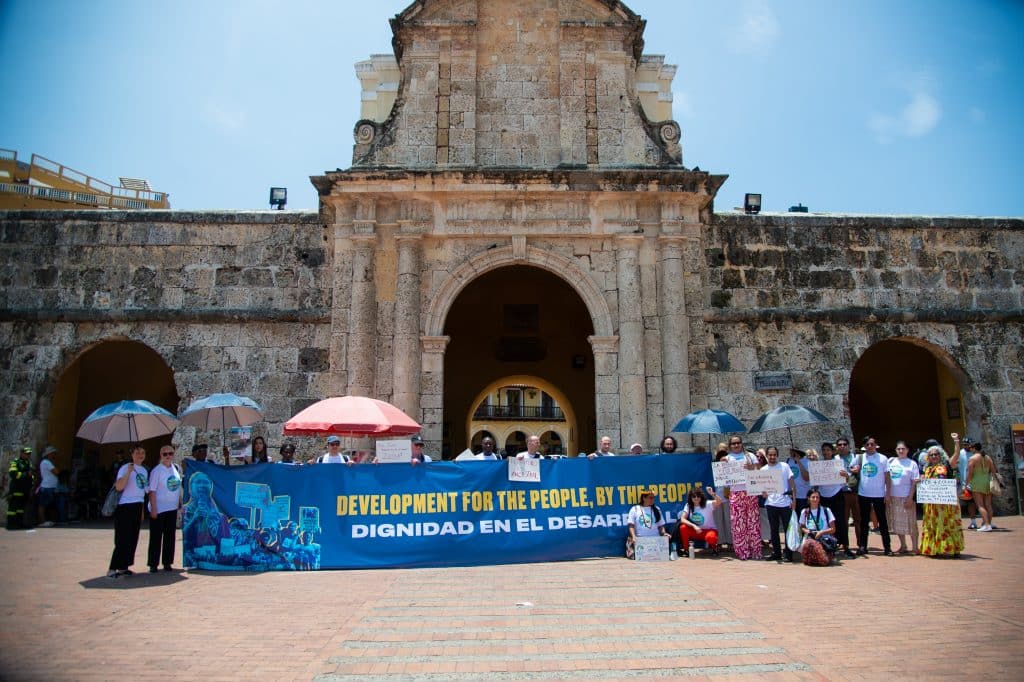
Mobilization action during the Finance in Common Summit on 5 September 2023. Credit: Barros Sebastian.
Variation from 2017 members’ gathering
There are also some priorities that emerged in the last members’ gathering, where we do not yet have a collective approach. These include community-led development, alternatives to the current development model, and a more cross-cutting gender approach. Additionally, we are also seeing members and partners increasingly using the Coalition as a space to advance climate justice and just energy transitions, which had not been articulated in 2017.
Next steps
As we work towards the Coalition’s strategic plan from 2025 to 2030, we need to keep all of this in mind and honestly reflect on our strengths and weaknesses, and decide opportunities we want to focus on going forward.
How to get involved
- Please send us feedback on the text above and share your thoughts, writing to us at: contact@rightsindevelopment.org
- Please fill this survey to shape the Coalition’s strategic plan from 2025 to 2030, by May 31, 2024.
- Join one of the consultation sessions we will be hosting over April to June 2024, or schedule a one-on-one discussion contacting a member of the secretariat or the Steering Committee.