

Grassroots voices are essential to solve global challenges like climate change, biodiversity loss, lack of energy access, conflict, and food insecurity. However, governing and business elites keep using public development banks (PDBs) to advance a top-down economic development model, which focuses on economic growth at all costs, ignores grassroots voices and often does more harm than good.
At the Coalition for Human Rights in Development, we see how local communities are effectively challenging this model, by connecting with regional and global networks of allies to seek solidarity, internationalize their struggles for development justice, and push for systemic change.
In this blog, we celebrate their collective struggles and we share a snapshot of what we learned in 2023, what we achieved, and our hopes and dreams for the work ahead.
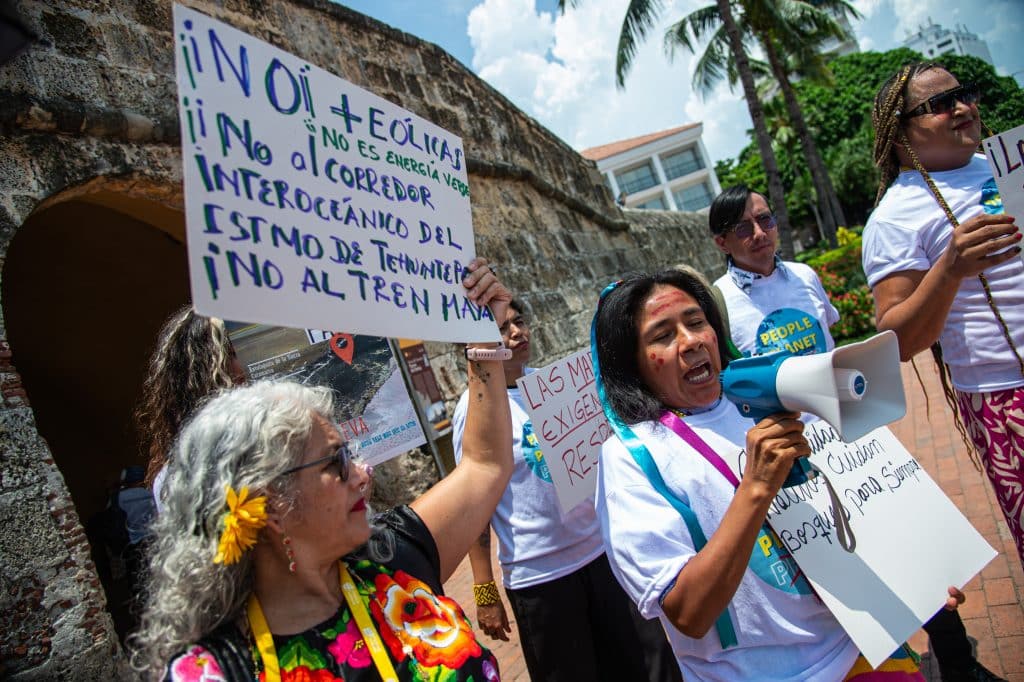
Mobilization action during the Finance in Common Summit. (September 2023) Credit Barros Sebastian
Communities speak up and take action
In 2023, strong community voices spoke up in various global forums. Bettina Cruz Velazquez, for example, is one of the 40 activists who attended the Finance in Common Summit in Cartagena, an event that brings together all the world’s public development banks (PDBs). Bettina is an Indigenous Binnizá activist who is resisting wind farms, industrial parks, and other destructive infrastructure projects funded by the Inter-American Development Bank and other PDBs in Mexico, like the Interoceanic Corridor of the Isthmus of Tehuantepec.
“Development banks are saying they’re going to save us from poverty and from the climate disaster, but they are those who provoked these crises. They don’t even realize this, so they keep replicating the same destructive model based on exploitation,” she said during one of the sessions at the Summit.
Through the Community Resource Exchange (CRE), in the past year we’ve been grateful to collaborate with about 100 communities as they defended their environmental and human rights, and critiqued broader systems of development finance. For example, we collaborated with several Indigenous Peoples and local communities who are pushing back against large-scale extractives (like lithium mining in Argentina), mega infrastructure (like large hydropower in Nepal), and false climate solutions (like green hydrogen in Chile). All these PDB-supported projects violate their right to free, prior and informed consent, fail to account for their disproportionate impacts on women, and lead to environmental degradation and loss of livelihoods.
Many communities are coming together in collective learning processes, to co-develop skills with their peers and consider joint action. For example, in 2024 youth climate activists from Uganda will be hosting community representatives from the Democratic Republic of the Congo who are affected by Chinese-financed mining, for an in-person workshop on protection and advocacy with Chinese financiers.
The CRE is now transitioning into the second phase of the pilot, which is expected to last 5 years. To collectively set its future direction, the groups who are part of the CRE (including the advisory committee and regional working groups) are now starting a structured, participatory review to reflect on the CRE impact for individual communities and at a systemic level.
Just transitions for peoples and the planet
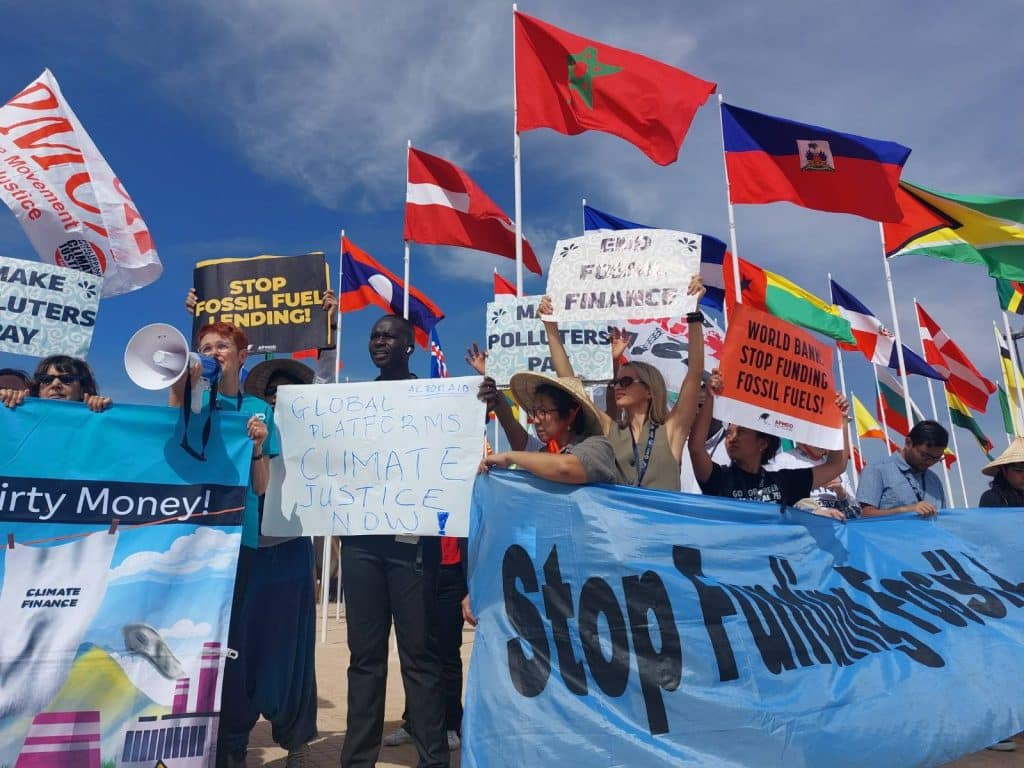
World Bank Annual Meetings 2023 Protest in Marrakech.
PDBs and corporations are co-opting the language of just transitions while sidelining communities who are on the frontlines of the climate crisis. PDBs are claiming a bigger role in the global response to climate change, but they are using their resources primarily to support the private sector rather than meet the needs and priorities of local communities and Indigenous Peoples.
We cannot measure the success of the climate response solely by the quantum of funds mobilized. Rather, we need to consider the development impact of the funds using rights-based indicators.
Elites in banks, governments and corporations are citing the urgency of the climate crisis to weaken current environmental and social safeguards. But Coalition members and partners have been pushing back. Through its advocacy, the civil society working group on the African Development Bank (AfDB) was able to avoid any serious gutting of transparency, accountability and participation of directly affected communities in the review of the bank’s safeguards, and to advance protections against reprisals. Similarly, several members and partners are also pushing for stronger safeguards at the Asian Development Bank, strategically using inside and outside strategies.
In Latin America, a broad regional working group has defined their own vision of how a just energy transition should look like, and how to respond to climate change while examining the role of development financiers and centering the voices of Indigenous peoples and local communities. Several regional members of the Coalition, including from the IDB working group, are strategically working to push issues related to human rights and development finance within broader political agreements on the Amazon.
Latin American groups are seeking greater global coordination, especially with groups in Africa and Asia, to mobilize towards the G-20 in 2024 and climate COP in 2025, which will both be held in Brazil, under the leadership of President Lula.
True participation requires people to feel safe, and to be heard
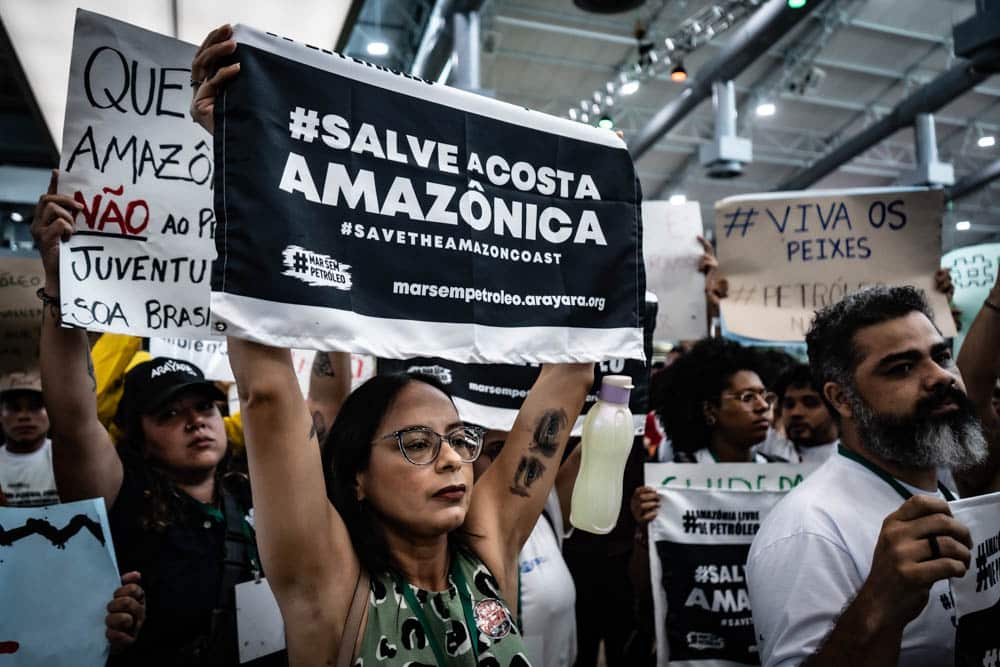
Amazon Dialogues in Belem, Brazil, in August 2023. Credit: Todd Southgate
Many people – who are excluded from decision-making about their traditional lands, forests and water sources, like in top-down forest conservation efforts in Uganda – are often too scared to speak up due to closing civic space, or face retaliation for expressing their concerns. For the most part, development banks have tended to shirk their responsibility under international law and are doing too little or too late to prevent reprisals and respond to them.
Defenders from across Latin America, Africa and Asia have been using the Defenders in Development Campaign to push banks to act on reprisals when they occur. For example, on the request of civil society, the AfDB spoke to the Senegalese authorities to urge the release of 26 community members who were detained for speaking up about their project. There have been some opportunities to push for reprisal-sensitive human rights due diligence at the European Bank for Reconstruction and Development, and incorporating civic space indicators in the World Bank Group’s risk assessment of countries and projects. Additionally, many Coalition members are pushing for remedy and responsible exit frameworks at the International Finance Corporation. These civil society calls have also been supported and reiterated by the United Nations Office of the High Commissioner, and other UN special procedures including the UN working group on business and human rights.
The Defenders in Development Campaign has started reflecting on its impact over the last two years, as part of a strategy setting process to set its objectives for the next three years. The campaign is also planning its second gathering in Tbilisi, Georgia in May 2024.
Geopolitics trumps development impact
Donor countries use development finance to advance their geopolitical and economic interests rather than prioritize development outcomes for people in the Global South. This is particularly troubling as rich countries that have built wealth through polluting industries, extractivism, capitalist exploitation, slavery and colonialism are closely controlling the purse strings of climate and development finance. For example, the Loss and Damage fund that is meant to serve as a form of climate reparation has been entrusted to the US-led World Bank, which denies its human rights obligations. Like most other PDBs, the World Bank has skewed incentives to pursue debt-based economic growth, privatization and profit; they prioritize demands of global markets over the environment and local communities’ needs. Several of these critiques about the World Bank Group have also been raised during the consultation process for the World Bank Evolution Roadmap, but they do not appear to have been taken on.
The growth of Chinese public and private finance, including the Chinese-led Asian Infrastructure Development Bank create opportunities for civil society to leverage geopolitical tensions and facilitate a race to the top on environmental and social issues. Chinese policy makers have demonstrated sensitivity to reputational risks when community groups approach them through evidence-based advocacy, and have taken steps such as creating a mining sector accountability mechanism. At the same time, US-led geopolitical processes like the Summit of Democracies, have affirmed commitments to civic space and human rights, which need to be incorporated into the international financial institutions these states support.
Community-led development as the way forward
The top-down economic development model needs to be flipped on its head if we want human rights-based and community-led development.
For this reason, we have been collaborating with local communities and their allies as they raise their voices to governments, international financiers and other actors. Many Indigenous Peoples and local communities are pushing to protect their traditional ways of life while advancing development in accordance with their own cosmovision. Feminist groups are pushing for greater recognition of the care economy. And despite trends towards centralized market based approaches, we are seeing growing public support and successful examples of decentralized approaches such as agroecology, and community-based energy systems including micro-hydro and solar.
The new UN special rapporteur on the right to development has also amplified these calls from civil society and is advocating for planet-centered, participatory development, urging financial institutions to act accordingly. We need to ensure human-rights based and community-led development, and the role of finance, continue to be front and center in the instrumentalisation of the right to development. And we also need to explore strategies to better engage other regional and global human rights mechanisms that do not always pay enough attention to public development banks.
The Coalition continues to have an important role
This changing world has reaffirmed the importance of having a Global South-led coalition that works to shape global finance and make it work for local communities, Indigenous Peoples and the planet.
If the Coalition wants to speak truth to power outside, it also has to live its values within. For this reason, the Coalition’s Steering Committee, which acts like a board, has gone through a governance review process and is overseeing the first election for the next steering committee. Meanwhile preparatory work has already started for the Coalition’s strategy setting process till 2030.
We look forward to working collectively under guidance of communities to build a just and equitable world, where we can all share and steward this abundant planet with dignity.
* This blog was written by Siddharth Akali, Director at the Coalition for Human Rights in Development.