

What is the CRE
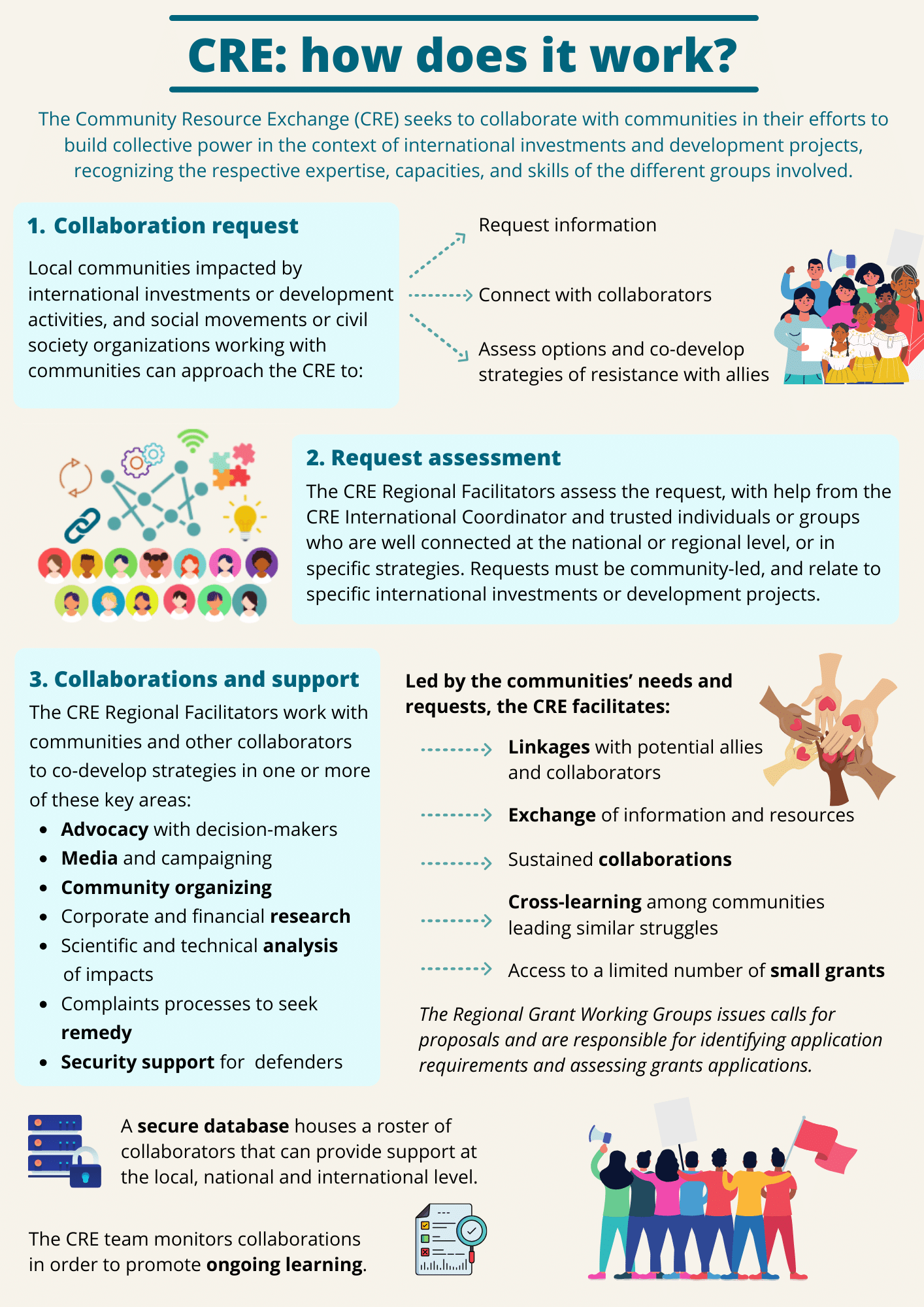
The Community Resource Exchange (CRE) is a system to facilitate collaborations and co-develop strategies with and among communities defending their rights in the context of international investments and development projects. It works at the direction of communities and their partners, to coordinate:
- Linkages with potential allies and collaborators
- Exchange of information and resources
- Cross-learning among communities leading similar struggles
- Access to small financial assistance (under US$ 5000) through regular calls for applications
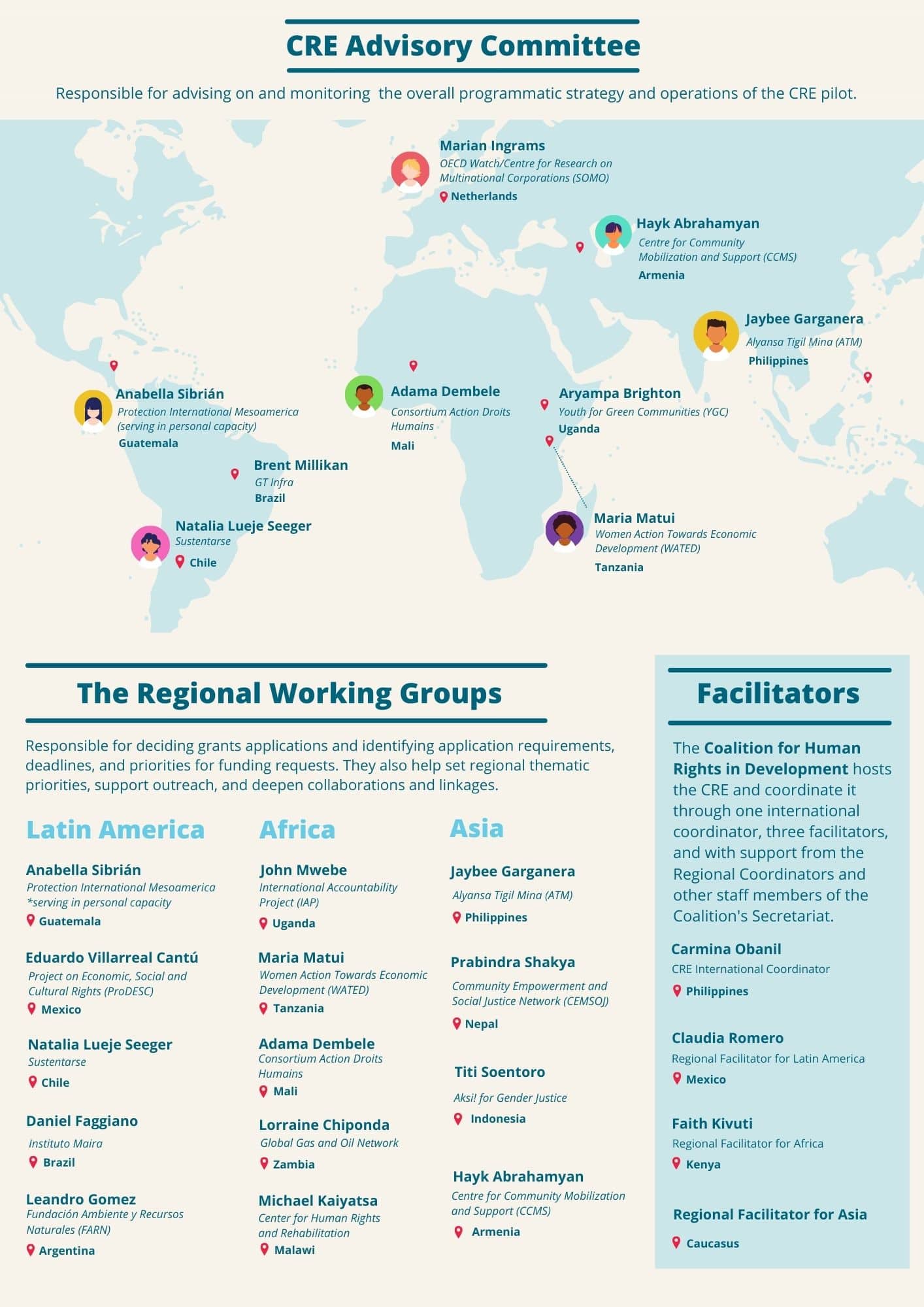
To learn more about the CRE, check out these infographics available in English, French, Spanish, Russian and Portuguese.
Call for proposals
In April 2026, the CRE opened three regional calls for proposals:
- Africa [see this page] | Thematic call on critical minerals | (closed)
- Asia [see this page] | Thematic call on energy projectts | Deadline: 30 May 2026
- Latin America [see this page] Thematic call on water and extractivism | Deadline: 30 May 2026
If you are a community in the Global South impacted by an international investment or development project and you’d like to collaborate with the CRE, check out this page and get in touch: cre@rightsindevelopment.org.


Stories
Behind the “green” transition: the impact of graphite mining in Ulanga, Tanzania

CRE bulletin – January 2025
Claudia’s blog: Why I joined the Coalition

How renewable projects in Kenya are replicating the same mistakes of the fossil fuel industry

Can there be a fair remedy for the harm inflicted on Indigenous Peoples?

From Nigeria to Uganda, oil-affected communities are standing up for climate justice
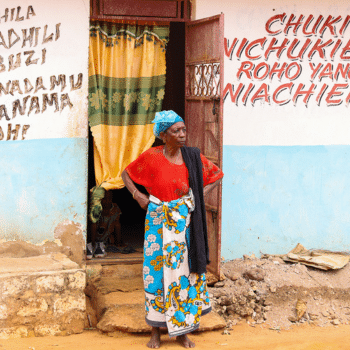
Kenya: Nightmare at Bamburi Farm

A Tale of a Defender in Development
Collaborators Map
In this interactive map, you can see some short profiles of the first cohort of CRE collaborators. In the coming months, we’ll continue updating the map with new profiles and additional information on their struggles. Please note that, for security reasons, those collaborators who prefer to remain anonymous will not be featured in the map. If you have collaborated with the CRE and you’d like to spotlight your community-led struggle on the map, get in touch and write to us at: cre@rightsindevelopment.org.
Country
Sector
Impacted Communities
Violations/Impacts
- All Collaborator Violations/Impacts
- Conflict & militarization
- Consultations / access to information
- Corruption / Fraud
- Cultural Heritage
- Displacement & land grabbing
- Environmental impacts: Biodiversity
- Environmental impacts: Climate change
- Environmental impacts: Pollution
- FPIC & Indigenous Peoples’ rights
- Gender-based violence and impacts
- Health & Safety
- Loss of livelihoods / Food insecurity / Increased cost of living
- Obstruction of monitoring
- Pollution
- Property damage
- Reprisals
- Water
Types of financiers
Financiers
- All Collaborator Financiers
- Aboitiz Equity Ventures (AEV)
- ADB
- AfDB
- Africa Oil Corporation
- AIIB
- Allkem
- ANZ Bank Australia
- ArcelorMittal S.A.
- Australis Seafoods
- Ayala Corporation
- Banco de Desarrollo de América Latina
- Bank of China
- Bluestone Resources
- BM Global Business
- BNP Paribas
- BNP Paribas Singapore LTD
- Caledonia Mining Corporation
- Canadian B2Gold
- Celulosa Arauco y Constitución
- Central Cipta Murdaya (CCM) Holding
- China Construction Bank
- China Exim Bank
- China Eximbank
- Chinese Overseas Finance
- CITI Group USA
- CITIC Group Corporation Ltd
- Comisión Federal de Electricidad
- Compañía Mexicana de Exploraciones
- Congo Blueant Minerals
- Corporación Eléctrica del Ecuador
- Credit Suisse AG Switzerland
- DFC
- Dutch Entrepreneurial Development Bank
- EBRD
- EIB
- Ellington Properties Development
- Empresa de Transmisión Eléctrica
- EU
- Export-Import Bank of India
- Fénix S.A de C.V.
- Filminera Resources Corporation
- First Patriot Mining Company
- French Development agency
- Galaxy Resources
- Gazelle Ventures
- Gécamines
- Glencore
- Government
- Groupe Cristal
- Grupo Dragon
- Hana Financial Group
- Hongkong and Shanghai Banking Corporation Limited
- Hwange Electricity Supply Company
- IFAD
- IFC
- Indorama Corporation
- Industrial and Commercial Bank of China Limited
- ING Bank N.V
- International Finance Corporation
- Japan Bank for International Cooperation
- Japan International Cooperation agency
- Latin Resources
- Legend Holdings
- Livent
- Lombardi Group
- Lydian Armenia CJSC
- Metorex Limited
- MIGA
- Minerales Sierra Pacífico S.A.
- Mitsubishi UFJ Financial Group
- Mizuho Bank Ltd Japan
- New Continent Mineral
- Next Energy
- Nordic Development Bank
- Oriental Ressources Congo Sarl
- Oyu Tolgoi
- Pacific Rim/Oceana Gold
- Petróleos Mexicanos
- RMG
- S.A de C.V
- Salala Rubber Plantation
- San Miguel Corporation
- Sensunapan S.A. de C.V.
- Sinohydro Corporation Limited
- Socfin
- Société Générale
- Standard Bank
- TC Energy
- Ternium
- Total Energies
- Uganda Electricity Generation Company Ltd.
- Volcanic Gold Mines Inc.
- World Bank
- Yellow Water Ressources
- Zijin Mining
- Zimbabwe Power Company
In Georgia, the local community living near the Poti port is speaking out about the severe air pollution, due to the millions of bulk cargo processed out in the open. The community has been demanding environmental protection measures, raising awareness about the health impacts, and conducting advocacy at the local and international level (including with DFC, one of the port's financiers).
Since 2017, MODETEAB (Movimiento por la Defensa de los Territorios y Ecosistemas de Bocas del Toro) has been resisting the construction of the IFC-funded Transmission Line IV project, which aims to run 330 kilometers along the Atlantic coast, crossing numerous indigenous lands and violating their rights.
The Asociación de Desarrollo Económico y Social (ADES), together with the communities of Santa Marta in Cabañas, El Salvador, is resisting government attempts to revive large-scale metallic mining projects that threaten their lands and water sources.
In Chile, Agrupación Ciudadana Última Esperanza (A.C.U.E.) is fighting alongside artisanal fishers, family farmers, and the Indigenous Kawésqar people to resist the salmon industry’s expansion, specifically the Puerto Demaistre processing plant.
In the north of the Philippines, the Kabugao Youth Organization is resisting the hydro-power plants Gened-1 and Gened-2, built by the Pan Pacific Renewable Power Philippines Corporation. They have been mobilizing the local community and filing legal cases to stop the project, which was imposed violating the rights of the local Indigenous community.
With the support of Green Development Advocates (GDA), riverside communities of the Sanaga River in Cameroon have taken on legal action turning their struggle against the Nachtigal Hydro Power Project into a collective fight for justice and accountability.
For over two decades, palm oil company PT. Hardaya Inti Plantations in Indonesia's Buol District has seized thousands of hectars of land from indigenous people in the area and committed serious rights violations. In response, Forum Petani Plasma Buol (FPPB) has been mobilizing local farmers, raising awareness about the project's impact, building alliances at the local and international level, and demanding justice.
Driven by their desire to address social injustices in Uganda, the Oil Refinery Residents Association (ORRA) together with the Youth for Green Communities (YGC) set out to empower local communities impacted by the East African Crude Oil Pipeline (EACOP). Through CRE support, the organizations were able to link oil-impacted Indigenous communities, raising awareness about their rights and strengthen participatory advocacy action. They amplified local voices through social media, provided legal support, and shared strategies with other human rights defenders worldwide.
How did the CRE start?
In 2018, a group of activists and organizations working around development and human rights issues came together and started imagining a new system to facilitate linkages among communities and groups that provide support to community-led struggles. They had a question in mind: what if we could spread our branches and roots, as a global civil society community, to be better connected to each other?
The CRE was developed through a 2.5-year participatory process. To ensure the system would truly meet the needs of local communities, around 400 people from grassroots groups, indigenous peoples, and civil society organizations working from the local to the global were consulted through online surveys, focus groups, interviews, and consultative webinars. Together, we co-created and shaped what we now call the Community Resource Exchange.
Since launching our first call for proposals in 2021, we have been facilitating collaborations with hundreds of communities around the world. You can read more in the evaluation of the first phase of our pilot.
Learn more
Blogs about the CRE growth
Frequently asked questions
We’ve put together some commonly asked questions to give you more information about the Community Resource Exchange (CRE) and the support we offer communities. If you’d like to know more or explore a possible collaboration, you can request a call with any member of the CRE team at: cre@rightsindevelopment.org.
What is the Community Resource Exchange (CRE) and how was it created?
The CRE was developed through a 2.5-year participatory process, involving over 400 people. The group of organizations that co-designed the CRE entrusted the Coalition for Human Rights in Development with hosting the pilot phase and coordinating its implementation.
What do you mean by “development finance and international investments”?
- Public development banks (such as the World Bank, the Asian Development Bank, the African Development Bank, or export-import agencies like China Export-Import Bank)
- Transnational commercial banks (e.g.: Standard Chartered Bank Corporation)
- International companies and corporations investing abroad (e.g.: Nestle, Indorama, Barrick Mining, etc).
Development projects include, for example, activities in the areas of energy, mining, infrastructure, agribusiness, forestry, conservation, water, health, education or housing, both in the public and private sectors.
Do you need to be a member of the Coalition for Human Rights in Development to seek support from the CRE?
How can communities start a collaboration? And what are the ways the CRE can support communities?
When calls for proposals are opened, communities can submit proposals for collaborations with financial support (see details below). During the rest of the year, when there are no open calls for proposals, we can facilitate non-financial support.
Depending on the communities’ needs and priorities, that will be discussed during a call with one of the CRE Regional Facilitators, we can facilitate support by:
- providing information;
- connecting communities with potential allies and other CRE collaborators who can offer guidance or accompany in advancing the community’s struggle;
- organizing capacity building initiatives;
- facilitating peer-to-peer learning to share experiences, strategies and achievements;
- providing small grants or facilitating connections to other funding sources.
- providing tailored communications support to visibilize the community’s struggle at the local, regional or global level
Our support covers the following strategy areas:
- community organizing;
- corporate and follow the money research;
- scientific and technical support;
- access to remedy;
- advocacy and campaigns;
- media engagement and communications;
- security support.
For example, if a community sees a billboard suddenly announcing a dam project in their territory (funded by the Asian Development Bank), the CRE could support in different ways:
- Information: Help the community access information about the impacts of the dam or to find out who is behind the project (e.g.: by connecting them to groups like the Early Warning System, that monitors projects funded by development banks, or assisting with financial research to map the other companies/financiers involved).
- Linkages: If the community gets information and decides to take action, the CRE can discuss potential linkages with allies (e.g.: networks that are engaging the Asian Development Bank in their advocacy) and possible strategies. In some cases, the community already knows which strategy to pursue. In others, the CRE can brainstorm with them about the different options available.
- Collective learning and capacity building: Recognizing the expertise of the communities, the CRE can also support peer-to-peer learning exchanges and capacity-building sessions (e.g.: a “learning circle” on community organizing or on advocacy with international financiers, where other communities impacted by ADB-funded dams share their experiences).
- Financial support: when we open calls for proposals, we can provide small grants that act as a “seed fund” to implement activities.
How can a community access support if they are unsure of who is financing the project affecting them?
Does the CRE provide security support for communities? And can a CRE grant be used for security purposes?
Given the deliberative process by which CRE grants are awarded and the time needed to assess the proposals these grants are not intended for urgent emergency cases where support is needed immediately.
What type of groups does the CRE prioritize?
Which projects are ineligible for CRE’s support?
- livelihood projects;
- water and sanitation project;
- medical emergencies;
- other activities not related to projects funded by development or with international investments.
We believe that these projects are important, but these areas fall outside our scope of work.
How much is the grant from the CRE and how can communities apply?
Communities can submit proposals for financial support when there are calls for proposals. Regional or global calls for proposals are usually opened twice a year, and they will be posted on this page. The calls can be either open or can be targeted for specific groups, topics or strategies.
The Regional Grant Working Groups, made up by members of the CRE team and a group of collaborators from the different regions, is ultimately responsible for deciding who to award financial support. Further information in this infographic.
Outside the calls for proposals, communities can still apply to collaborate with the CRE. However, financial support is only awarded through the calls for proposals.
If I have already received CRE financial support, can I apply again to get support for a different activity?
If I applied for a grant but it was not approved, can I still get other forms of support?
- Non-financial support: we can facilitate linkages with possible allies, learning opportunities, sharing resources and information, and supporting any activity that falls within our strategy areas.
- Linkages with or referrals to other organizations that provide small grants: the CRE can help you understand the grant application process and requirements for other funds, and can also review your proposals so that you can potentially access funds from other groups.
How can we collaborate with the CRE to support communities?
We are constantly mapping potential collaborators (especially experts in specific strategy areas) to ensure that we can support communities once they request linkages.
You can also opt to become a “national” or “strategic” node.”Strategy nodes” share their expertise on their specific areas of expertise (e.g.: financial mapping, Chinese finance, international law, etc). National nodes perform three key functions:
- help the CRE conduct due diligence on communities requesting assistance;
- connect communities seeking support to the CRE;
- conduct outreach activities, in partnership with the CRE, so that more communities can be connected to the CRE.
How does the CRE collaborate with sister networks?
Which regions and countries does the CRE work?
Who are the CRE Regional Facilitators?
- Faith Kivuti – fkivuti@rightsindevelopment.org [Africa]
- Claudia Romero – cromero@rightsindevelopment.org [Latin America]
- Carmina Flores Obanil – cfobanil@rightsindevelopment.org [International Coordinator – can forward requests to our Asia and Caucasus Regional Facilitator]