Amid turbulent times, our 2025 Annual Report highlights some moments that give us hope: local communities shaping their own futures, hundreds of civil society groups and human rights defenders joining forces to challenge the status quo, and grassroots movements winning legal cases to protect their land.
As we marked our ten-year anniversary, 2025 was a year of deep reflection and experimentation for the Coalition. We strategized on how to confront the profound challenges we face, while also creating space for our dreams and aspirations. In this report, we are proud to present our Manifesto for 2026 to 2030 – the result of an 18-month collective process – setting out our shared priorities for the years ahead and how we will continue to strengthen our network.
Throughout 2025, we also tested new strategies and pursued emerging opportunities: facilitating peer-to-peer connections that evolved into “communities of action,” building cross-regional alignment around collective demands for a community-led just energy transition, and exposing the human rights violations linked to Germany’s development bank, KfW.
We invite you to explore our Annual Report and join us on this collective journey to advance community-led, human rights-based development—and to imagine a future rooted in justice, dignity, and community power.
Annual report: flipbook
Foreword
Our Coalition for Human Rights in Development turned 10 in 2025. A decade ago, we started planting the first seeds for our work and now those seeds have sprouted roots and blossomed into trees. Today, we are an interconnected network of over a hundred groups in more than 50 countries across Africa, the Americas and Eurasia. And while the scale of the work ahead is huge, many of the trees are already bearing fruit.
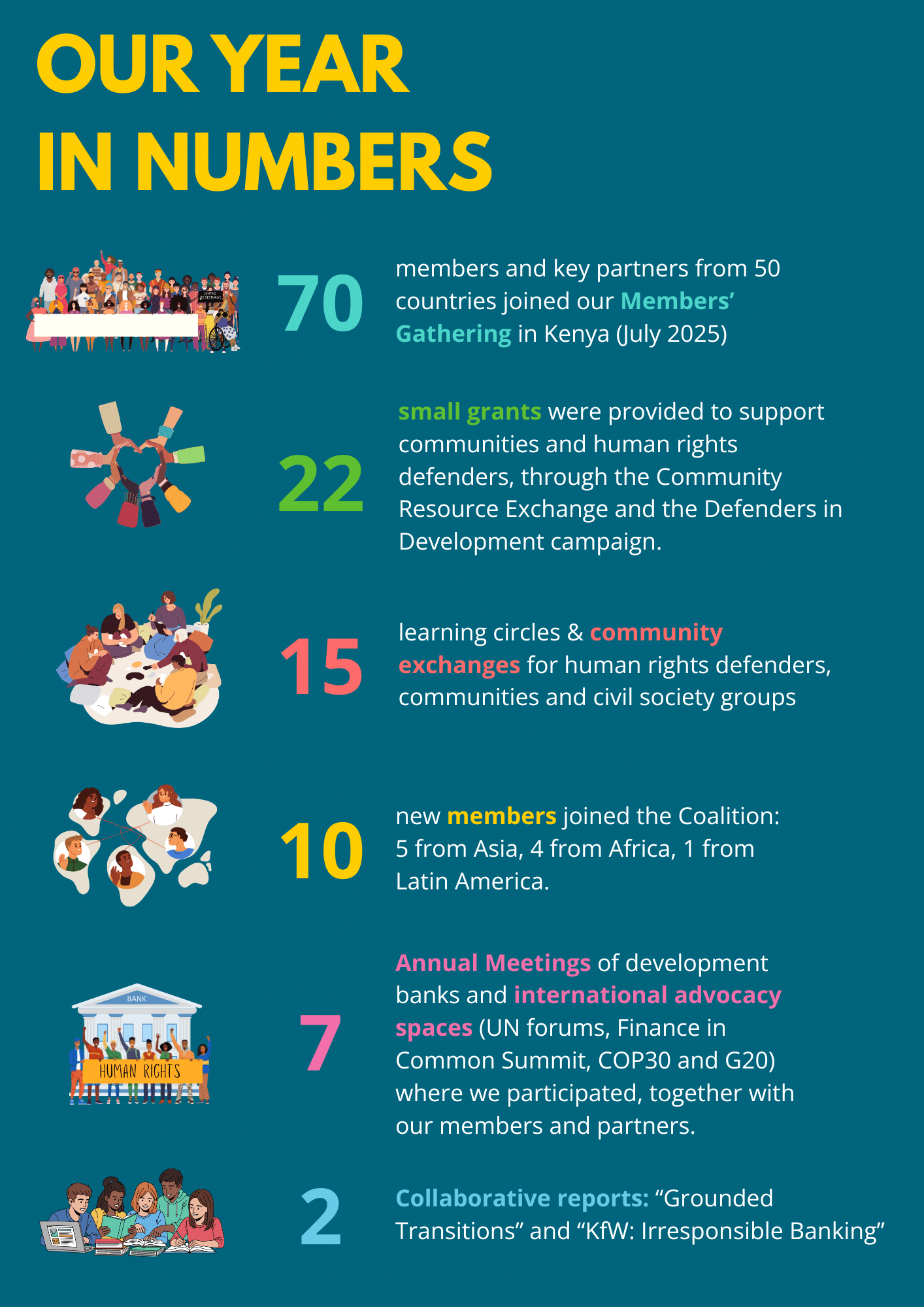
This year was extra special, because the Coalition had its first Members’ Gathering since the coronavirus pandemic. Seventy people from 55 organisations and 40 countries came together in Nairobi, Kenya. It was inspiring to see many of the founding groups and individuals who continue to serve in the Coalition through leadership and collaboration, stewarding our collective work for development justice. And humbling that so many more have joined our mission to make communities, peoples and the planet the center of how development is imagined, planned, financed and implemented.
During the Members’ Gathering we made crucial decisions about the path forward and developed our Manifesto for the next five years. We strategized on how to address the profound challenges we are facing, from shifting geopolitics to increasing conflict and authoritarianism, growing corporate power, exacerbating inequalities, ecological collapse, and accelerating climate change threatening our futures. But we also created space for our dreams and aspirations, to imagine and build new realities rather than only respond to outside threats.
The key values enshrined in our Manifesto are that we center love and care in how we work together, and that we are both member-led and community-led in our approach. These deep roots have allowed the Coalition to grow into a series of interconnected forest canopies, that offer protection and safe spaces for members and community partners to engage in horizontal collaborations.
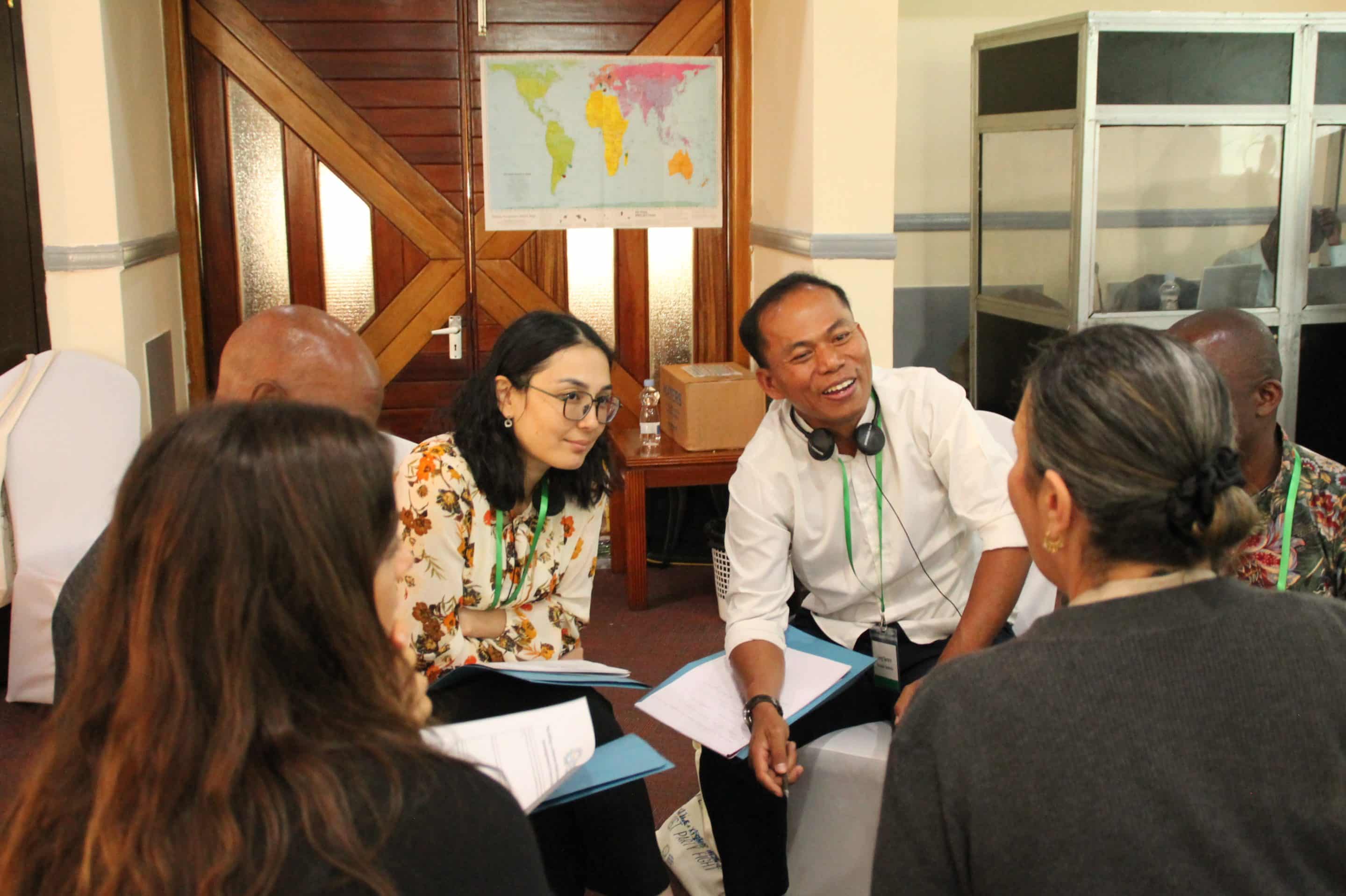
Members Gathering (Nairobi, July 2025). Credit: CHRD
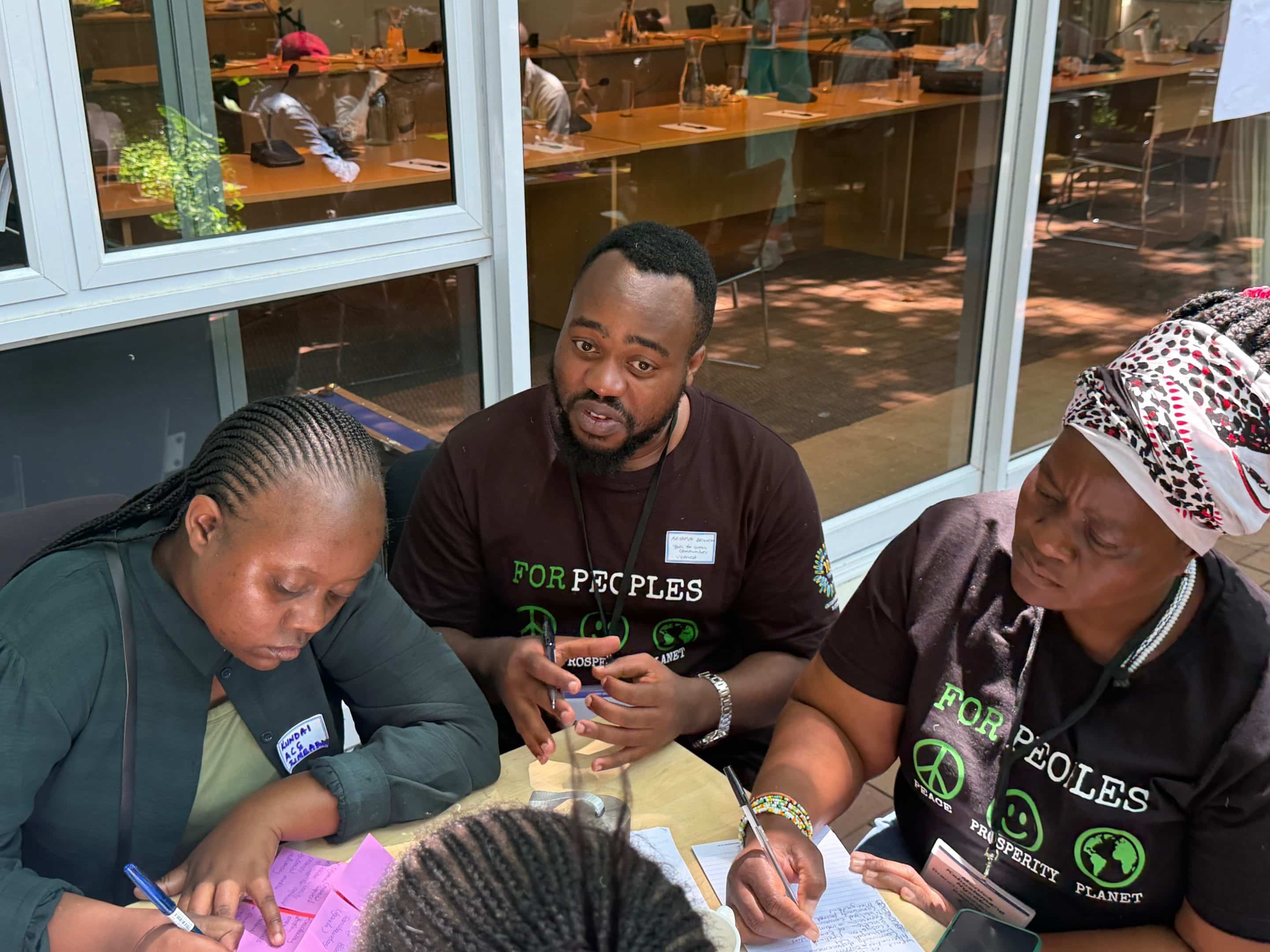
Coalition’s Members and partners at the G20 in Johannesburg (November 2026). Credit: CHRD
For 2026 to 2030 we have chosen to organise our work around four interconnected themes, or canopies of work, that speak to the kinds of impact we want to have in the world. We recommit to center community-led development as a viable development model within global policy, finance and media spaces. The global response to climate change under the framework of just energy transitions is creating opportunities for us to work cross-regionally, from the local to the global, to advance rights-based and community-led development as a way towards safe, equitable and sustainable energy access while mitigating greenhouse gas emissions.
None of this will be possible unless human rights defenders, communities and Indigenous Peoples can participate safely. So we will be continuing to respond to and prevent reprisals, and open up civic space. We will also be working to counter the trend of increasing conflict and militarization while focussing on development finance’s role.
Learning from old growth forests, we commit to strengthening our trunks and branches so that more life can call the Coalition home. We are evolving our work through our existing programmes – the Community Resource Exchange, the Defenders in Development Campaign and Regional Coordination (in our three focus regions of Asia, Africa and Latin America) – while striving to bridge any silos across programs and regions.
Over the last ten years, the Coalition’s governance has become stronger by moving to a transparently elected Steering Committee. In the coming period, we are working to make our governance even more representative and responsive. We also registered as a legal entity in the Netherlands to facilitate agency and control over collective resources. We recognize that times are tough and will explore more sustainable resourcing models.
This Annual Report – with glimpses into the work and achievements of our members and partners over the last year – imbues us with energy and hope for the path forward.

Our year in focus
2025 was a year of deep reflections and experimentation. While focusing on the consultations, discussions and co-creation processes that resulted in our Manifesto for 2026-2030, we also tested new strategies and pursued emerging opportunities. In the following section, we highlight three key areas of our work last year:
- The connections facilitated between groups affected by same actors or sectors, which are now evolving into “communities of action”;
- Our collective efforts to demand a community-led approach to the just energy transition and economic transformation, including our first active engagement in the COP and the G20.
- Our first report focusing on a single institution, specifically a bilateral development bank, Germany’s KfW.
Communities of action
In 2025, we focused on supporting “communities of action,” helping groups move from isolated struggles to collective engagement around shared challenges. Many communities facing similar actors or sectors expressed interest in connecting, so we facilitated spaces for joint learning, experimentation and strategy development.
In the Democratic Republic of Congo (DRC), five partners working with mining-affected communities used this space to strengthen their knowledge of the DRC mining code, financial research, and security, while also connecting with allies. The group is now exploring strategies to bring their advocacy for mining accountability to regional and global platforms.
In Latin America, communities affected by green hydrogen projects engaged in collective learning to better understand the sector’s risks, identify pressure points, and explore advocacy strategies. This process strengthened linkages among communities and helped build a shared understanding. They aim to pursue joint advocacy, improve project monitoring capacity, and build counter-narratives to “false” solutions such as green hydrogen.
In Asia, communities affected by Chinese-financed coal and industrial projects in Indonesia leveraged regional networks to coordinate advocacy, strengthen accountability efforts, and exchange lessons on local resistance and engagement strategies.
Each community of action continues to test approaches and define its own goals, contributing locally grounded models for collective advocacy.Throughout the year, we have also facilitated several learning circles, at the regional and cross-regional level, bringing together partners of the communities of action and other collaborators to share their experiences and build their capacities on issues such as legal and protection strategies, documentation of human rights abuses, community journalism, narratives, and Chinese finance. Collective learning has proven effective in building connections, deepening shared understanding, and laying the foundation for coordinated strategies that amplify local voices.
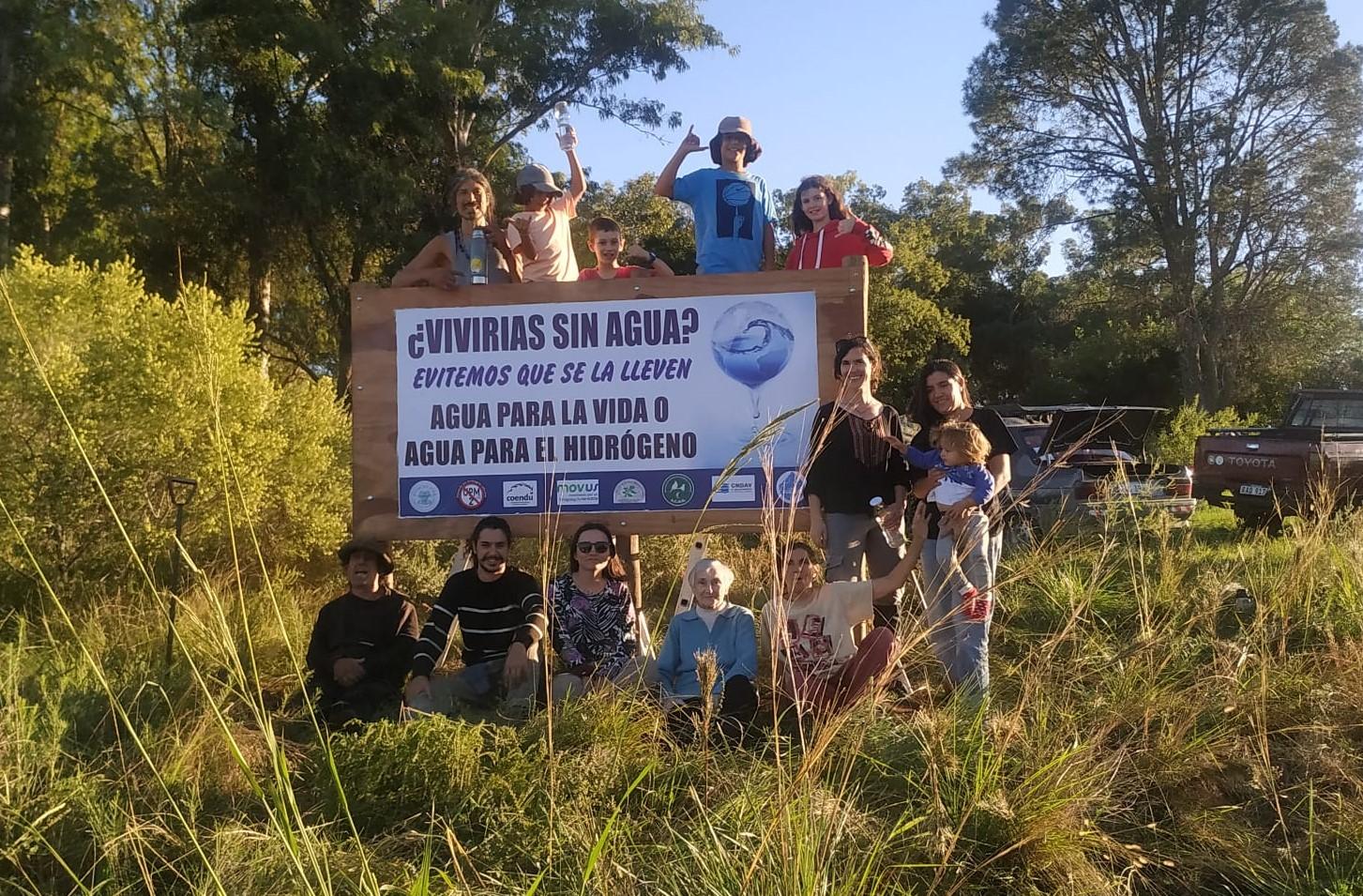
Action to protest against planned green hydrogen project in Uruguay. Credit: Agua es Vida Tacuarembó.

Members and partners of the Coalition at the G20 (November 2025).
Demanding a community-led approach to the just energy transition
Over the past year, the Coalition has advanced its Just Energy Transition (JET) work by connecting grassroots struggles to policy and finance spaces, bringing community perspectives into arenas often dominated by technocratic or market-driven narratives. Rooted in community experiences, struggles, and visions, this work has challenged dominant green growth approaches and exposed extractive or so-called “false” solutions promoted in the name of decarbonisation.
Through workshops and cross-regional collaborations in 2025, Coalition members and partners developed collective demands on how public development banks should support community-led energy projects – whether for access or transition. These demands emphasised communities as central decision-makers, prioritised Free, Prior and Informed Consent, gender-just approaches, and grant-based, decentralised support that protects land, livelihoods, and ecosystems. They rejected models that reproduce sacrifice zones through so-called critical minerals extraction, large-scale renewable energy projects, or speculative markets such as green hydrogen.
These demands were carried into spaces including the G20 and COP30. African grassroots representatives participated in preparatory workshops and the G20 Social Summit, complemented by research and advocacy materials—including the Grounded Transitions report, op-eds, and webinars—linking critical minerals and just transition priorities to community realities. Ahead of COP30, with our Latin American partners we took part in a round table on JET, the Mesoamerican Caravan, and a panel event on financial institutions investments on infrastructure in the Amazon.
These engagements strengthened networks, provided lessons on engaging policy spaces, and raised the visibility of community-led demands. In 2026, the Coalition will deepen cross-regional coordination, strengthen engagement with development finance institutions and other regional spaces, and continue to sharpen community-led alternatives to extractive transition models.
Germany’s irresponsible development bank, KfW
In 2025, in response to a growing number of cases of reprisals and other violations linked–directly or indirectly–to operations financed by Germany’s public development bank KfW, the Defenders in Development (DiD) campaign published “KfW – Irresponsible Banking”. Drawing on three case studies and a detailed analysis of KfW’s policies, the report reveals the gap between the bank’s human rights commitments and realities on the ground. In particular, it shows how KfW inadequate policies –and their even more inadequate implementation–contribute to creating a risky environment for human rights defenders and local communities, as those who speak out against violations linked to KfW projects face threats and attacks.
This marked the first time the DiD campaign focused a report on a bilateral development bank, and it has proven to be an effective strategy. Since its publication in September 2025, the report has been making waves. In Germany, several media outlets–including Deutsche Welle–covered the report’s findings. As a result, we were also contacted by HRDs who had been impacted by KfW projects and wanted to join our collective advocacy efforts. Additionally, as a result of our advocacy, KfW and other involved institutions have responded in relation to the cases highlighted in the report, expressing concern about the reported violations. We now look toward concrete changes being implemented by the institutions.
What gives us hope
In 2025 our members and allies celebrated some important victories:
- In Poco Leok, Indonesia, Germany’s public development bank KfW funded a geothermal project despite strong resistance from local Indigenous communities. Last year, thanks to the community’s sustained mobilization and advocacy efforts (including the submission of an official complaint in 2024), KfW temporarily suspended the project recognizing the lack of meaningful consultations and the violation of the community’s right to free, prior and informed consent. The Ulumbu geothermal power plant risks displacing local Indigenous communities, threatening to destroy their sacred sites, way of life, and environment. The project has also escalated tensions in the area. In an effort to silence dissent, police and military forces have violently attacked and criminalised local activists. Despite these attacks, the community continues to resist and to call on KfW to withdraw from the project.
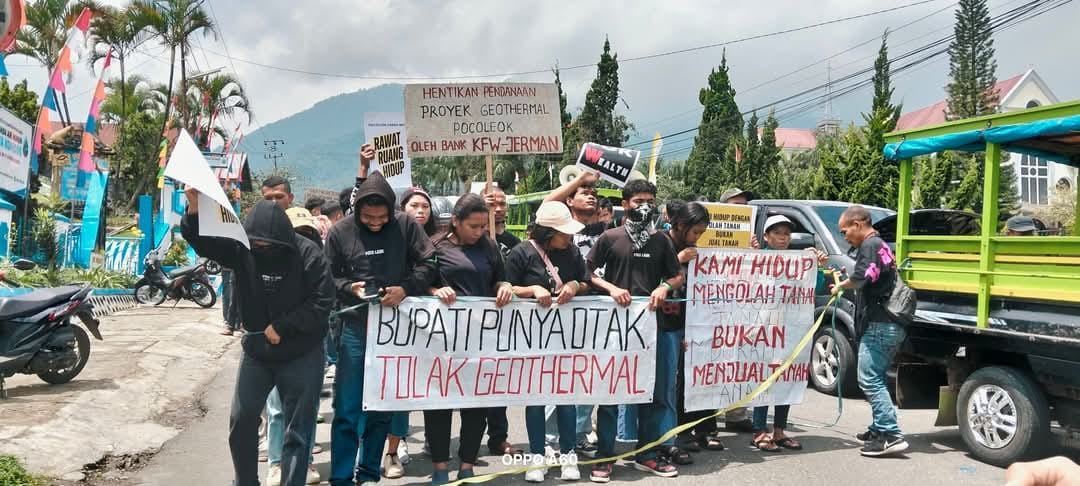
Protest against geothermal plant in Poco Leok, Indonesia. Credit: Poco Leok’s activist
- In April 2025, Panama’s Ministry of the Environment halted the Environmental Impact Assessment (EIA) process for the Fourth Electrical Transmission Line, an IFC-funded project resisted by local Indigenous communities as it risks displacing them and endangering one of Panama’s last intact tropical forests. The decision was the result of powerful social and legal pressure from grassroots groups, including our community collaborators at MODETEAB, with the support of Alianza para la Conservación y el Desarrollo and Center for International Environmental Law. This decision effectively suspends the environmental permitting process required for the project to move forward.
- In February 2025, the World Bank decided to suspend the environmental assessments linked to proposed lithium exploration and extraction in Argentina’s Salinas Grandes and Laguna de Guayatayoc Basin. This decision resulted from sustained action by the communities themselves, with the support of our member Fundación Ambiente y Recursos Naturales (FARN), who were concerned about the plans to expand lithium mining despite the absence of consultation or consent from the local Indigenous communities. By halting its support, the World Bank effectively paused its involvement in the projects until dialogue with affected communities was carried out.
- In January 2025, in a landmark ruling, a Kenyan court ruled that two Northern Rangelands Trust (NRT) conservancies in Isioli county were set up unconstitutionally as they violated land rights and were imposed without proper community consent, halting their operations. The ruling was a win for the 165 local residents who had filed the case against NRT, and our CRE community collaborators involved in this struggle. The court also ordered that the heavily-armed NRT rangers – accused of systematic and serious human rights violations against local Indigenous communities – must leave these conservancies.
In the media
In 2025, we supported our members and partners to produce blogs and op-eds, to engage with the media, and to shape their own narrative to counter the predominant top-down development discourse. Some media highlights include:
- “How communities in sacrifice zones suffer environmental injustices in Mexico, Chile, Nigeria and Indonesia” (Mongabay)
- Civil Society at the Finance in Common Summit Calls for Community-led, Equitable, and Human Rights-based Development (IPS News)
- “ADB, UK eye scaling biodiversity markets in Asia Pacific under new nature partnership” (Carbon Pulse)
- “Communities in Cameroon Demand Justice as Chinese-funded Iron Mining Project Advances” (The Diplomat)
- “Indigenous Kenyans forced off ancestral lands in name of conservation: NGOs” (Radio France International)
- “Private financing for Argentina’s lithium is anything but green, critics say” (Mongabay)
- “Asian Development Bank backs Pakistan copper mine despite human rights fears” (Climate Home News)
- “Germany’s state-owned KfW bank linked to rights violations” (DW)
- “We have no power here” (Taz)
- “Fear in Ohuira Bay” (Welt Sichten)
- “Is KfW Bank violating human rights?” (Loma Zoma)
- “Whose Transition It is Anyway?” (Africa Is A Country)
- “Ramaphosa, the G20 and empty promises of a just transition” (Business Day and Amandla)