Mission
The Coalition for Human Rights in Development is a global coalition of social movements, civil society organizations, and grassroots groups working together to ensure that development is community-led and that it respects, protects, and fulfills human rights.
We do so by making sure that communities have the information, power and resources to determine their own development paths and priorities and to hold development finance institutions, governments, and other actors accountable for their impacts on people, peoples and the planet.

OUR COLLECTIVE IMPACTS
Our key collective impacts over the last ten years include:
- Movement-building: hundreds of communities, defenders and civil society groups across the world have joined forces to advance human rights-based and community led development through increased awareness, coordination and strategic mobilization.
- Project-level changes: scores of local communities have led powerful campaigns to successfully mitigate or stop harmful project impacts, prevent future harms and secure remedy.
- Policy reform: hundreds of members and partners have come together to successfully push the largest public development banks to introduce zero tolerance policies for reprisals and increase transparency, accountability and participation.
Members Map
The Coalition has over 120 members based in more than 50 countries.
Click here to check who our members are, learn more about their work, and read more information about how our membership model works.
Country
- All Member Countries
- South Africa
- Armenia
- Canada
- Democratic Republic of Congo
- Chad
- United States
- Nepal
- Bangladesh
- Brazil
- Cambodia
- Indonesia
- Kazakhstan
- Kenya
- Senegal
- United Kingdom
- Colombia
- Zimbabwe
- Switzerland
- Nigeria
- Netherlands
- Germany
- Peru
- Mexico
- India
- Jordan
- Philippines
- Lebanon
- Mongolia
- Argentina
- Thailand
- Uganda
- Cameroon
- Egypt
- Fiji
- Bolivia
- Sierra Leone
- Liberia
- Panama
- Ireland
- Honduras
- Ecuador
- Chile
- Sri Lanka
- Guatemala
- Global
- Salvador
- Regional
- Uzbekistan
- Tanzania
Strategies Used
Sector Focus
- All Sector focus
- Dams & Infrastructure
- Energy
- Mining & Extractives
- Education
- Water & Sanitation
- Agriculture & Forestry
- Health
- Housing
- Climate & Environment
- Business & Human Rights
- Transparency & Access to Information
- Accountability
- Labor Rights
- Corruption & Governance
- Gender & Equality
- Participation & Freedom of Expression
- Food
- Civic Space & Defenders
Constituency/Partners
Rivers & Rights Foundation
Mission: To collaborate with river dependent communities and their allies across Southeast Asia and beyond to assert rights to dignified livelihoods and healthy river ecosystems, create the pressure needed for accountability for violations of community and environmental rights and collectively mobilize to overcome oppression and injustice.
Inisiasi Masyarakat Adat (IMA)
Mission: To support and empower Indigenous Peoples and local communities who are facing exctractivist projects
Asian Forum for Human Rights and Development (FORUM-ASIA)
Mission: To strengthen movements for human rights and sustainable development in Asia
Women Action Towards Economic Development (WATED)
Mission: To Contribute Towards Women Economic Entrepreneurship Development.
Natural Resource Women Platform (NRWP)
Mission: To amplify the voices of under-represented women who are dependent on land and natural resources
Asamblea Ciudadana Ultima Esperanza
Mission: For sustainable, community-based, ecofeminist social development, from the local to the international level.
Oil Refinery Residents Association (ORRA)
Mission: To promote environment and human rights of vulnerable communities with a focus on women and youth in Albertine region.
Uzbek Forum for Human Rights
Mission: To protect human rights and strengthen civil society in Uzbekistan

Previous members of the Steering Committee include: Egyptian Center for Economic and Social Rights, International Network for Economic, Social and Cultural Rights (ESCR-Net), International Disability Alliance (IDA), Chiadzwa, Society for Democratic Initiatives, Fundar, Asia Indigenous Peoples Pact (AIPP), Conectas, Fundación Ambiente y Recursos Naturales (FARN), Center for International Environmental Law (CIEL), Derecho, Ambiente y Recursos Naturales (DAR), Ekta Parishad, Human Rights Watch, International Rivers Africa, Lumiere Synergie pour le Developpement (LSD), NGO Forum on the ADB, Public Interest Law Center (PILC), Sustentarse, CEMSOJ (Nepal).
GOVERNANCE
The Steering Committee – currently composed of 10 member organizations – acts like the board of the Coalition and provides governance, oversight and accountability. As the highest body of the Coalition, the Steering Committee is responsible for overall strategy and objectives for the Coalition and approves any new areas of work, policy positions and admission of new members. It also provides oversight for hiring for key secretariat positions, fundraising and budgeting. The Steering Committee also has a role in outreach to new members, partners, and allies, as well as representation of agreed Coalition advocacy positions.
In March 2024, the Coalition for Human Rights in Development completed its first open election process to appoint the ten members of our Steering Committee. As of January 2026, the current members are:
- Sukhgerel Dugersuren (OT Watch | Mongolia)
- Pallab Chakma (Asia Indigenous Peoples Pact | Bangladesh)
- Kazi Zaved Khalid Pasha Joy (Initiative for Rights View | Bangladesh)
- Paulina Garzón (Latinoamérica Sustentable, LAS | Latin America)
- Gonzalo Roza (FUNDEPS | Argentina)
- John Brownell (Green Advocates International | Liberia)
- Amy Ekdawi (Arab Watch Coalition | Middle East and North Africa)
- Petra Kjell Wright (Recourse | Global)
- Carlo Manalansan (International Accountability Project | Global)
- CEE Bankwatch Network (Europe and Central Asia)
SECRETARIAT
The Coalition is supported by an International Secretariat, currently composed of 15 staff members. The Secretariat is committed to foster good, accountable, respect-based relationships with members and partners in accordance with commitments under our operating principles towards love and care.

The current Secretariat staff members are:
- Siddharth Akali (Director) – Asia
- Hisham Al-Thamir (Admin Coordinator) – Italy
- Dalile Antunez (Collaborative Researcher) – Argentina
- Tala Batangan (Asia Regional Coordinator) – Philippines
- Lorena Cotza (Communications Lead) – Italy
- Carmina Flores-Obanil (Community Resource Exchange, International Coordinator) – Philippines
- Mark Fodor (Defenders in Development campaign, Coordinator) – Hungary
- Rebeka Gluhbegovic (Fundraising Coordinator)
- Faith Kivuti (Community Resource Exchange, Africa Facilitator) – Kenya
- Ivahanna Larrosa (Latin America Regional Coordinator) – Uruguay
- Ony Soa Ratsifandrihamanana (Africa Regional Coordinator) – Madagascar
- Claudia Romero (Community Resource Exchange, Latin America Facilitator) – Mexico
- Daniela Sepulveda (Latin America Communications Facilitator) – Brazil
- Charlize Tomaselli (Research and Learning Facilitator) – South Africa
- Community Resource Exchange, Asia & Caucasus Facilitator
Our History
Coalition's history: milestones
2013: Center for International Environmental Law (CIEL), ESCR-Net, Human Rights Watch and International Accountability Project (IAP) lead efforts to collectively mobilize resources towards a coalition – with a nexus in the Global South – to work on human rights in development finance.
2014: The Coalition is officially launched, with the name of Bank on Human Rights. A global coordinator is hired and the first Steering Committee is created.
2015: First global members gathering in South Africa, with 40 members and partners attending. Name changed to “Coalition for Human Rights in Development”.
2016: The Coalition starts Community Engagement Partnerships. Fundación para el desarrollo de políticas sustentables (FUNDEPS) hosts first Regional Coordinator for Latin America in Argentina.
2017: Second global members gathering in Washington DC, with 70 members. Alyansa Tigil Mina (ATM) hosts first Regional Coordinator for Asia in the Philippines.
2018: Coalition helps organize a Defenders in Development Campaign gathering in Georgia. Coalition members and partners start working to develop a more systematic way to collaborate with communities and grassroots groups affected by international investments and development finance. This system will later be called the Community Resource Exchange (CRE).
2019: Defenders in Development Campaign Coordinator position created. CRE design process and consultations ongoing.
2020: New secretariat director and Communications Lead positions created. Members and partners who are designing and building the CRE ask the Coalition and its secretariat to host the CRE pilot. Coalition Steering Committee agrees to host the CRE pilot.
2021: Coalition members and partners work together to help launch the Community Resource Exchange pilot and hire new staff for the CRE to be hosted in member organizations in the Global South. Lumière Synergie pour le Développement (LSD) hosts first Regional Coordinator for Africa in Senegal.
2024: First election process to renew the Steering Committee, under the updated terms of reference; 2nd Defenders in Development campaign gathering in Georgia. Members in Latin America, Asia and Africa develop regional strategies for collaborative work.
2025: CRE pilot transitions to its second phase and completes impact evaluation of the first phase. Third Coalition Members’ Gathering (Nairobi, 8-11 July) with 70 participants from 40 countries;
Do you feel an important milestone of the Coalition was left out? Please email contact@rightsindevelopment.org.
 In 2014, groups from around the world came together to form a coalition grounded in the Global South, with the goal to build power and secure human rights commitments from public development finance institutions. Since its early stages, the Coalition brought together diverse groups such as grassroots groups, social movements, Indigenous Peoples, women leaders, labour groups, groups working on disability issues, environmental activists and civil society organizations working at the local, national, regional and international levels.
The first campaign of the Coalition for Human Rights in Development was to demand human rights due diligence during the World Bank’s environmental and social safeguards review. Soon, grassroots members and their allies questioned this initial focus on bank policy work at the global level. In response, Coalition members and partners started to prioritize and deepen collaborations with communities directly impacted by development finance.
Local and national members of the Coalition also indicated preferences to coordinate efforts at the regional level. This led to greater regionalisation of the Coalition’s work, including mobilization on regional development banks like the Inter-American Development Bank and the African Development Bank.
Additionally, communities and human rights defenders who were raising their voices about development finance-funded activities expressed concerns about escalating reprisals and how closing civic space stymied their participation. This led to innovative collective efforts to facilitate access to protection and security, and to leverage development finance as a protection strategy.
As more groups began to see the Coalition as a relevant and responsive network of relationships which they could shape to advance their collective goals, more members joined the Coalition. The Steering Committee of the Coalition also stewarded a growth in the budget and Secretariat size to be responsive to the growing membership and increased scope of the work.
Today, we have over 100 members, and many more partners, who work together through several regional and topical working groups, campaigns and initiatives to advance human right based and community-led development.

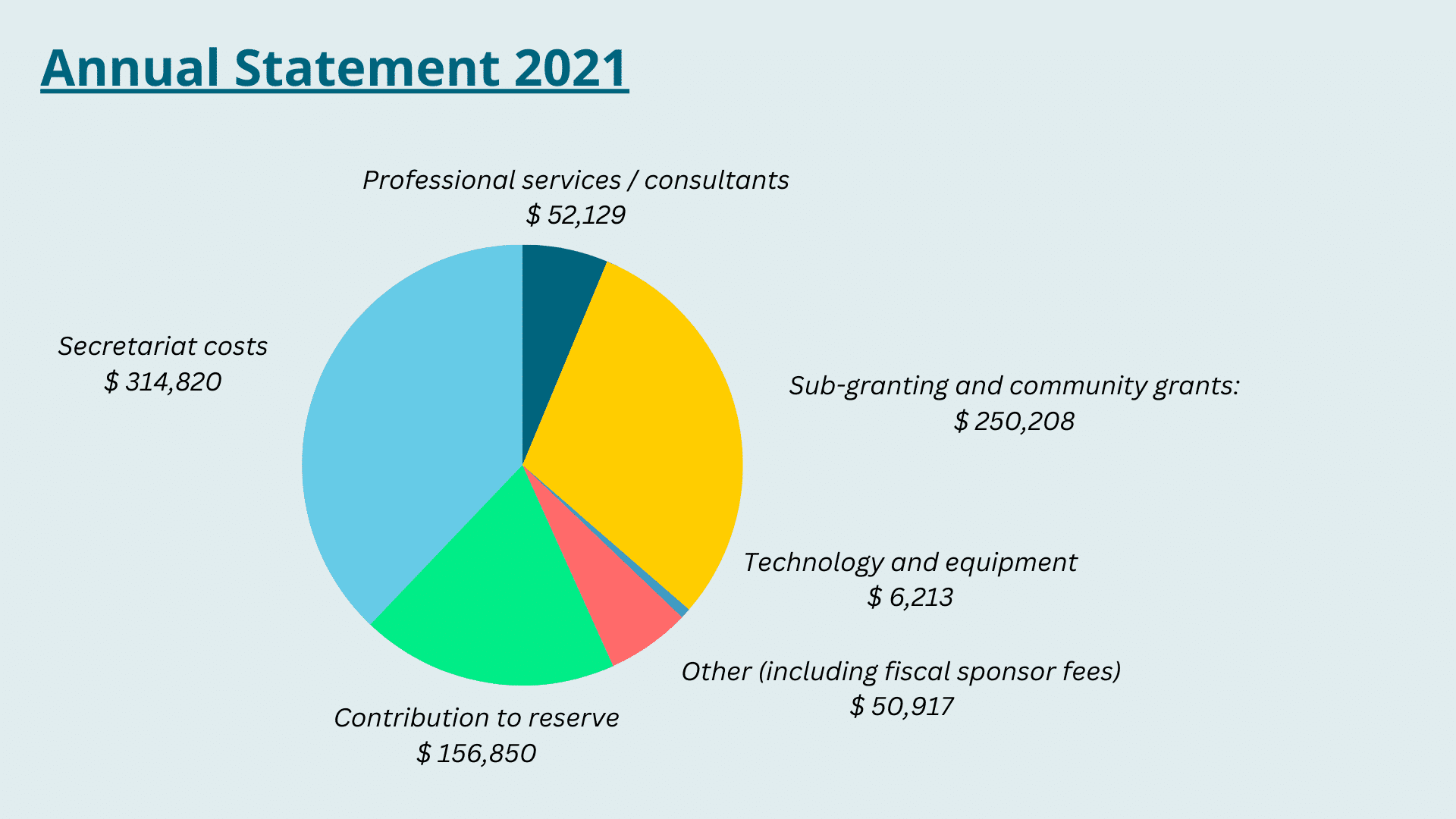
FINANCIAL INFORMATION
& REGISTRATION
The Coalition for Human Rights in Development receives funding from
the Ford Foundation, Charles Stewart Mott Foundation, Open Society Foundations, and two donors who prefers to remain anonymous. We are extremely grateful for their invaluable support, that has allowed us to grow, strengthen our Coalition, and deepen our engagement with communities, defenders and organizations around the world.
In July 2025, the Coalition for Human Rights in Development registered in the Netherlands as Stichting Sister Networks (KvK number: 97946796). Stichting Sister Networks is overseen by a Board of Directors consisting of three members. You can find Stichting Sister Networks’ Strategic Plan in this document.